


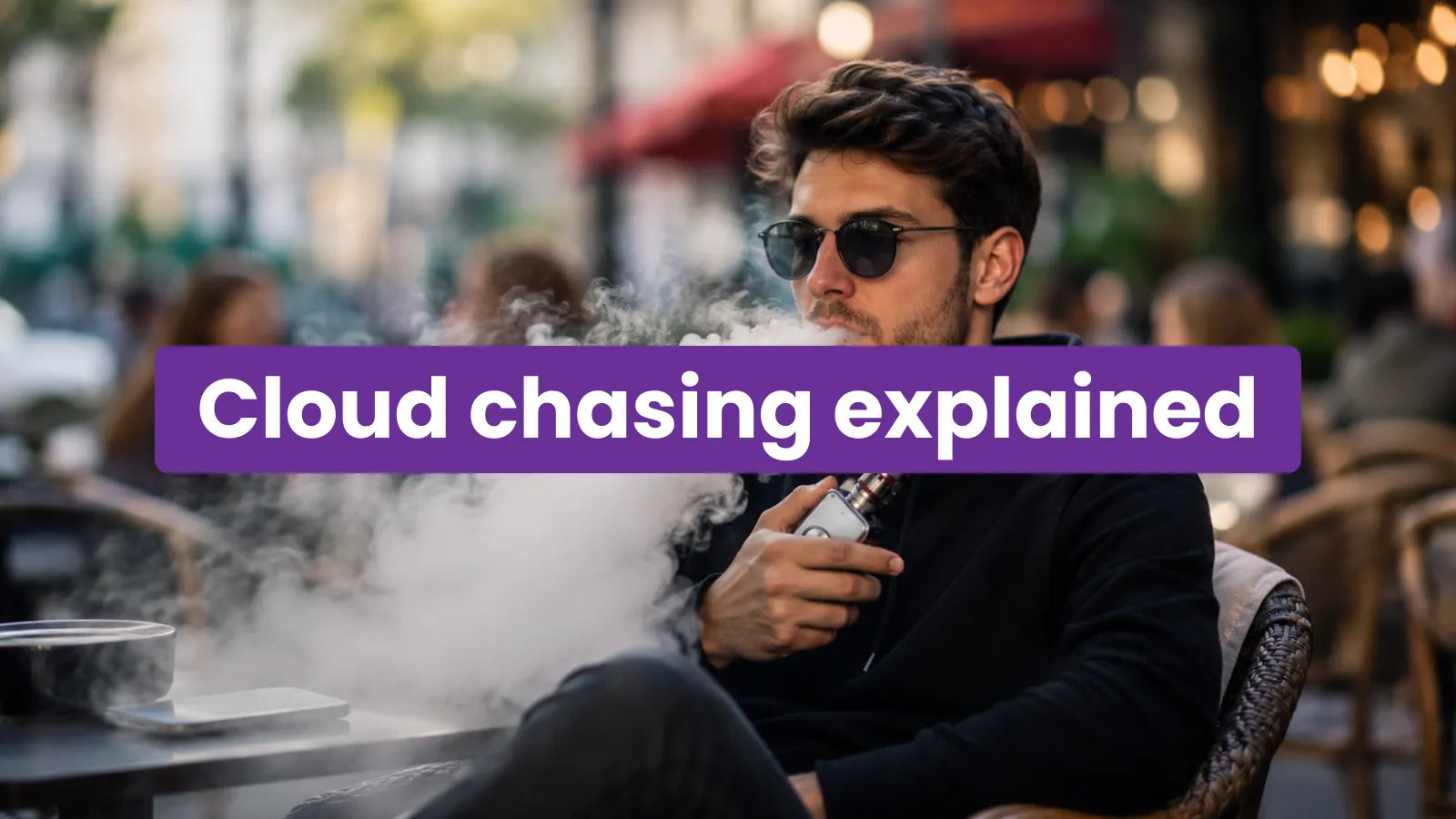
Cloud chasing is the practice of producing large, dense vapour clouds from a high-power vaping device. Cloud chasers prioritise vapour volume over nicotine strength, combining sub-ohm kits, high-VG e-liquid and a direct-to-lung draw to maximise output.
Vapour becomes the whole point of the setup, which shifts the hardware, the e-liquid and the inhale technique away from standard nicotine vaping. The sections below define the practice, list the equipment it needs, break the technique into 4 steps, and explain the battery safety that keeps cloud chasing controlled.
What Is Cloud Chasing?
Cloud chasing is a vaping technique focused on producing the biggest, thickest vapour clouds possible. Standard vaping delivers nicotine through a tight, cigarette-style draw, whereas cloud chasing turns vapour output into a hobby or a competitive pursuit.
Vapour volume depends on 3 factors working together: device power, e-liquid VG content, and inhale technique. Cloud chasers run low-nicotine or 0mg e-liquid, because large inhalations turn high nicotine strengths harsh on the throat.
How Is Cloud Chasing Different From Standard Vaping?
The main difference between cloud chasing and standard vaping is the goal, cloud chasing maximises vapour volume, while standard vaping prioritises nicotine satisfaction. Standard vaping relies on a mouth-to-lung draw, which holds vapour in the mouth before inhaling, much like a cigarette.
Cloud chasing relies on a direct-to-lung draw instead, pulling vapour straight into the lungs for a far larger exhale. The two styles sit at opposite ends of the airflow scale, and you can compare them in full in our guide to MTL and DTL vaping. Sub-ohm hardware powers the direct-to-lung style, so cloud chasing always builds on sub-ohm vaping rather than pod or pen setups.
The table below compares cloud chasing and standard mouth-to-lung vaping across the 7 settings that separate them.
| Aspect | Cloud Chasing | Standard (MTL) Vaping |
|---|---|---|
| Draw style | Direct-to-lung (DTL) | Mouth-to-lung (MTL) |
| Device | Sub-ohm kit or mod | Pod kit or vape pen |
| Coil resistance | Below 1 ohm | Above 1 ohm |
| Power | 60W and above | 8W to 25W |
| VG/PG ratio | 70/30 or higher | 50/50 |
| Nicotine | 0mg to 3mg | 10mg to 20mg |
| Main goal | Maximum vapour | Nicotine satisfaction |
Every row shifts toward higher power and lower nicotine, which is the pattern that defines a cloud chasing setup.
What Equipment Do You Need for Cloud Chasing?
Cloud chasing needs 4 core components, a sub-ohm vape kit, a high-power vape mod, low-resistance coils, and high-VG e-liquid. Each component controls one part of vapour production, from raw power through to the surface area that heats the liquid.
The right combination produces dense clouds safely, whereas a mismatched one produces dry hits or battery strain.
Sub-Ohm Vape Kit
A sub-ohm vape kit is a device that fires coils below 1 ohm to produce high vapour output. Sub-ohm kits deliver the wattage and airflow that cloud chasing demands, which pod kits and vape pens cannot match. Regulated sub-ohm vape kits give beginners built-in safety features, short-circuit protection, overheat cut-off and battery monitoring, which makes them the sensible starting point.
High-Power Vape Mod and Batteries
A vape mod is the powered body of the device that houses the battery and controls wattage. High-wattage mods, from 60W up to 200W and beyond, drive the vapour volume that defines cloud chasing. Dual-battery vape mods run on external vape batteries in 18650 or 21700 formats, and consistent high-drain power keeps clouds dense from the first puff to the last.
Low-Resistance Coils
A low-resistance coil is a heating element rated below 1 ohm that vaporises e-liquid quickly across a large surface. Mesh and Clapton vape coils increase surface contact with the wick, which raises vapour production and warmth. Our guide to the best coils for sub-ohm vaping explains resistance ratings, wattage ranges and coil types in detail.
Hardware supplies the power and the heat, but the e-liquid inside the tank controls how thick each cloud becomes.
What E-Liquid Is Best for Cloud Chasing?
The best e-liquid for cloud chasing is a high-VG blend with low or zero nicotine. Vegetable glycerin (VG) produces thick, dense vapour, so a higher VG ratio creates bigger clouds. A minimum 70/30 VG/PG ratio suits cloud chasing, and max-VG blends around 80/20 produce the densest output. Most shortfill e-liquids arrive nicotine-free at 70/30 or higher, ready for large-volume vaping.
Nicotine strength stays low for cloud chasing, at 0mg to 3mg. Large direct-to-lung draws deliver vapour straight to the lungs, which turns higher nicotine strengths harsh and overwhelming. UK law caps nicotine e-liquid at 20mg/ml in 10ml bottles, though cloud chasers stay far below that ceiling for comfort.
How Do You Cloud Chase? A 4-Step Technique
To cloud chase, follow these 4 steps. Each step builds vapour volume, from the inhale through to the exhale. Technique matters as much as hardware, because the same kit produces small or large clouds depending on the draw.
- Draw the vapour directly into your lungs. Pull one deep, direct-to-lung breath for 3 to 5 seconds, bypassing the mouth entirely. A quick, full inhale loads the lungs with the vapour needed for a large exhale.
- Open the airflow fully. Slide the airflow control wide open so more air passes over the coils. More airflow cools the vapour and expands the cloud.
- Exhale slowly and steadily. Keep your lips relaxed and open, and push the vapour out gently rather than forcing it. A slow release lets the cloud grow instead of dispersing.
- Sit or stand upright. Straighten your posture to open the chest and reach full lung capacity. Upright breathing supports the deep inhale that step 1 requires.
How Do You Cloud Chase Safely?
Cloud chasing safety depends on 4 practices, correct batteries, a regulated mod, saturated wicks, and hydration. High-power vaping draws heavy current, so safe habits protect both the vaper and the device. Each practice removes a common risk, from battery faults to dry hits.
- Use high-drain batteries from trusted brands: fit undamaged cells with intact wraps, rated for the current your coils pull. The Vapcell M35A 18650 and Molicel P42A 21700 are both high-drain cells suited to high-wattage mods.
- Choose a regulated mod: regulated mods calculate safe firing limits automatically and block unsafe builds. Built-in chipsets guard against short circuits, overheating and over-discharge.
- Keep your wicks saturated: re-wet the wick with e-liquid between draws to prevent a dry hit. A dry hit tastes harsh and burns the coil.
- Stay hydrated: drink water before and after sessions, because VG draws moisture and dries the mouth. Regular hydration reduces dry mouth and throat irritation.
Vaping is less harmful than smoking, but not risk-free, according to the NHS. Cloud chasing does not change that position, and safe technique matters most where high power and large draws combine.
Is Cloud Chasing Suitable for Beginners?
No, cloud chasing suits experienced vapers rather than complete beginners. Sub-ohm hardware, higher wattage and external batteries all require handling knowledge that new vapers rarely have on day one.
Adult smokers switching to vaping start best with a mouth-to-lung pod or starter kit, which delivers steady nicotine at low power. Cloud chasing becomes a reasonable next step once the basics of coils, wattage and battery care are second nature.
FAQs
Your vape produces small clouds for 4 common reasons: a worn coil, low VG e-liquid, low wattage, or restricted airflow. Replace the coil every 1 to 2 weeks, switch to a 70/30 or higher VG blend, raise the wattage within the coil's printed range, and fully open the airflow. Each fix takes only a few minutes.
The best wattage for cloud chasing starts at 60W and climbs higher. Higher power heats a sub-ohm coil faster and vaporises more e-liquid per draw, producing denser clouds. Most cloud chasing setups run between 60W and 200W, matched to the coil's printed wattage range. Low-wattage pod kits cannot achieve the same vapour output.
Yes, higher VG produces bigger clouds. Vegetable glycerin (VG) is the thick base that creates dense vapour, while propylene glycol (PG) carries flavour and throat hit. A 70% VG blend or higher produces the thick clouds needed for cloud chasing. A 50/50 blend creates lighter vapour better suited to pod kits.
The best VG/PG ratio for cloud chasing is 70/30 or higher. Vegetable glycerin produces the thick vapour needed for large clouds, so increasing the VG content creates denser vapour. Max VG blends around 80/20 produce the biggest clouds, while 50/50 blends are better suited to mouth-to-lung pod vaping.
Cloud chasing carries the same general risks as any high-power vaping. According to the NHS, vaping is less harmful than smoking but is not risk-free. Large direct-to-lung draws and low-resistance coils increase the importance of proper battery care and safe vaping practices. For personal health concerns, speak with a GP or the NHS.
Cloud chasing typically uses a low nicotine strength between 0mg and 3mg. Large direct-to-lung draws produce high vapour volumes, making stronger nicotine harsh to inhale. Many cloud chasers choose 0mg e-liquid to focus entirely on vapour production. UK law permits nicotine strengths up to 20mg/ml, though cloud chasing stays well below that limit.
No, most pod kits cannot cloud chase effectively. Pod kits operate at lower wattages with high-resistance coils designed for mouth-to-lung vaping, limiting vapour production. Cloud chasing requires a sub-ohm vape kit or mod using coils below 1 ohm at higher power. Pod kits focus on flavour and nicotine delivery rather than maximum cloud production.
No, disposable vapes cannot cloud chase because they use low-power, high-resistance coils designed for small mouth-to-lung draws. In addition, single-use disposable vapes have been banned across the UK since 1 June 2025. A refillable sub-ohm vape kit is the compliant choice for producing large clouds.
The main difference between cloud chasing and sub-ohm vaping is intent, not equipment. Sub-ohm vaping describes the hardware that uses coils below 1 ohm, while cloud chasing is the goal of producing the largest possible vapour clouds. Every cloud chaser sub-ohm vapes, but not every sub-ohm vaper is focused on cloud production.
No, you do not need an RDA for cloud chasing. Rebuildable dripping atomisers (RDAs) are mainly used by advanced users and competition cloud chasers who build their own coils. Modern regulated sub-ohm kits produce large clouds with less maintenance and greater built-in safety, making them the better choice for most beginners.


