


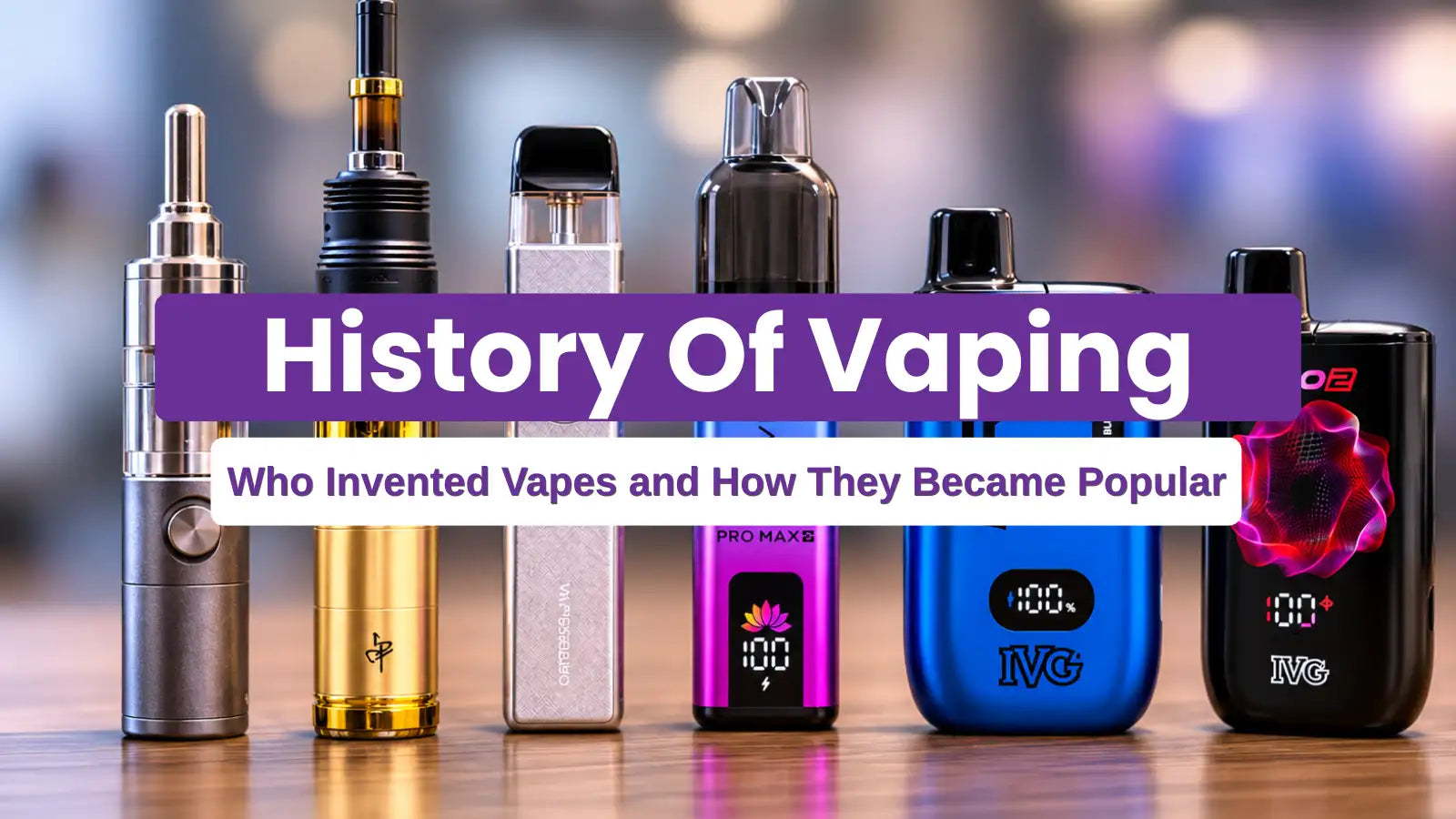
Vaping has a history spanning nearly 100 years, beginning with Joseph Robinson’s 1927 patent for an electric vaporiser and reaching mainstream adoption through Hon Lik’s 2003 e-cigarette invention in China. The concept of heating a liquid to produce inhalable vapour evolved through 3 key inventors, 4 generations of device design, and decades of regulatory development before becoming the global industry recognised today.
E-cigarettes arrived in the UK around 2005 to 2007 and grew rapidly through the 2010s. An estimated 5.5 million adults in Great Britain currently vape according to the ASH Smokefree GB 2025 survey, with 55% of those vapers being ex-smokers. The UK regulates vaping under the Tobacco and Related Products Regulations 2016 (TRPR), enforced by the MHRA, making it one of the most structured vaping markets in the world.
This guide covers every stage of vaping history: early patents, commercial breakthroughs, device evolution from cigalikes to pod kits, and the regulatory framework that shapes UK vaping in 2026.
Quick Answer: When Did Vaping Start?
Vaping started in 1927, when Joseph Robinson filed a patent for an electric vaporiser in the United States. Robinson’s device was never manufactured or sold commercially. The first working prototype of a smokeless cigarette came in 1963 from Herbert A. Gilbert. The first commercially successful e-cigarette was created in 2003 by Chinese pharmacist Hon Lik in Beijing, manufactured under the brand name Ruyan in 2004, and introduced to European and UK markets between 2005 and 2007.
A Short Timeline of Vaping History
The history of vaping covers 9 key milestones from the first patent to the UK’s current regulatory framework. Each milestone marks a shift in technology, adoption, or regulation that shaped the vaping industry.
| Year | Milestone |
|---|---|
| 1927 | Joseph Robinson files the first electric vaporiser patent in the US (granted 1930) |
| 1963 | Herbert A. Gilbert patents the “smokeless non-tobacco cigarette” with flavoured air |
| 1979 | Phil Ray and Norman Jacobson commercialise a nicotine inhalation device and coin the verb “vape” |
| 2003 | Hon Lik invents the modern e-cigarette in Beijing, China |
| 2004 | First commercial e-cigarette manufactured under the Ruyan brand in Shenyang, China |
| 2005 to 2007 | E-cigarettes reach UK and European markets; US imports begin in 2006 to 2007 |
| 2007 | Umer and Tariq Sheikh invent the cartomizer in the UK, integrating coil and liquid chamber |
| 2012 to 2015 | Vape shops emerge across the UK; vape pens, mods, and sub-ohm devices gain traction |
| 2016 to present | TRPR enacted in the UK; MHRA registration required; UK disposable vape ban from 1 June 2025 |
The timeline shows a pattern of invention followed by long gaps before adoption. Robinson’s 1927 concept took 76 years to reach commercial reality through Hon Lik’s 2003 breakthrough. The UK adopted e-cigarettes within 2 to 4 years of their Chinese launch, faster than any previous vaporiser concept.
What Is Vaping?
Vaping is the act of inhaling vapour produced by an electronic device that heats a liquid solution called e-liquid. E-liquid typically contains nicotine, propylene glycol (PG), vegetable glycerine (VG), and food-grade flavourings. The device heats the e-liquid to produce an aerosol, not smoke, which the user inhales through a mouthpiece.
Vaping differs from smoking in one critical way, no combustion occurs. Traditional cigarettes burn tobacco at temperatures above 600°C, producing tar, carbon monoxide, and thousands of harmful chemicals. Vape devices heat e-liquid at significantly lower temperatures, typically between 100°C and 250°C, without burning any material.
NHS England acknowledges that vaping is substantially less harmful than smoking, though it is not risk-free. Vaping remains a nicotine delivery method intended for adult smokers seeking an alternative to combustible tobacco.
Who Invented Vaping?
Vaping was invented through the contributions of 3 key inventors across 3 different decades: Joseph Robinson in 1927, Herbert A. Gilbert in 1963, and Hon Lik in 2003. Each inventor built upon the concept of delivering inhalable vapour without combustion, progressing from a theoretical patent to a working prototype and finally to a commercially viable product.
Joseph Robinson and the First Vaporizer Idea
Joseph Robinson filed the first patent for an electric vaporiser in 1927 in the United States, and the patent was granted in 1930. Robinson’s device described a chamber, a heating element, and a mouthpiece, the same 3 basic components found in every modern vape. Robinson designed the vaporiser for medicinal compound delivery, not specifically for nicotine.
Robinson never manufactured a commercial product from his patent. The device remained a concept on paper during an era when the link between smoking and lung cancer was not yet established. Scientists did not formally connect cigarette smoking to cancer until the 1940s and 1950s, which meant there was no public demand for a smoking alternative at the time of Robinson’s filing.
Herbert A. Gilbert and the Smokeless Cigarette
Herbert A. Gilbert patented the “smokeless non-tobacco cigarette” in 1963 in the United States. Gilbert’s patent was granted in 1965. The device replaced burning tobacco with heated, flavoured air powered by a battery element, closely resembling the function of today’s e-cigarettes.
Gilbert built working prototypes of his smokeless cigarette with multiple flavour options. The device was never commercialised due to a lack of manufacturer interest. During the 1960s, approximately 42% of American adults smoked, and the tobacco industry had little incentive to support an alternative product. Gilbert’s concept was decades ahead of its time.
Hon Lik and the Modern E-Cigarette
Hon Lik, a Chinese pharmacist born in 1951 in Shenyang, China, invented the first commercially successful e-cigarette in 2003. Hon Lik was a heavy smoker who lost his father to lung cancer. That personal loss motivated him to develop a device that could deliver nicotine through vapour instead of smoke.
Hon Lik’s original design used a piezoelectric ultrasound element to vaporise a nicotine solution mixed with propylene glycol. He filed patents in China, the US, and the EU in 2003. The first commercial e-cigarette was manufactured in 2004 in Shenyang under the brand name Ruyan, meaning “like smoke” in Chinese.
Ruyan e-cigarettes reached Europe by 2005 to 2006 and the US by 2006 to 2007. Imperial Tobacco (now Imperial Brands) acquired the intellectual property from Hon Lik’s company, Dragonite International, in 2013. Hon Lik’s invention laid the foundation for the entire modern vaping industry.
Why Was Vaping Invented?
Vaping was invented to provide a less harmful method of nicotine delivery that eliminates the combustion process responsible for most smoking-related diseases. Every major inventor in vaping history, from Gilbert in 1963 to Hon Lik in 2003, designed their device specifically as an alternative to burning tobacco.
Cigarette smoke contains over 7,000 chemicals, with at least 70 identified as carcinogens. The principle behind vaping is straightforward: remove combustion, and the most dangerous by products, including tar and carbon monoxide, are eliminated. Nicotine, while addictive, is not the primary cause of smoking-related death.
Hon Lik’s motivation was deeply personal. His father died from lung cancer caused by decades of heavy smoking. Hon Lik, himself a pack-a-day smoker, wanted to create a product that satisfied nicotine cravings without exposing the user to combustion toxins. The harm reduction principle that drove his invention remains the core purpose of vaping today.
When Did Vapes Come Out?
Vapes came out commercially in 2004 in China, 2005 to 2006 in Europe, 2006 to 2007 in the US, and around 2005 to 2007 in the UK. The rollout followed a region-by-region pattern as Ruyan and other early manufacturers expanded distribution internationally.
When Did Vapes Come Out in China?
Vapes came out in China in 2004, when the Ruyan e-cigarette was manufactured in Shenyang. Hon Lik developed the device in 2003, and commercial production started the following year. The Ruyan e-cigarette used a 3-part system, a battery, a plastic cartridge containing a nicotine solution, and an ultrasonic atomiser.
Initial consumer interest in China was modest. The domestic market grew slowly through 2004 to 2006. International exports, particularly to Europe and North America, generated stronger demand and helped fund further development.
When Did Vapes Come Out in the UK?
Vape devices came out in the UK in approximately 2005 to 2007. Early e-cigarettes entered the UK market as imports from Chinese manufacturers, primarily sold through online retailers. The first devices available to UK consumers were cigalikes, small, cigarette-shaped electronic devices designed to replicate the size, weight and mouth feel of a tobacco cigarette.
Vaping in the UK remained a niche activity from 2005 to 2009, driven primarily by word-of-mouth recommendations and early online forums such as UK Vapers and Planet of the Vapes. Community events such as Vapefest helped build a small but dedicated UK vaping community.
By 2007, British entrepreneurs Umer and Tariq Sheikh invented the cartomizer, a mechanism that integrated the heating coil into the liquid chamber. The cartomizer made e-cigarettes more reliable and compact, contributing to faster UK adoption.
When Did Vaping Become Popular?
Vaping became popular in the UK and globally during the early to mid-2010s. Vape shops began appearing across UK high streets from around 2012. The Oxford Dictionaries named “vape” the word of the year in 2014, reflecting its rapid cultural mainstream acceptance.
3 factors drove vaping’s popularity surge during this period:
-
Device improvements: the shift from basic cigalikes to refillable vape pens and box mods gave users better battery life, flavour, and vapour production
-
Flavour variety: e-liquid manufacturers introduced hundreds of flavour options across fruity, dessert, menthol, and tobacco categories
-
Public health endorsements: Public Health England’s landmark 2015 report stated that e-cigarettes are around 95% less harmful than smoking, providing UK smokers with confidence to switch
By 2015, millions of UK adults were vaping. The ASH Smokefree GB survey has tracked rising vaper numbers from approximately 700,000 in 2012 to an estimated 5.5 million adult vapers in 2025, representing 10.4% of the adult population.
How Vape Devices Changed Over Time
Vape devices have evolved through 4 distinct generations, each improving on battery capacity, vapour production, flavour delivery, and user experience. The progression from cigalikes to pod systems reflects the industry’s response to user feedback, regulatory requirements, and technological advances.
Cigalikes
Cigalikes were the first generation of consumer e-cigarettes, available from 2004 to the early 2010s. Cigalikes resembled traditional cigarettes in size, shape, and weight. Each device contained a small battery, a pre-filled cartridge, and a basic heating coil.
Performance was limited. Cigalikes produced minimal vapour, offered restricted flavour options, and required frequent cartridge replacements. Battery life lasted only a few hours of moderate use. Despite these limitations, cigalikes introduced millions of smokers to the concept of electronic nicotine delivery.
Vape Pens
Vape pens represented the second generation of vape devices, gaining popularity from around 2010 onwards. Vape pens featured larger batteries, refillable tanks, and replaceable coils. The pen form factor offered improved battery life, greater e-liquid capacity, and wider flavour choice compared to cigalikes.
Refillable tank systems allowed users to choose their own e-liquid brand, flavour, and nicotine strength for the first time. This customisation drove rapid community growth and encouraged the expansion of the UK e-liquid market.
Vape Mods
Vape mods were the third generation, emerging in the early to mid-2010s. Mods introduced variable wattage, adjustable voltage, larger tanks, and external 18650 batteries. Sub-ohm coils (below 1.0Ω resistance) enabled significantly higher vapour production and flavour intensity.
The modding community drove innovation in coil design, airflow engineering, and battery safety. Sub-ohm vaping paired with high-VG shortfill e-liquids (typically 70/30 VG/PG) created a direct-to-lung (DTL) vaping style focused on cloud production and bold flavour.
Pod Systems and Disposable Vapes
Pod systems are the fourth and current generation of vape devices, dominating the UK market from the late 2010s to the present. Pod kits use compact, low-wattage designs with either prefilled or refillable pods. The introduction of nicotine salt e-liquids (nic salts) complemented pod kits by delivering smoother throat hits at higher nicotine strengths, ideal for adult smokers transitioning from cigarettes.
Disposable vapes emerged in the late 2010s as single-use, pre-charged, pre-filled devices. Brands such as Elf Bar and SKE Crystal drove massive adoption, particularly among younger demographics. Environmental concerns, youth access issues, and the waste generated by disposable lithium batteries led the UK government to ban single-use disposable vapes from 1 June 2025. Refillable and rechargeable pod kits and big puff vape kits now serve as the recommended alternatives.
E-Cigarette vs Vape: Is There a Difference?
E-cigarette and vape refer to the same category of electronic nicotine delivery device. The term “e-cigarette” was used predominantly in the early days of the industry (2003 to 2012) to describe cigalike devices designed to resemble traditional cigarettes. “Vape” became the more common term as devices diversified beyond the cigarette form factor into pens, mods, and pod systems.
In regulatory and medical contexts, “e-cigarette” remains the standard term. The UK’s TRPR and MHRA notifications use “electronic cigarette” in all official documentation. In consumer and retail contexts, “vape” is the dominant term in the UK market.
The functional principle is identical across both terms: a battery-powered device heats an e-liquid to produce inhalable vapour containing nicotine without combustion.
How Vaping Became a Global Industry
Vaping grew from a single product in Beijing to a global industry valued at approximately USD 40 to 45 billion in 2025, according to Grand View Research and other market analysts. Multiple factors drove this transformation:
-
Public health advocacy: organisations including Public Health England, the Royal College of Physicians, and Cancer Research UK publicly supported vaping as a harm reduction tool for adult smokers
-
Nicotine salt technology: the development of nic salts enabled smoother, faster nicotine delivery in compact devices, making the transition from smoking to vaping more accessible
-
Flavour innovation: thousands of e-liquid flavours across fruity, menthol, dessert, beverage, and tobacco categories attracted a broad adult consumer base
- Tobacco industry investment: major tobacco companies acquired vaping brands and patents, channelling distribution networks and marketing budgets into the sector
-
Regulatory frameworks: structured regulations, including the EU Tobacco Products Directive and UK TRPR, created consumer confidence by ensuring product safety and quality standards
The UK is one of the largest vaping markets in Europe. An estimated 5.5 million adults in Great Britain vape as of 2025 (ASH Smokefree GB Survey). The UK market is valued at approximately £2.5 billion in 2025, with refillable pod systems and nic salt e-liquids leading sales volumes.
A Brief Note on Vaping Regulations and Safety Resources
UK vaping regulation operates under the Tobacco and Related Products Regulations 2016 (TRPR), which sets 5 core requirements for all e-cigarette and e-liquid products sold in the UK:
- Maximum nicotine strength of 20mg/ml for all e-liquids
- Maximum refill bottle size of 10ml for nicotine-containing e-liquid
- Maximum tank or pod capacity of 2ml
- Mandatory MHRA product notification before sale
- Childproof and tamper-evident packaging on all e-liquid containers
Single-use disposable vapes were banned in the UK from 1 June 2025. A new vape duty of £2.20 per 10ml of e-liquid is scheduled for introduction from October 2026.
Selling vaping products to anyone under 18 is illegal in the UK. Adults purchasing an e-cigarette on behalf of a minor face the same legal penalties.
For authoritative guidance, NHS England and Public Health England provide regularly updated information on vaping and smoking cessation.
FAQs About the History of Vaping
When was vaping first invented?
Vaping was first invented in 1927, when Joseph Robinson filed a patent for an electric vaporiser in the United States. The patent was granted in 1930. Robinson’s device was designed for medicinal compound delivery and was never manufactured commercially. The first commercially produced e-cigarette came from Hon Lik in 2003.
Who was the first person to vape?
Herbert A. Gilbert is widely credited as the first person to build and use a working vaporiser prototype in the 1960s. Gilbert patented his “smokeless non-tobacco cigarette” in 1963 and constructed prototypes with flavoured air. Robinson filed an earlier patent in 1927, but there is no confirmed evidence he built a working device.
Who created vapes and why?
Hon Lik, a Chinese pharmacist, created the modern vape in 2003. Hon Lik developed the device as a harm reduction tool after his father died from lung cancer caused by smoking. The purpose was to deliver nicotine through heated vapour instead of combustible smoke, eliminating exposure to tar and carbon monoxide.
When did vaping become popular?
Vaping became popular in the UK during the early to mid-2010s. Vape shops opened across UK high streets from 2012 onwards. Public Health England’s 2015 report endorsing e-cigarettes as significantly less harmful than smoking accelerated mainstream adoption. “Vape” was named word of the year by Oxford Dictionaries in 2014.
When did vapes come out in the UK?
Vapes came out in the UK in approximately 2005 to 2007. The first devices were cigalike e-cigarettes imported from Chinese manufacturers. Broader UK adoption grew from 2007 onwards, following the invention of the cartomizer by British entrepreneurs Umer and Tariq Sheikh.
What were the first vapes like?
The first vapes were small, cigarette-shaped devices called cigalikes. Cigalikes contained a basic battery, a pre-filled nicotine cartridge, and a simple heating coil. Vapour production was minimal. Battery life lasted only a few hours. Flavour options were limited to tobacco and menthol in most early models.
Are e-cigarettes and vapes the same thing?
Yes, e-cigarettes and vapes are the same category of device. “E-cigarette” was the original term used from 2003 onwards, while “vape” became more common as devices evolved beyond cigarette-shaped designs. UK regulations use “electronic cigarette” in official documentation. Both terms describe a battery-powered device that heats e-liquid to produce inhalable vapour.


