


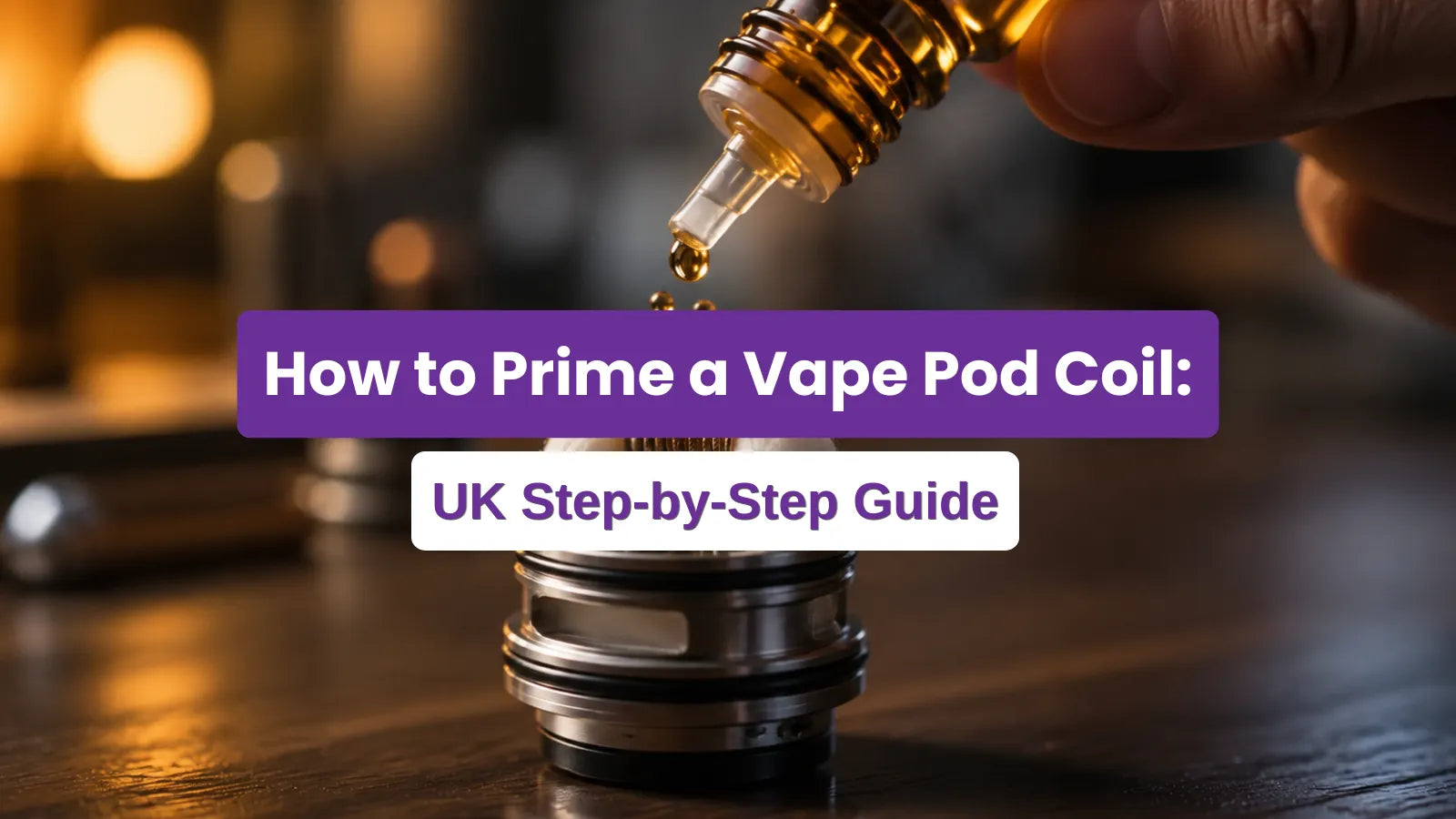
What does priming a vape coil mean?
Priming a vape coil means soaking its cotton wick with e-liquid before you fire the device. Drip e-liquid onto the coil ports, fill the tank or pod, then wait 10 to 20 minutes for full saturation. Firing a dry coil burns the cotton permanently, so priming protects flavour and coil life.
Priming a vape coil means saturating its cotton wick with e-liquid before the coil heats up. Every coil holds cotton wrapped around a metal heating element, and the cotton draws e-liquid toward that element to be vaporised.
Heat applied to dry cotton climbs past 200°C (392°F) within a second and burns the fibres instantly. Burnt cotton cannot recover, so it keeps producing a bitter taste until you fit a fresh coil.
Priming removes that risk by letting the cotton soak fully, which gives clean vapour and steady flavour from the first draw. Every replaceable coil and every refillable pod needs priming before its first puff. The NHS regards vaping as less harmful than smoking, though not risk-free, so keeping a coil in good order matters for adults who have switched from cigarettes.
Royal Vapery stocks vape coils and pods across leading MTL and sub-ohm devices, and the method below works the same way for all of them. This guide covers the exact steps, the correct waiting times by coil type, and the fixes for a coil that already tastes burnt.
How do you prime a vape coil?
To prime a vape coil, wet the exposed cotton, fill the tank or pod, then rest the device for 10 minutes before a gradual power ramp. The method suits every replaceable coil, from Vaporesso GTX to Geekvape and VooPoo PnP heads. Follow these steps for a new coil or a fresh pod:
- Inspect the coil and remove any protective seal from the ports.
- Drip 3 to 4 drops of e-liquid onto each cotton port on the side of the coil.
- Add 2 to 3 drops onto any cotton visible at the top of the coil.
- Fit the coil hand-tight, then fill the tank or pod with e-liquid.
- Rest the device upright for 10 minutes so the cotton saturates to its core.
- Start at the lowest wattage the coil supports and take 5 to 6 gentle draws.
- Raise the power by 5W every few draws until you reach your normal setting.
How to prime a coil in a refillable tank
Priming a coil in a refillable tank starts with dripping e-liquid directly onto the visible cotton ports. Sub-ohm tanks and MTL tanks both expose two to four cotton windows on the side of the coil.
Wet each window, screw the coil into the base hand-tight, fill the tank, then wait 10 minutes minimum. A gradual wattage climb over the first 15 to 20 draws beds the cotton in and prevents scorching on a coil that is otherwise well primed.
How to prime a coil in a refillable pod kit
Priming a coil in a refillable pod kit depends on the coil design, because most refillable pod kits use one of two builds. Removable-coil pods let you drip 2 to 3 drops onto the cotton before you seat the coil, then fill and wait 10 minutes.
Fixed-coil pods hide the cotton entirely, so you fill the pod to the line and wait 15 minutes for the wick to soak from the inside. Gentle draws without firing pull e-liquid through the cotton and shorten the wait.
Do prefilled pod kits need priming?
No, prefilled pod kits do not need priming, because the manufacturer fills and saturates the pod before packaging. Big puff kits and prefilled pod kits arrive with the cotton already soaked, so they fire cleanly from the first draw.
A short rest of 5 minutes after fitting a fresh pod still helps if the device has travelled in the cold, though the wick is ready to use. Priming by hand applies to refillable tanks and refillable pods, where you add the e-liquid yourself.
How long should you prime a vape coil?
Prime a standard coil for 10 minutes, a mesh coil for 15 minutes, and a ceramic coil for 20 minutes before the first draw. Wicking speed changes with the coil material and the thickness of the e-liquid. Denser wicking and higher VG both slow saturation, so the waiting time rises with each.
| Coil type | Minimum wait | Reason |
|---|---|---|
| Standard wire | 10 minutes | Quickest cotton to saturate |
| Mesh | 15 minutes | Larger surface area needs longer |
| Ceramic | 20 minutes | Porous material wicks slowest |
High VG e-liquid at 70/30 or thicker adds around 5 minutes to each figure, and small MTL coils feel the delay most because their narrow channels draw thick liquid slowly. Setting a timer removes the guesswork, since a rushed prime is the most common reason a brand new coil tastes burnt.
Which e-liquid suits coil priming?
A coil primes best with an e-liquid matched to its resistance, which means 50/50 nic salts for high-resistance MTL coils and 70/30 shortfills for low-resistance sub-ohm coils. High-resistance coils above 1.0Ω wick thin 50/50 liquid quickly and suit nic salt e-liquids at 10mg or 20mg. UK pods hold up to 2ml and nicotine e-liquid ships in 10ml bottles under the TRPR regulations, with a 20mg/ml nicotine cap.
Low-resistance coils below 0.6Ω need the thicker base of a shortfill e-liquid to keep a larger wick fed at higher wattage. Coils fitted to sub-ohm kits run hotter and drain the cotton faster, so the liquid must be thick enough to keep up. Mismatching the two starves the cotton mid-draw and burns a coil you primed correctly.
Why does a new vape coil taste burnt?
A new vape coil tastes burnt when the cotton fired before it fully saturated, which scorches the fibres beyond repair. Four causes explain almost every burnt new coil, and the fix sits inside each one:
- Wait time: the outer cotton soaked while the inner core stayed dry, so a longer prime on the next coil fixes it.
- Wattage jump: a leap straight to high power scorches even a primed coil, so start at the low end and climb.
- Liquid mismatch: thick 70/30 e-liquid in a small MTL coil cannot wick fast enough, so the cotton dries mid-draw.
- Coil defect: rare dead-on-arrival heads exist, so a fresh coil from the pack settles it.
Can you over-prime a vape coil?
Yes, you can over-prime a vape coil by soaking it with too much e-liquid, a state known as flooding. A flooded coil gurgles or spits when you fire it, and it can seep from the airflow.
Clearing the excess fixes it, remove the pod or tank, then flick the device downward into a sink or tissue to expel the trapped liquid. Reassemble the device and take a gentle draw to confirm the gurgle has gone.
How do you make a primed coil last longer?
Keep a primed coil alive by staying above the wicking holes, easing off top-end wattage, and giving a new coil gentle use for its first day. Four habits stretch coil life:
- Liquid level: keep e-liquid above the wicking ports at all times, because one dry draw scorches cotton that took 15 minutes to soak.
- Break-in period: vape a new coil gently for a few hours before heavy use, so the cotton finishes bedding in.
- Wattage headroom: run 5W to 10W below the top of the coil's range, since constant peak power shortens its life.
- Flavour choice: expect fewer draws from sweet dessert and candy e-liquid, because sweeteners caramelise on the coil faster than fruit, menthol, or tobacco.
Coil life depends on usage, and it varies by material and wattage. Fitting a fresh coil on time avoids the burnt draw, and Royal Vapery keeps replacement pods in stock across MTL and sub-ohm ranges from brands such as IVG, Vaporesso, and OXVA.
FAQs About Priming a Vape Pod Coil
A vape coil is primed when the visible cotton has darkened evenly and no white patches remain. Saturated cotton looks translucent and slightly wet rather than dry and bright. On fixed-coil pods you cannot see the cotton, so the clock is your guide, and a 15 minute wait signals a coil ready for a gentle first draw.
No, you should not vape at full power straight after priming a coil. Rest the device for 10 to 20 minutes so the cotton saturates to its core, then start at the lowest wattage. A gradual climb over the first 15 to 20 draws beds the cotton in and protects the coil you just primed.
Three to four drops of e-liquid on each cotton port prime a coil in a tank. Add 2 to 3 drops on any cotton visible at the top. Fixed-coil pods take no drops because you cannot reach the cotton, so you fill the pod and let it soak from the inside instead.
You prime a coil in stages, dripping onto the cotton while the tank is empty, then filling the tank before the wait. Direct drops wet the outer cotton fast, and the full tank keeps the wick fed while it soaks. Both steps matter, so skipping the drops leaves the inner cotton dry.
No, you cannot prime a vape coil without e-liquid, because priming means soaking the cotton in e-liquid. Water, oil, or any other liquid damages the coil and must never go near it. Only vape e-liquid at the correct VG/PG ratio for your coil primes it safely and gives clean vapour.
Wait 10 minutes for a standard coil, 15 minutes for a mesh coil, and 20 minutes for a ceramic coil before vaping. High VG e-liquid adds around 5 minutes to each. The wait lets the cotton saturate to its core, which is the single priming step most people rush.
No, prefilled pod kits do not need priming, because the manufacturer saturates the pod before packaging. Big puff kits and prefilled pods fire cleanly from the first draw. A 5 minute rest after fitting a fresh pod still helps if the device has been cold, though the cotton inside is already soaked.
Firing an unprimed vape coil burns the dry cotton within a second, which ruins the coil permanently. The taste turns harsh and bitter, and it never clears no matter how long you wait afterwards. Burnt cotton cannot recover, so the only fix is a fresh coil primed correctly the second time.
No, a burnt coil cannot be fixed after firing it dry, because scorched cotton is damaged for good. The bitter taste stays through every draw and gets no better. Replace the coil, then prime the new one with a longer wait so the inner cotton saturates fully before you fire it.
Yes, high VG e-liquid takes longer to prime, because thicker liquid wicks through cotton more slowly. A 70/30 shortfill needs around 5 extra minutes over a 50/50 nic salt. Small MTL coils feel the delay most, so a longer wait prevents a dry first draw on thick liquid.
Prime a mesh coil by dripping 3 to 4 drops onto each cotton port, fitting the coil, filling the tank, then waiting 15 minutes. Mesh coils hold a larger surface area of cotton than wire coils, so they need longer to saturate. A gradual wattage climb over the first draws protects the mesh.
Yes, you can over-prime a vape coil by adding too much e-liquid, a state called flooding. A flooded coil gurgles, spits, or leaks when you fire it. Flick the device into a sink or tissue to clear the excess, then take a gentle draw to confirm the gurgle has stopped.
Start at the lowest wattage in the coil's printed range after priming a coil. Take 5 to 6 gentle draws, then raise the power by 5W every few draws. Reaching your normal setting over the first 15 to 20 draws beds the cotton in and prevents a scorch on a fresh coil.
Yes, priming a coil works the same with nic salts, because the method depends on wetting the cotton, not the nicotine type. Nic salt e-liquid at 50/50 wicks quickly into high-resistance MTL coils. Drip, fill, and wait 10 minutes, then start low, exactly as you would with any 50/50 liquid.
Prime a vape coil every time you fit a new coil or a fresh replacement pod. Priming applies again if a refillable pod runs dry, because the cotton dries out and needs resoaking. Prefilled pods need no repeat priming, since the sealed pod stays saturated until it empties.


