


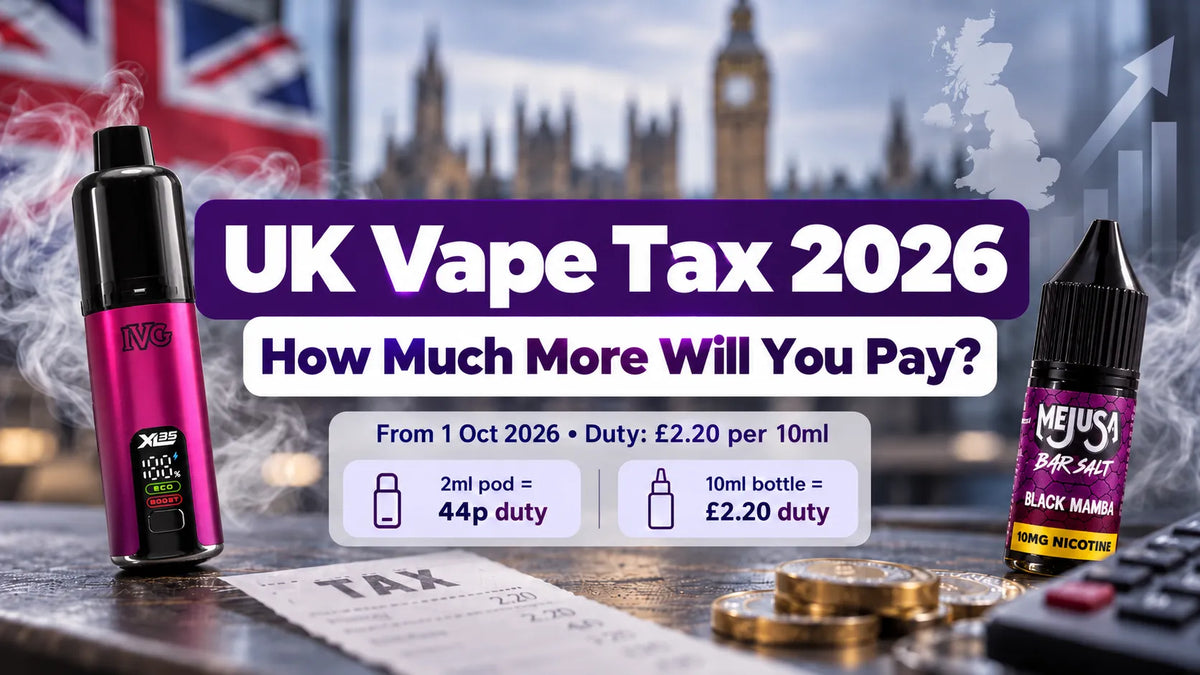
UK Vape Tax 2026 - Price Rise
The UK Vape Tax 2026 adds £2.20 duty per 10ml of vaping liquid. An illustrative customer price increase is £2.64 per 10ml, assuming businesses pass on the full duty and apply 20% VAT. Vaping Products Duty started on 1 October 2026. Actual retail prices vary. For someone purchasing 60ml of liquid each month, that calculation represents £15.84 extra per month.
A smaller or larger monthly quantity produces a different result. The amount of liquid matters more than the advertised puff count. Existing stock, retailer pricing and the contents of each pack affect what you eventually pay. The duty forms part of the wider regulatory framework covered in our guide to UK vaping laws.
What is the UK vape tax?
Vaping Products Duty is an excise tax on liquid intended for vaping. The charge applies regardless of whether the liquid contains nicotine. HMRC sets the rate at 22p per millilitre, equivalent to £2.20 per 10ml. Three figures help explain the effect on a purchase:
| Figure | What it means |
|---|---|
| Duty | The government’s tax on the vaping liquid |
| VAT | The sales tax applied to the taxable selling price |
| Retail price | The final amount charged to the customer |
Duty is accounted for within the supply chain. Customers buying from a UK retailer generally encounter its effect through the selling price, rather than paying HMRC separately.
How much is vape liquid going up in October 2026?
A 10ml bottle has an illustrative £2.64 price increase when the full £2.20 duty is passed on with 20% VAT. The government has not set a compulsory £2.64 retail increase for every bottle. GOV.UK confirms that vaping products attract standard-rate VAT.
The calculation is: £2.20 duty + £0.44 additional VAT = £2.64
For example, a hypothetical bottle previously priced at £4.00 including VAT becomes £6.64 under these assumptions. That represents a 66% increase.
The £4.00 starting price is a worked example, not a verified Royal Vapery price. Supplier costs, discounts and retailer margins can produce a different final result.
Do not add: another 20% VAT to the whole old VAT-inclusive price. The £0.44 above represents the additional VAT associated with passing on the duty.
How much duty applies to different liquid volumes?
The duty calculation uses the liquid supplied across the complete pack. Count every filled pod, cartridge, refill container and bottle. HMRC’s published examples calculate a 2ml pod at 44p duty and a 10ml bottle at £2.20 duty.
The following figures are calculated examples, not confirmed price changes.
| Example | Total liquid supplied | Duty only | Illustrative increase including VAT |
|---|---|---|---|
| One filled 2ml pod | 2ml | £0.44 | £0.53 |
| Two filled 2ml pods | 4ml | £0.88 | £1.06 |
| One 10ml bottle | 10ml | £2.20 | £2.64 |
| One 10ml nicotine shot | 10ml | £2.20 | £2.64 |
| Filled 2ml pod plus separate 10ml refill | 12ml | £2.64 | £3.17 |
| 50ml shortfill without shots | 50ml | £11.00 | £13.20 |
| 50ml shortfill plus one 10ml shot | 60ml | £13.20 | £15.84 |
| 100ml shortfill without shots | 100ml | £22.00 | £26.40 |
| 100ml shortfill plus two 10ml shots | 120ml | £26.40 | £31.68 |
Calculation assumptions: Full duty pass-through, 20% VAT and no other price changes. Totals are rounded to the nearest penny after calculating the complete liquid volume. The exact VAT-inclusive calculation for 2ml is £0.528, rounded to £0.53. For 12ml, the result is £3.168, rounded to £3.17.
Does a 2ml pod with a 10ml bottle always contain 12ml?
No. The pack contains 12ml only when the pod already holds 2ml and the bottle supplies another 10ml. An empty 2ml pod packaged with a 10ml bottle contains only 10ml of liquid. Filling that pod from the bottle moves the liquid; it does not create another 2ml.
Check whether the packaging describes a prefilled pod, an empty refillable pod or an additional refill container. Our explanation of the different types of vapes provides context for these formats.
Does shortfill vape tax include empty bottle space?
No. Empty bottle capacity is not liquid volume. A 120ml-capacity bottle containing 100ml of shortfill liquid has 100ml of liquid for this example. HMRC’s volume rules govern how the quantity is established.
Two separately supplied 10ml nicotine shots add another 20ml:
- Shortfill liquid: 100ml.
- Separate nicotine shots: 20ml.
- Combined quantity: 120ml.
- Combined duty: £26.40.
- Including VAT: £31.68.
Shots are a separate quantity and cost. A person using the shortfill without nicotine shots should not automatically include them in the calculation.
Does the tax apply to nicotine-free liquid and nic salts?
Yes. Nicotine-free liquid and nicotine-containing liquid attract the same duty rate per millilitre. Nicotine strength does not create a different tax band. For equal liquid volumes, a nicotine-free bottle, a nic salt bottle and a freebase bottle therefore have the same duty calculation.
Concentrates and mixing components require attention to their intended use. HMRC’s scope guidance includes substances intended for vaping and liquid manufactured from components such as propylene glycol, vegetable glycerine and flavourings.
The tax classification is separate from the liquid’s formulation. Our VG and PG guide explains those ingredients and ratios.
Are vape kits, coils and empty pods taxed?
Vape devices sold without e-liquid do not have to pay Vaping Products Duty. A device bundle containing liquid requires that liquid to be counted separately.
The distinction is between an empty component and a component supplied with liquid:
| Pack contents | Liquid to include in the calculation |
|---|---|
| Device and empty pod | None |
| Replacement coil only | None |
| Empty refillable pods | None |
| Device with one filled 2ml pod | 2ml |
| Device with a separate 10ml bottle and empty pod | 10ml |
Hardware prices can still change for commercial reasons. Being outside the liquid-duty calculation does not guarantee an unchanged shelf price. Product standards are a separate issue. Our guide to TRPR and TPD explains the regulatory context beyond taxation.
Why have some vape prices not increased yet?
Some prices remain unchanged because eligible older stock can still be sold, while businesses decide how to price their inventory. HMRC permits eligible unstamped, non-duty-liable stock to be sold until 31 March 2027. The transition has three relevant dates:
| Date | What changes |
|---|---|
| 1 October 2026 | Vaping Products Duty and the stamp scheme started |
| Until 31 March 2027 | Eligible older unstamped stock can remain on sale |
| From 1 April 2027 | Products within the vaping-duty scheme sold in the UK must carry a valid duty stamp |
Different flavours or strengths can come from different batches. A higher price for one strength does not establish a higher nicotine-based tax rate.
The transition does not require retailers to keep old prices. Nor does an overseas manufacturing date before October automatically establish eligibility if the goods were imported afterwards.
How much could your monthly vaping costs increase?
The illustrative monthly increase is the liquid quantity purchased multiplied by £0.264, assuming full duty pass-through with 20% VAT. The table uses a 30-day month. Daily quantities are calculation scenarios, not estimates of average consumption.
| Example daily quantity | Quantity over 30 days | Duty only | Illustrative increase with VAT |
|---|---|---|---|
| 1ml | 30ml | £6.60 | £7.92 |
| 2ml | 60ml | £13.20 | £15.84 |
| 3ml | 90ml | £19.80 | £23.76 |
| 5ml | 150ml | £33.00 | £39.60 |
These amounts represent the tax-related change, not the entire monthly bill. For a separate yearly example, purchasing one 10ml bottle each week produces an illustrative increase of:
£2.64 × 52 weeks = £137.28 per year
Actual spending depends on the quantity bought, selling prices and stock batches. Liquid used this month may have been purchased earlier, so receipts give a clearer spending record than estimated daily use.
Why do percentage increases differ between products?
Percentage increases differ because the same duty amount can represent a different share of the original price. Consider two hypothetical 10ml bottles:
| Hypothetical original price | Illustrative increase | Illustrative new price | Percentage increase |
|---|---|---|---|
| £3.00 | £2.64 | £5.64 | 88% |
| £6.00 | £2.64 | £8.64 | 44% |
Both examples contain the same liquid volume. Both receive the same assumed £2.64 increase. The lower starting price produces the larger percentage change. These figures explain the arithmetic; they are not product-price comparisons. Claims that every pod rises by one fixed percentage, or every shortfill by another, require verified starting prices.
How should you compare costs after the tax?
Compare costs using the actual price per millilitre and total monthly expenditure. A lower pack price does not necessarily mean a lower unit cost.
Use four steps:
- Count the liquid. Include every filled pod, refill container and bottle.
- Record the final price. Use the actual VAT-inclusive amount, including relevant delivery charges.
- Calculate the unit cost. Divide the liquid price by the total millilitres supplied.
- Add recurring costs. Include replacement components when assessing the monthly total.
For a purely mathematical example, £9 divided by 30ml equals 30p per ml. A real comparison needs verified prices and equivalent contents. Device bundles need care because the price can include hardware as well as liquid. Avoid comparing a complete starter bundle directly with a liquid-only refill.
Advertised puff counts do not enter the tax formula. Device format and use are separate considerations, explained in our guide to MTL, DTL and RDL vaping styles.
Why has the government introduced the vape tax?
The government says the duty aims to reduce vaping’s affordability and appeal, particularly among young people and non-smokers. The accompanying stamp scheme is intended to support enforcement against illicit trade.
Those statements describe policy objectives. They do not establish that the duty has already reduced youth vaping or increased illicit sales. The effect on household spending is easier to calculate than the effect on behaviour. Longer-term claims require evidence collected after implementation.
What else should you know about UK vape tax?
How can you avoid vape tax in the UK?
Choosing a nicotine-free liquid or a different nicotine strength does not avoid the duty. Eligible older stock can remain on sale during the transition, but that is a stock rule rather than a permanent customer exemption. Special situations, such as travellers’ allowances, have separate conditions.
Are there loopholes for homemade e-liquid?
Home manufacture is not a general tax exemption. HMRC says manufacturing vaping liquid from raw materials at home requires approval, including for personal consumption. Mixing liquids from duty-paid components is permitted, that is different from producing untaxed vaping liquid from raw materials.
Will every retailer increase prices by the full amount?
No. Passing on the duty is a commercial decision. A retailer may absorb some cost, change a promotion or adjust prices for other reasons. The £2.64-per-10ml figure is a full-pass-through illustration, not a compulsory minimum increase or a confirmed Royal Vapery pricing announcement.
Are free nicotine shots now prohibited?
No. A promotion does not remove the duty liability, but duty does not itself prohibit a retailer from including a shot in a bundle. Whether a business continues such offers is a pricing decision. Claims that every free-shot promotion must end go beyond the tax calculation.
Is the UK banning all vaping?
No. Vaping Products Duty is not a blanket vaping ban. NHS guidance states that single-use disposable vapes can no longer be sold or supplied in the UK, while reusable and refillable vapes remain available. Those product-sale rules are separate from the duty.
Is vaping worse than smoking because it is now taxed?
No. A tax rate does not measure comparative health harm. The NHS states that vaping is less harmful than smoking, but is not risk-free. Children and non-smokers should not vape. Our article on Vaping Myths and Vaping Facts covers the broader distinctions.
What is the most affordable way to vape?
There is no universal lowest-cost setup established by the tax rate alone. Actual expenditure depends on liquid use, final prices, replacement components and delivery. Compare complete monthly costs rather than assuming the smallest pack, largest bottle or lowest percentage increase offers the best value.
Should ex-smokers receive a tax exemption?
That is a policy question. The published framework does not provide a general exemption based on a buyer’s former smoking status. Arguments for an exemption should be distinguished from the rules currently in force. Anyone struggling to stay smoke-free can seek support from a local stop smoking service.


