


What is e-liquid?
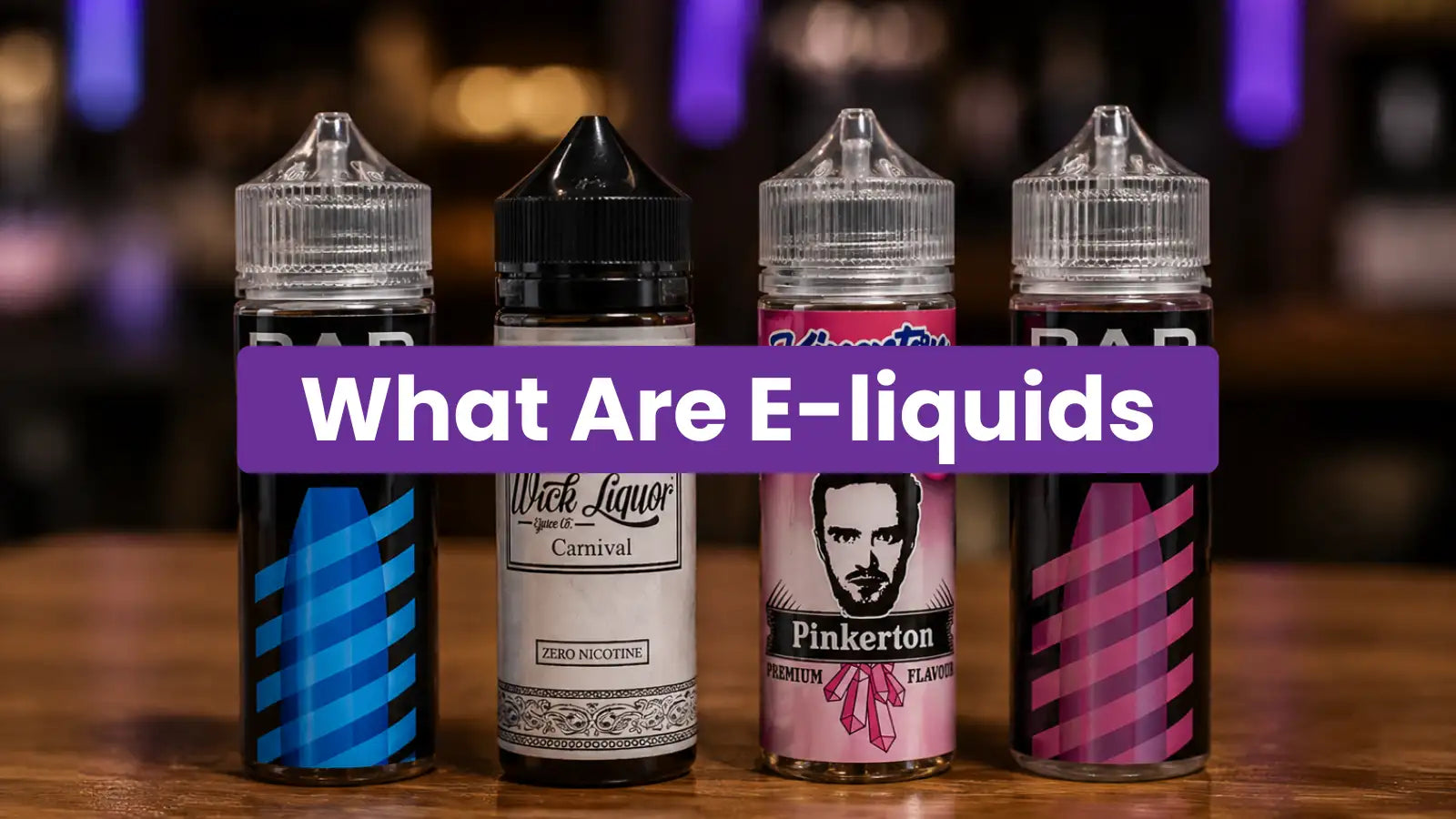
E-liquid is the flavoured fluid a vape device heats into vapour, blended from propylene glycol, vegetable glycerine, food-grade flavourings and optional nicotine.
A coil warms the liquid until it turns to vapour, carrying flavour and, in most cases, nicotine. E-liquid replaces the smoke of a cigarette without burning tobacco, so the vapour contains no tar and no carbon monoxide. The NHS states that vaping is less harmful than smoking, but not risk-free, and is intended for adult smokers rather than non-smokers or under-18s.
The term covers three formats a UK vaper meets straight away: freebase, nic salt and shortfill. Some vapers call it vape juice, though the names mean the same product. Royal Vapery stocks e-liquid across nic salt, freebase and shortfill formats, all TRPR-compliant and MHRA-notified for legal UK sale.
UK rules: every nicotine e-liquid sold in the UK follows the Tobacco and Related Products Regulations 2016, capping nicotine at 20mg/ml, refill bottles at 10ml and tanks at 2ml, as set out by GOV.UK. Single-use disposable vapes have been banned since 1 June 2025, and a Vaping Products Duty of £2.20 per 10ml applies from 1 October 2026.
- Four ingredients: PG, VG, food-grade flavourings and optional nicotine.
- Three main types: freebase, nic salt and shortfill, each suited to a different device.
- Strengths run 0mg to 20mg, with 20mg/ml the UK legal maximum.
- Match the ratio to the kit: 50/50 for pod kits, high-VG shortfills for sub-ohm kits.
What is e-liquid made of?
E-liquid is made of four ingredients: propylene glycol, vegetable glycerine, food-grade flavourings and optional nicotine. A nicotine-free bottle contains only three. Each ingredient controls a different part of the vape: throat feel, cloud size, taste and craving relief.
A thin, faintly sweet liquid that carries flavour and gives a sharper throat feel. PG wicks easily through small coils, so it suits pod kits and starter kits.
A thicker, plant-derived liquid that produces the vapour. A higher VG share gives a smoother inhale and bigger clouds, at the cost of slightly muted flavour.
Food-grade concentrates that set the taste, split into fruit, menthol, tobacco and dessert. UK rules ban caffeine, taurine and colourings in e-liquid.
Optional and adjustable, from 0mg up to the UK legal ceiling of 20mg/ml. Two forms exist, freebase and nic salt, each with a different throat feel.
What does PG do in e-liquid?
PG carries flavour and throat feel in e-liquid. Propylene glycol is a thin, clear liquid with a faint sweetness, and its low viscosity wicks easily through small coils. A higher PG content delivers a defined throat feel and clearer flavour, which suits low-power pod kits.
What does VG do in e-liquid?
VG produces the vapour in e-liquid. Vegetable glycerine is a thicker, plant-derived liquid, and it generates the dense clouds sub-ohm vapers look for. A higher VG content gives a softer throat feel and demands more power to vaporise, so it belongs in higher-wattage devices.
Is there nicotine in e-liquid?
Nicotine in e-liquid is optional and adjustable. Nicotine satisfies the craving a smoker feels when quitting, without tobacco combustion. UK e-liquid caps nicotine at 20mg/ml, and bottles run from 0mg up to that legal ceiling.
What are the different types of e-liquid?
There are four main types of e-liquid, split by nicotine form and bottle format. Each type suits a different device, strength and vaping style, from beginner pod kits to advanced sub-ohm setups.
- Freebase nicotine e-liquid: the traditional form of nicotine, giving a pronounced throat feel that grows harsher above 6mg. Freebase suits strengths of 3mg to 12mg in MTL pod kits. Royal Vapery stocks freebase nicotine e-liquids in 10ml bottles across fruit, menthol and tobacco profiles.
- Nic salt e-liquid: nicotine bonded with an organic acid to lower its pH, producing a smoother inhale even at 20mg. Nic salts absorb faster and hold flavour at high strengths, which suits smokers moving to a pod kit. Bar salts sit inside this group, blended to echo the fruit and menthol tastes of the old disposables.
- Shortfill e-liquid: a larger bottle of nicotine-free liquid, usually 50ml or 100ml, with headroom to add a nicotine shot. Shortfills carry a high VG ratio for sub-ohm vaping and offer strong value per millilitre. The 10ml limit does not apply because the bottle contains 0mg nicotine.
- Hybrid nicotine e-liquid: a blend of freebase and nic salt, pairing the fast relief of salts with the firmer throat feel of freebase. Hybrid stays less common across UK ranges than the other three.
What do PG/VG ratios mean in e-liquid?
The PG/VG ratio sets the thickness of an e-liquid and the device it suits. A higher PG share gives a thinner liquid, more throat feel and clearer flavour. A higher VG share gives a thicker liquid, bigger clouds and a softer inhale. Matching the ratio to your coil prevents leaking on one end and dry, burnt hits on the other.
| PG/VG ratio | Consistency | Best vaping style | Throat feel | Suited device |
|---|---|---|---|---|
| 50/50 | Balanced, thin | MTL / RDL | Moderate | Pod kits, starter kits |
| 60/40 (high PG) | Thin | MTL | Stronger | MTL pens, pod kits |
| 70/30 (high VG) | Thick | DTL / RDL | Mild | Sub-ohm kits |
| 80/20 (high VG) | Very thick | DTL | Very mild | Advanced sub-ohm mods |
A 50/50 ratio is the most versatile starting point and carries most nic salts and beginner freebase bottles. Thicker 70/30 and 80/20 blends belong in sub-ohm devices that can vaporise them cleanly.
What nicotine strengths does e-liquid come in?
E-liquid comes in seven common strengths, from 0mg to 20mg per millilitre. The number on the bottle is the milligrams of nicotine in each 1ml of liquid. UK law caps nicotine-containing e-liquid at 20mg/ml under the e-cigarette regulations published by GOV.UK. Your previous smoking level guides the strength that satisfies cravings without feeling harsh.
| Strength | Percentage | Best suited for |
|---|---|---|
| 0mg | 0% | Flavour-only vaping, cloud chasing on sub-ohm kits |
| 3mg | 0.3% | Social smokers, sub-ohm DTL vapers |
| 6mg | 0.6% | Light freebase MTL users |
| 10mg | 1% | Average smokers, nic salt MTL |
| 12mg | 1.2% | Average to heavy freebase MTL |
| 18mg | 1.8% | Heavy freebase MTL |
| 20mg | 2% | Heavy smokers, nic salt MTL (UK legal maximum) |
Which nicotine strength should you choose?
Choose your nicotine strength based on how much you used to smoke. A heavier habit needs a higher strength to curb cravings, while a lighter habit is served by a lower one. Nic salts stay smooth at the top of the scale, so heavy smokers reach for 20mg salts rather than 18mg freebase.
| Smoking habit | Recommended type and style | Strength |
|---|---|---|
| Heavy (15+ per day) | Nic salt, MTL | 20mg |
| Average (10 to 15 per day) | Nic salt MTL, or freebase MTL | 10mg salt or 12mg freebase |
| Light (1 to 10 per day) | Nic salt or freebase, MTL | 5mg to 10mg salt, or 6mg freebase |
| Social (1 to 5 per week) | Freebase or salt, MTL | 3mg |
| Reducing intake | Freebase MTL, or high-VG DTL | 3mg |
| No nicotine | Any style | 0mg |
If a strength feels harsh, step to a nic salt at the same level for a smoother inhale. If it feels too mild and cravings return, move up one step rather than vaping constantly.
Nic salts vs freebase nicotine: what is the difference?
The main difference between nic salts and freebase is throat feel: nic salts stay smooth at high strengths, while freebase turns sharp above 6mg. Nic salts absorb faster for quicker craving relief, which suits smokers switching to a pod kit. Freebase gives a firmer throat feel that some vapers prefer at lower strengths.
| Characteristic | Nic salt | Freebase nicotine |
|---|---|---|
| Throat feel | Smooth at high strengths | Sharper above 6mg |
| Nicotine delivery | Fast absorption | Slower absorption |
| Common strengths | 5mg, 10mg, 20mg | 3mg, 6mg, 12mg, 18mg |
| Best for | MTL pod kits, transitioning smokers | MTL and lower-strength vaping |
| Device | Low-wattage pod kits | Pod kits and MTL pens |
Browse the full range of nic salts in 10mg and 20mg, the strengths most switchers begin with.
Which vaping style suits your e-liquid?
There are three vaping styles, and each pairs with a different e-liquid: MTL, DTL and RDL. Your style sets the throat feel, cloud size and strength you want, so it points you toward the right ratio and nicotine level.
- Mouth-to-lung (MTL): draw the vapour into your mouth, then inhale it, mimicking a cigarette. MTL suits high-PG liquids and nic salts at higher strengths for a defined throat feel.
- Direct-to-lung (DTL): inhale the vapour straight into your lungs for large clouds and a soft throat feel. DTL suits high-VG shortfills at low strengths of 3mg or 6mg.
- Restricted direct-to-lung (RDL): a middle ground with wider airflow than MTL and more vapour, favouring rich flavour. RDL suits 50/50 and 70/30 liquids in modern pod kits.
How do you match e-liquid to your vape kit?
Match your e-liquid to your kit by pairing the PG/VG ratio to the coil resistance. Thin, high-PG or 50/50 liquids belong in high-resistance MTL coils, while thick, high-VG liquids belong in low-resistance sub-ohm coils. A mismatch causes leaking in small pods or burnt, dry hits in powerful kits.
- Starter kits and pod kits: run 50/50 blends and nic salts, since thinner liquid wicks cleanly through small coils. These starter vape kits and pod kits suit smokers switching from cigarettes.
- Sub-ohm kits: run 70/30 and 80/20 shortfills at low strengths, producing big clouds from higher wattage. Pair a sub-ohm kit with high-VG liquid for DTL vaping.
As a quick rule: pod kits love 50/50 or nic salts, and sub-ohm kits love high-VG shortfills.
What bottle formats does e-liquid come in?
E-liquid comes in three bottle formats: 10ml, shortfill and nicotine shots. The format sets how much you buy and how you adjust the strength. A 10ml bottle arrives ready to vape, while shortfills need a nic shot to reach the strength you want.
- 10ml bottles: the TRPR-standard size for nicotine e-liquid, capped at 20mg/ml. These carry both freebase and nic salt, and suit vapers who switch flavours often.
- 50ml and 100ml shortfills: larger nicotine-free bottles with headroom for a nic shot, giving strong value for sub-ohm vaping. Explore shortfill e-liquid in high-VG blends.
- Nicotine shots: 10ml bottles of unflavoured nicotine, added to a shortfill to set the strength. One 18mg shot in a 50ml shortfill produces roughly 3mg.
For a versatile all-round pick, a 50/50 e-liquid in 10ml works across the widest range of kits.
How do you store e-liquid, and does it expire?
E-liquid expires, with a typical shelf life of 1 to 2 years from manufacture. Over time the nicotine oxidises and the flavour fades, so the liquid darkens and loses potency. Every bottle carries a batch code and best-before date on the label.
Store e-liquid in a cool, dark place, away from heat and direct sunlight, with the cap sealed tight. Light, heat and air speed up oxidation, which is why a bottle in a warm car darkens quickly. A darkening colour is normal oxidation and does not mean the liquid is unsafe.
Popular e-liquids at Royal Vapery
Royal Vapery stocks nic salts and shortfills from the brands UK vapers reach for most. The table below pairs six popular ranges with their type, strength and bottle format.
| E-liquid | Type | Strength | Format |
|---|---|---|---|
| Elf Bar ELFLIQ | Nic salt | 10mg, 20mg | 10ml |
| IVG Intense Salts | Nic salt | 10mg, 20mg | 10ml |
| Hayati Pro Max Nic Salt | Nic salt | 10mg, 20mg | 10ml |
| Hayati Pro Max Shortfill | Shortfill | 0mg | 100ml |
| Doozy Seriously Fruity | Shortfill | 0mg | 100ml |
| Ultimate Juice | Shortfill | 0mg | 100ml |
Why buy e-liquid from Royal Vapery?
Royal Vapery is a UK online vape store based in Preston, Lancashire, stocking 100% authentic, MHRA-notified e-liquid across nic salt, freebase and shortfill formats. Every bottle meets TRPR limits, with transparent pricing, age verification at checkout and fast UK delivery. Free delivery applies on orders over £49.99.
Frequently asked questions
E-liquid is made of four ingredients: propylene glycol, vegetable glycerine, food-grade flavourings and optional nicotine. A nicotine-free bottle contains only three. PG carries flavour and throat feel, VG produces vapour, flavourings set the taste, and nicotine satisfies cravings at strengths up to 20mg/ml under UK law.
Yes, e-liquid and vape juice are the same product. Both names describe the fluid a vape heats into vapour, blended from PG, VG, flavourings and optional nicotine. UK retailers use e-liquid as the standard term, while vape juice is a common everyday variant. The ingredients and function stay identical.
A beginner should use a 50/50 e-liquid or a nic salt in a 10ml bottle. Both are thin enough for pod kits and starter kits, and both give a satisfying throat feel. Nic salts suit heavier smokers at 10mg or 20mg, while 50/50 freebase suits lighter habits at 6mg or below.
The best nicotine strength depends on your previous smoking level. Heavy smokers of 15 or more a day suit 20mg nic salt, average smokers suit 10mg salt or 12mg freebase, and light smokers suit 5mg to 6mg. Adjust up if cravings return, or down if the vape feels harsh.
The difference is throat feel and absorption speed. Nic salts stay smooth at high strengths and absorb quickly, which suits smokers switching to a pod kit. Freebase gives a sharper throat feel above 6mg and absorbs more slowly. Nic salts run to 20mg, while freebase commonly runs from 3mg to 18mg.
No, e-liquid must match the device. Thick high-VG liquid clogs and burns small pod coils, while thin 50/50 liquid leaks and underperforms in sub-ohm kits. Pod kits and starter kits need 50/50 or nic salts, and sub-ohm kits need high-VG shortfills. Matching the ratio to the coil prevents both problems.
A 50/50 PG/VG ratio is best for beginners. The balanced blend wicks cleanly through small MTL coils, gives clear flavour and a comfortable throat feel, and works across the widest range of pod kits and starter kits. Thicker 70/30 and 80/20 ratios need a sub-ohm device to vaporise properly.
E-liquid contains nicotine only if you choose it. Nicotine is an optional, adjustable ingredient, and bottles run from 0mg to a UK legal maximum of 20mg/ml. Nicotine-free 0mg options exist for flavour-only vaping. Two forms exist, freebase and nic salt, each with a different throat feel.
Yes, e-liquid expires, typically 1 to 2 years from manufacture. Over time the nicotine oxidises and the flavour fades, so the liquid darkens and loses some potency. Each bottle shows a batch code and best-before date. Stored cool and dark with the cap sealed, a bottle stays stable for many months.
Store e-liquid in a cool, dark place, away from heat and direct sunlight, with the cap sealed tight. Light, heat and air speed up oxidation, which darkens the colour and weakens the flavour. A cupboard or drawer works well. Keep bottles out of reach of children and pets.
The maximum nicotine strength in UK e-liquid is 20mg/ml (2%). This TRPR limit applies to every nicotine-containing product, including nic salts, freebase, prefilled pods and nicotine shots. UK law caps nicotine bottles at 10ml and tanks at 2ml. Any nicotine e-liquid above these limits is not legal for UK sale.
E-liquid changes colour through oxidation, a natural reaction between nicotine, flavourings and air. Exposure to light, heat and oxygen darkens the liquid from clear to a browner shade over time. A colour change alone does not mean the liquid is unsafe to vape. Cool, dark storage slows the process considerably.
Yes, you can mix different e-liquids together. Many vapers blend flavours to create their own combinations. For a consistent result, mix liquids with similar PG/VG ratios, ideally from the same format. Blending a thin 50/50 with a thick 70/30 changes the overall ratio, which affects how the mix vapes in your device.
A nicotine shot is a 10ml bottle of unflavoured nicotine, added to a shortfill to set the strength. Shots typically carry 18mg or 20mg nicotine in a plain PG and VG base. One 18mg shot in a 50ml nicotine-free shortfill produces roughly 3mg, a common strength for sub-ohm DTL vaping.
E-liquid sold in the UK is regulated under TRPR and notified to the MHRA before sale, with banned ingredients such as diacetyl, caffeine and taurine excluded. The NHS states that vaping is less harmful than smoking, but not risk-free, and is intended for adult smokers rather than non-smokers or under-18s.
Information is for adults aged 18 and over. Vaping is less harmful than smoking but is not risk-free, and is intended for current smokers, per NHS guidance. All e-liquid sold by Royal Vapery is TRPR-compliant and MHRA-notified: 20mg/ml maximum nicotine, 10ml maximum bottle and 2ml maximum tank. Single-use disposable vapes have been banned in the UK since 1 June 2025, and a Vaping Products Duty of £2.20 per 10ml applies from 1 October 2026.


