


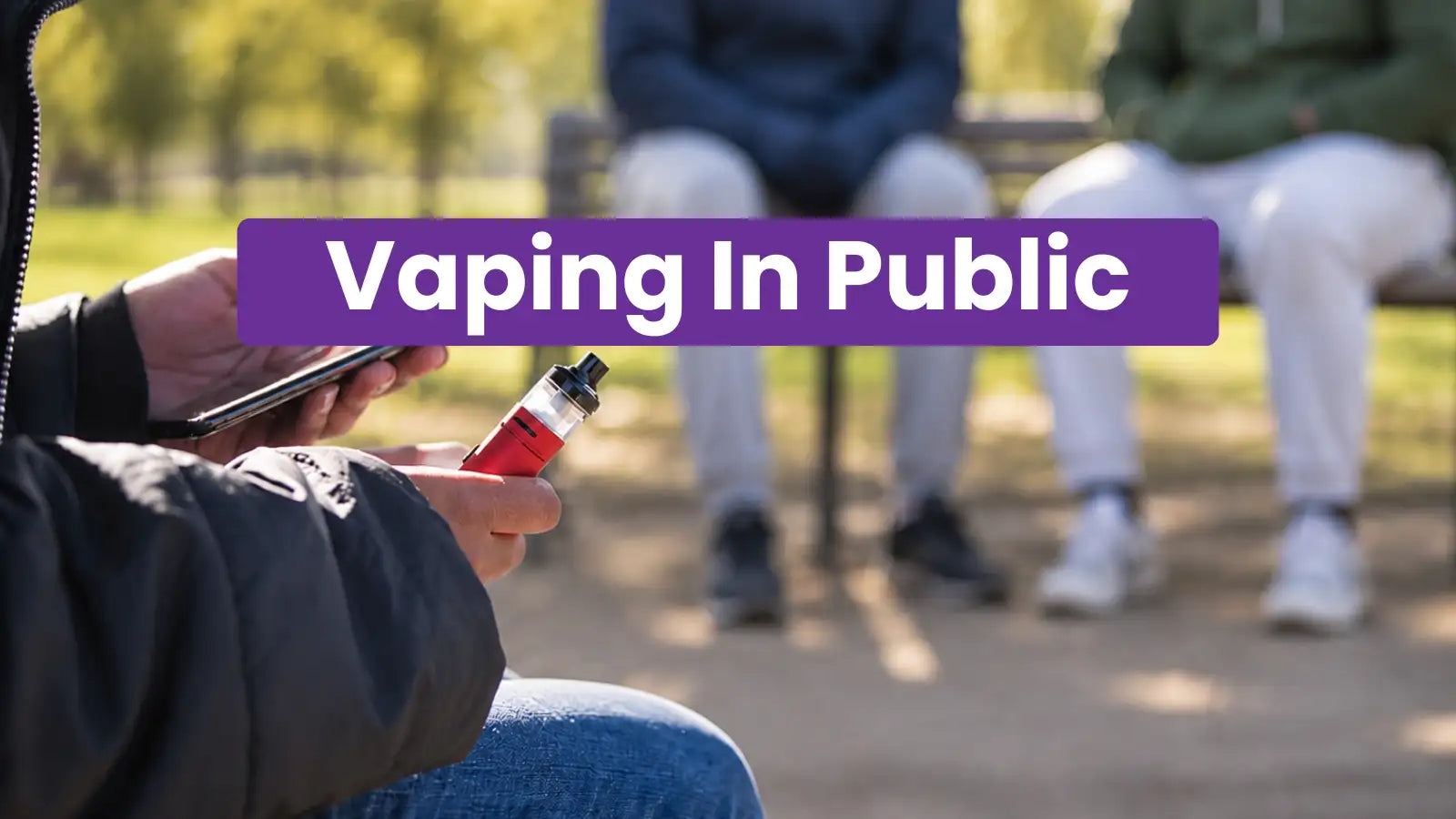
Is vaping in public legal in the UK?
Yes, vaping in public, meaning using an e-cigarette in shared or open spaces, is legal across the UK. Vapes are not classed as tobacco, so they fall outside the Health Act 2006 and the smoke-free laws that banned indoor smoking in enclosed public places in 2007. No nationwide law dictates where you use a vape, which sets vaping apart from cigarettes at a legal level.
Freedom under the law does not mean freedom everywhere. The NHS describes vaping as less harmful than smoking, but not risk-free, and that framing shapes how venues treat it. Royal Vapery, a UK online vape store based in Preston, fields the same questions daily: where you can vape, what changes across 2026, and how to stay considerate around others.
Individual venue owners, employers, local authorities and transport operators each set their own vaping policies, which creates a patchwork of rules across the country. Age of sale carries a firm limit, since selling vapes to anyone under 18 is illegal, and Royal Vapery runs age verification at checkout. Product standards stay strict too, with UK-compliant e-liquid capped at 20mg/ml nicotine, 2ml tank capacity and 10ml bottle size under the TRPR framework.
Where can you vape in public in the UK?
Vaping in public is decided setting by setting, so the reliable habit is to check for signage and to treat indoor spaces as off limits. Most enclosed venues in the UK handle vaping like smoking as a matter of house policy, even where the law does not require it. Open outdoor spaces stay the most relaxed, provided you keep clear of sheltered entrances and designated smoking areas.
| Setting | Typical status | Who decides |
|---|---|---|
| Shops and shopping centres | Not permitted indoors | Venue owner |
| Pubs, cafes and restaurants | Not permitted indoors | Individual establishment |
| Public transport | Banned network-wide | Transport operator |
| Airports and planes | Banned indoors and in-flight | Airport and airline |
| Hotels | Restricted, detectors common | Hotel policy |
| Your own car | Permitted, with control caveats | The driver |
| Open outdoor spaces | Permitted, mind shelters | Local authority signage |
Can you vape in pubs, cafes and restaurants?
No, most pubs, cafes and restaurants do not permit vaping indoors. Venues that serve food almost always forbid it, partly because they host families with children. Major pub and restaurant chains have adopted indoor vaping bans as company policy for customer comfort. A local landlord holds discretion in rare cases, so the reliable approach is to assume you cannot vape indoors and to ask a staff member first.
Can you vape on public transport?
No, vaping on public transport is banned across the UK. Every operating company forbids it, covering buses, trains, the London Underground, trams and station platforms. Transport for London prohibits vaping across its entire network, including the Tube, buses, taxis and private hire vehicles, for passengers and drivers. Network Rail and train operators extend the ban to platforms, station buildings and trains, in part because vape aerosol can trigger sensitive smoke alarms and delay a service.
Can you vape at airports and on planes?
No, vaping is banned inside airport terminals and completely forbidden in-flight. Every UK airport prohibits vaping indoors and handles it the same as smoking, so you use the designated smoking areas outside the terminal before your flight. Carry your device in hand luggage, never in checked baggage, because of the battery fire risk, and keep e-liquids within the 100ml cabin liquid limit. Cabin crew forbid any use of the device once you board.
Can you vape in hotels?
No, hotels handle vaping much like smoking, with restrictions posted in rooms and corridors. Many properties fit detectors and warn that a cleaning charge applies if you vape in a non-vaping room. Any permitted area sits outdoors and often gets shared with smokers. Checking the specific hotel policy at check-in avoids a fee, since chains and independents differ.
Can you vape while driving?
Yes, you can vape while driving your own car, with one clear caveat. No specific offence bans vaping at the wheel, yet losing proper control of the vehicle or obscuring your view with vapour brings a fixed penalty of £100 and 3 points, rising to a fine of up to £5,000 if the case reaches court, according to GOV.UK. Ask before vaping in a taxi or private hire vehicle, where the answer is usually no.
How is the Tobacco and Vapes Act 2026 changing public vaping rules?
The Tobacco and Vapes Act 2026 gives government the power to make many public places vape-free, though most of that change is still proposed rather than in force. The Act received Royal Assent on 29 April 2026 and builds a framework for smoke-free, vape-free and heated tobacco-free places. It does not ban public vaping by itself, since the specific restrictions arrive through secondary legislation after consultation.
What the 2026 consultation proposes
A government consultation on smoke-free, heated tobacco-free and vape-free places in England ran from 13 February 2026 to 8 May 2026, and ministers are weighing the response. The proposals set a defined scope:
- Indoor spaces: existing indoor smoke-free places would become vape-free and heated tobacco-free.
- Outdoor spaces: children's playgrounds, the areas outside schools, and the areas outside hospitals would become smoke-free.
- Left out: outdoor hospitality such as pub gardens, wide-open public spaces, and private homes and gardens.
Any new regulations arrive with at least 6 months notice and guidance, so the public and retailers get time to adjust. Two dated changes sit alongside this. The single-use disposable vape ban took effect on 1 June 2025 across all four UK nations, which makes prefilled and refillable kits the compliant route.
Vaping Products Duty starts on 1 October 2026 at £2.20 per 10ml of e-liquid, or 22p per ml, with nicotine-free liquid included and VAT charged on top, sourced to GOV.UK. The direction of travel is clear: public vaping will face more structure, most of it targeting indoor spaces and places where children gather.
What is good vaping etiquette in public?
Good vaping etiquette in public rests on awareness of the people and the space around you. Consideration matters most where the law stays quiet, because a considerate vaper protects the wider reputation of vaping. Follow these habits in shared spaces:
- Check first: look for signage and ask a staff member when a venue policy is unclear.
- Angle your exhale: direct vapour away from other people, never toward faces or food.
- Give children space: step back or pause near babies, young children and prams.
- Read the crowd: move to open air when a queue, platform or pavement seating area feels tight.
- Keep clouds small: favour a light draw in busy settings rather than a dense plume.
- Stay calm: respond politely to any objection and disengage rather than argue.
Etiquette pairs naturally with device choice, since a discreet setup does much of the work for you.
Which vapes are best for public spaces?
The best vapes for public spaces are low-vapour MTL devices, because they produce a light plume that disperses quickly. Mouth-to-lung setups draw air the way a cigarette does, so favour compact pod kits that run higher-resistance coils and pair with 50/50 nic salt e-liquid. Royal Vapery stocks the discreet formats that suit shared spaces:
- Open-system and compact, refillable pod kits run higher-resistance coils for a tight MTL draw and minimal cloud.
- Factory-filled and simple to use, prefilled pod kits became the legal alternative to disposables after the ban.
- Paired at 10mg or 20mg in a 50/50 ratio, nic salts deliver smooth satisfaction at low wattage without a heavy cloud.
- Built around control for new vapers, starter vape kits suit adult smokers making the switch from cigarettes.
Sub-ohm devices sit at the opposite end, producing dense clouds that draw attention outdoors, so they suit private settings rather than a busy pavement.
Can smoke alarms detect vape vapour?
Yes, some smoke alarms detect dense vape aerosol, though vapour is harder to pick up than smoke. Three detector types appear in hotel rooms, aeroplane toilets and public washrooms:
- Heat detectors: trigger above roughly 50C, so exhaled vapour does not set them off.
- Ionisation alarms: sense combustion particles and rarely react, yet a thick cloud from a high-VG e-liquid can catch one.
- Optical alarms: fire when an infrared beam meets particles, and dense vapour sometimes disrupts the beam.
A single unit may combine all three methods, and you cannot tell which sits above you. Attempting to vape in a banned enclosed space risks a triggered alarm, a cleaning fee or removal, so a designated area is the sound choice. This loops back to the core rule of vaping in public: when a space forbids it, wait until you reach one that allows it.
Why buy your vape kit from Royal Vapery?
Royal Vapery sells 100% authentic, MHRA-notified vape kits and e-liquids from a UK base in Preston, Lancashire. Free UK delivery applies on orders over £49.99, and orders placed before 12pm dispatch the same working day. Age verification runs at checkout, so every purchase meets the 18+ requirement. For low-vapour setups suited to shared spaces, the pod and starter range covers every experience level.
Frequently asked questions about vaping in public
No, vaping in public is not illegal in the UK. Vapes fall outside the smoke-free laws that ban indoor smoking, so no national law restricts where you use one. Venue owners, employers and transport operators set their own policies, which means an indoor space can forbid vaping as a house rule rather than a legal one.
No, enclosed shops and shopping centres do not permit vaping indoors. Retailers set this as house policy for customer comfort, and covered entrances near shopping centres often extend the restriction outdoors. Signage marks the boundary, and designated smoking areas outside sit away from doorways. Checking for a sign before you vape keeps you on the right side of the rule.
No, vaping on a train platform is banned in the UK. Network Rail and train operators forbid vaping on platforms, inside station buildings and on trains. The ban exists partly because vape aerosol can trigger a sensitive smoke alarm and delay a service. Wait until you leave the station and reach open air before using your device.
Yes, you can usually vape in a pub garden, since outdoor hospitality is not covered by the current proposals. The 2026 consultation on vape-free places excluded pub gardens and wider open public spaces from its scope. Individual pubs still hold discretion, so a garden can carry its own no-vaping signs. Reading the signage and asking staff avoids any awkwardness.
Vaping near children outdoors is legal, yet stepping back is the considerate choice. Children copy adult behaviour, and dense vapour can feel intrusive to families. Move to a less crowded spot or pause your vape when young children are close. The 2026 proposals target playgrounds and school gates precisely because these are places where children gather.
No national fine exists for vaping in an enclosed public space, because no law bans it directly. A venue can ask you to stop and to leave, and refusal that leads to police involvement can bring a separate charge. Hotels may add a cleaning fee. Driving without proper control while vaping carries a fixed penalty of £100 and 3 points, per GOV.UK.
Yes, you can take a vape on a plane in your hand luggage, but you cannot use it. Airlines forbid vaping in-flight, and airports ban it inside terminals. Pack the device and spare batteries in your carry-on, never in checked baggage, because of the fire risk. Keep e-liquids within the 100ml cabin liquid limit at security.
Yes, some smoke detectors sense dense vape aerosol, though vapour is harder to detect than smoke. Optical alarms can react when a thick cloud disrupts their infrared beam, and ionisation alarms sometimes catch dense high-VG vapour. Heat detectors do not respond to vapour. Many units combine methods, so vaping in a banned enclosed space risks setting one off.
Vaping at work depends entirely on your employer, since no law forces a workplace ban. Many employers apply their smoke-free policy to vaping and provide an outdoor area. The 2026 proposals would make indoor workplaces that are already smoke-free vape-free as well, once regulations arrive. Checking your staff handbook or asking a manager clarifies the current policy.
Vaping will not be banned outright in public places, though restrictions will grow. The Tobacco and Vapes Act 2026 gives ministers power to make indoor smoke-free places vape-free and to protect certain outdoor areas near children. A February to May 2026 consultation shaped the scope. Regulations arrive with at least 6 months notice, so wide public spaces stay open to vaping for now.
Vaping outside a hospital is currently legal, yet many NHS sites restrict it by their own policy. The 2026 proposals would make the areas outside hospitals and healthcare settings smoke-free to protect medically vulnerable people. Signs at entrances mark where vaping is discouraged. Using a designated area, where one exists, respects patients and staff around the building.
No, the disposable vape ban does not change where you can vape; it changes what you can buy. Single-use disposable vapes were banned across the UK from 1 June 2025. Refillable and prefilled pod kits replaced them as the compliant format. The rules on where you vape still come from venues, transport operators and councils, unchanged by the product ban.
The best vape for public places is a low-vapour mouth-to-lung pod kit. MTL devices run higher-resistance coils and pair with 50/50 nic salt e-liquid, which keeps the plume light while satisfying cravings. Refillable and prefilled pod kits both suit shared spaces. Sub-ohm kits produce dense clouds, so they draw attention outdoors and fit private settings better.
Vape discreetly in public by choosing a compact MTL device and a modest draw. Direct your exhale downward or away from people, take shorter puffs in crowds, and keep the cloud small. Low-vapour nic salt e-liquid on a higher-resistance coil produces little visible plume. Reading the space and stepping aside near others completes a discreet, considerate approach.
Yes, asking before vaping around others is polite and defuses most objections. People differ in how they feel about vapour, so a quick check shows respect for their space. The gesture matters most near children, elderly people and anyone eating. A calm, courteous approach protects the wider image of vaping and keeps shared spaces comfortable for everyone.
This guide is for adult smokers and vapers aged 18 and over. Vaping is less harmful than smoking but not risk-free, per NHS guidance, and it is not aimed at non-smokers or under-18s. UK-compliant e-liquid is capped at 20mg/ml nicotine, 2ml tank capacity and 10ml bottle size under the TRPR. Single-use disposable vapes have been banned across the UK since 1 June 2025, and Vaping Products Duty of £2.20 per 10ml applies from 1 October 2026. Information is correct at the time of publishing and provided for general guidance, not legal advice.


