


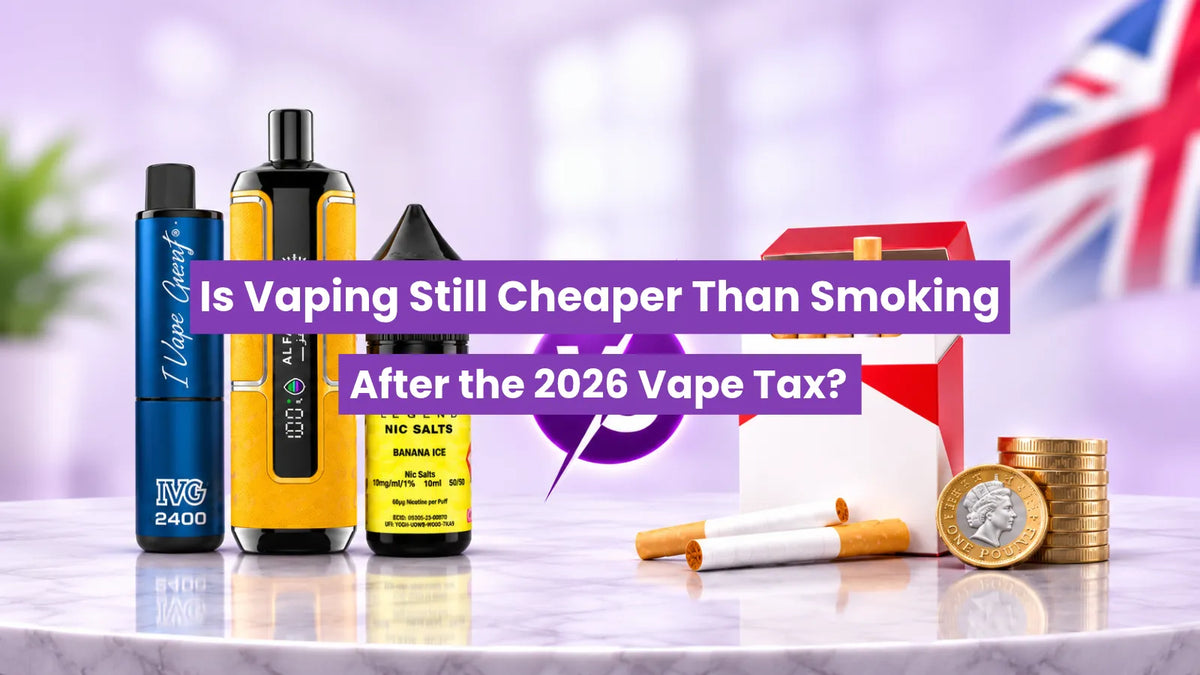
Vaping can still be cheaper than smoking in the UK after the 2026 vape tax, but the saving depends on your cigarette spending, liquid consumption and equipment costs. Compare the total price per day, rather than the pack price or advertised puff count.
This guide is for adults aged 18 and over who smoke or already vape. Vaping is less harmful than smoking, but it is not risk-free. Children and non-smokers should not start vaping, according to the NHS.
Is Vaping Still Cheaper?
Yes, vaping can remain the cheaper option after duty, particularly when a suitable refillable kit keeps liquid and replacement-part costs under control. However, the tax rate alone cannot establish what an individual saves.
The fair comparison includes everything you actually buy:
-
Smoking: cigarettes purchased over a week or month.
-
Vaping: liquid or prefilled refills, replacement pods or coils, and delivery.
- Equipment: the initial kit and any later replacement device.
Someone who continues buying cigarettes alongside vape supplies needs to count both. A lower vaping bill does not automatically produce a lower overall bill when cigarette spending continues.
The worked example below shows how to calculate your own costs. Its daily liquid quantities are budgeting scenarios, not recommended amounts or measured average consumption.
What Changed on 1 October 2026?
Vaping Products Duty introduced a charge of £2.20 per 10ml of vaping liquid, including nicotine-free liquid. The duty applies to liable liquid manufactured in or imported into the UK from 1 October 2026.
The rate equals 22p per ml before VAT. A 10ml bottle therefore carries £2.20 in duty, while a pack containing 12ml carries £2.64. With full pass-through and 20% VAT on the additional amount, those illustrative increases become:
- 10ml: £2.20 × 1.20 = £2.64.
- 12ml: £2.64 × 1.20 = £3.168, rounded to £3.17.
These are calculated tax-related increases, not confirmed retail price rises. HMRC states that passing the duty cost to retailers and consumers is a commercial decision.
Our guide to the UK Vape Tax 2026 explains the duty in more detail. For this comparison, the key question is what your complete daily spending looks like after any price change.
What Does a Pack of Cigarettes Cost Now?
The most useful cigarette price is the amount on your latest receipt. Brands, pack formats and retailers affect what you pay, so a national average cannot replace your own purchase price.
The Office for National Statistics publishes a series for the average price of 20 king-size filter cigarettes. However, the accessible table checked for this article did not provide a verifiable 2026 observation, so this guide does not present an older figure as today’s average.
Use this calculation:
Daily smoking cost = pack price ÷ cigarettes in the pack × cigarettes smoked per day
For example, a hypothetical £18 pack of 20 cigarettes costs someone smoking 10 a day:
£18 ÷ 20 × 10 = £9 per day
That equals £270 over 30 days or £3,285 over 365 days, assuming the same price and consumption throughout. The £18 figure is an illustration, not an ONS average or a verified November 2026 shop price.
Cigarette duty is already included in the retail price. Do not add it again when calculating spending from receipts.
What Does a Vape Pack Cost Now?
A vape pack’s daily cost depends on its total liquid volume, selling price and how long it lasts you. Two packs with the same price can provide different value when their liquid quantities differ.
Check the full contents. A prefilled refill pack may contain liquid in both a pod and a separate refill container. Count all the supplied liquid once. For bottled liquid, use:
Liquid cost per day = purchase price ÷ total ml purchased × ml used per day
Equipment and replacement parts then sit alongside that figure.
Royal Vapery’s Bar Series page displayed a five-bottle offer at the time of writing, but the accessible listing did not establish whether a particular batch was duty-paid or eligible older stock. This article therefore does not use that offer as a verified post-duty benchmark.
Likewise, a low price alone does not establish that a product is pre-duty stock. Batch eligibility needs confirmation. Eligible older unstamped stock can only remain on sale until 31 March 2027.
Cost Per Day: Smoking vs Vaping
The example below shows vaping costing less than smoking under the stated assumptions, even after a calculated duty increase. It demonstrates the method rather than promising a particular saving.
The smoking scenario uses a hypothetical £18 pack and 10 cigarettes a day. The vaping scenario starts with a hypothetical pre-duty price of £2 per 10ml and assumes the full £2.64 duty-and-VAT increase reaches the customer. That produces an illustrative post-duty liquid price of:
£2 + £2.20 duty + £0.44 VAT on the added duty = £4.64 per 10ml
| Cost element | Smoking: 10 cigarettes/day | Vaping: 3ml/day | Vaping: 5ml/day |
|---|---|---|---|
| Starting price | £18 per 20 cigarettes | £2 per 10ml before new duty | £2 per 10ml before new duty |
| Starting daily cost | £9.00 | £0.60 | £1.00 |
| vape duty per day | Not applicable | £0.66 | £1.10 |
| VAT duty at 20% | Not applicable | £0.132 | £0.22 |
| Daily cigarette or liquid cost | £9.00 | £1.392 ≈ £1.39 | £2.32 |
| Cost over 30 days | £270.00 | £41.76 | £69.60 |
| Additional costs to include | Any other tobacco purchases | Kit, pods/coils and delivery | Kit, pods/coils and delivery |
All selling prices are hypothetical. The vaping duty calculation uses the £2.20-per-10ml rate checked on 3 November 2026. Daily quantities are separate consumption scenarios, not nicotine-equivalent replacements for 10 cigarettes.
The 3ml calculation is £4.64 ÷ 10 × 3 = £1.392 per day. The monthly figure uses the unrounded amount, avoiding a small rounding difference.
Replacement parts matter too. A hypothetical £3 pod lasting 10 days adds 30p per day. Divide the initial kit price by your chosen budgeting period and add delivery charges to complete the comparison.
For a reliable personal result, record actual purchases for 30 days. That captures liquid consumption, replacement frequency and any cigarettes still bought.
Why Did the Government Raise Tobacco Duty at the Same Time?
The government raised tobacco duty alongside vape duty to preserve the financial incentive for smokers to switch to vaping. The policy included an additional one-off increase of £2.20 per 100 cigarettes, alongside the regular tobacco-duty escalator.
That one-off component equals 44p per 20 cigarettes before the wider retail-price calculation. It should not be confused with the complete October tobacco-duty change.
The cigarette-duty calculation also contains a minimum floor. From 1 October 2026, duty on a 20-pack is the higher of:
- £7.8818 plus 16.5% of the retail price
- £10.375 minimum excise duty
Those amounts are commonly rounded to £7.88 and £10.38 respectively. The minimum replaces the lower calculated duty; it is not added on top. VAT is separate.
This is why comparing £3.94 of cigarette-specific duty per day with vape duty alone gives an incomplete picture. Consumers pay the final selling price.
Which Products Can Keep the Cost Gap Widest?
Products with a low total daily cost offer the strongest financial case, provided the device and nicotine strength suit the adult smoker using them. A cheap bottle is only one part of that calculation.
Compare millilitres per pound
Millilitres per pound show how much liquid your money buys. Divide the total supplied liquid by the final selling price.
Alternatively, divide price by volume to calculate pounds per ml. Use the same method across products.
Advertised puff counts cannot reliably replace this calculation. Puff duration, device settings and individual use affect how long a pack lasts. A larger puff number does not establish a lower daily cost.
Compare refillable and prefilled running costs
Refillable and prefilled systems have different recurring purchases. Refillable systems involve bottled liquid and replacement pods or coils, prefilled systems involve compatible refill packs.
Neither format automatically wins for every person. Compare the complete cost over the same period, including parts that need replacing. Our comparison of prefilled vs refillable pods explains the practical differences.
Choose suitable strength and compatibility
Nicotine strength affects suitability, but it does not change the duty rate per ml. A 10ml bottle attracts the same vaping-duty amount regardless of its nicotine concentration.
Do not choose a strength solely because you expect it to reduce liquid spending. Read our guide to choosing a nic salt strength and seek suitable advice when switching from smoking.
For price comparisons, check the bottle sizes within our nic salt e-liquids, or the total liquid contents and device compatibility of our prefilled vape pods.
What Changes After 31 March 2027?
The grace period for eligible older unstamped stock ends on 31 March 2027. Retailers must not sell unstamped vaping products covered by the scheme from 1 April 2027.
Some prices may change as older stock disappears and retailers replenish with duty-paid products. However, the transition deadline is not itself a second £2.20-per-10ml tax.
A product already priced to reflect duty does not automatically attract another identical charge in April. Actual prices depend on the stock being sold and commercial pricing decisions.
Check three details when comparing an older offer with a replacement:
- Confirm the total liquid volume.
- Check the final price and delivery charge.
- Check if the offer covers unstamped stock.
Any quoted offer on that older stock needs the 31 March 2027 sales deadline beside it. Do not assume a temporary transition price represents a permanent running cost.
Health Note: Does Cheaper Mean Risk-Free?
No. A lower cost does not make vaping risk-free. The NHS states that vaping is less harmful than smoking, while acknowledging uncertainty about long-term effects.
This comparison supports informed budgeting for adult smokers and existing adult vapers. It does not provide a reason for non-smokers to begin using nicotine.
The NHS also explains that smokers obtain the full benefits of switching when they stop smoking completely. A local Stop Smoking Service can help with that process.
For household spending, use the same principle: count every cigarette purchase alongside vape supplies until smoking has stopped.
FAQs
Is vaping still cheaper than smoking in the UK?
Vaping can still be cheaper after the 2026 duty. Compare your actual cigarette spending with liquid, replacement parts, equipment and delivery. The result depends on consumption and product prices.
How much is vape duty in the UK in 2026?
Vaping Products Duty is £2.20 per 10ml, equivalent to 22p per ml. A fully passed-through increase with 20% VAT adds £2.64 per 10ml, although the actual retail change is a commercial decision.
How much is cigarette duty per 20 cigarettes in 2026?
From 1 October 2026, cigarette duty is the higher of approximately £7.88 plus 16.5% of retail price, or £10.38 per 20 cigarettes. VAT is separate, and these amounts are not the full pack price.
How much does smoking cost per year in the UK?
Annual smoking cost equals daily cigarette spending multiplied by 365. At a hypothetical £18 per 20-pack, smoking 10 cigarettes daily costs £3,285 annually. Use your receipt price for a personal calculation.
How much does vaping cost per day?
Daily vaping cost depends on liquid price, consumption and equipment costs. This article’s hypothetical £4.64-per-10ml example costs approximately £1.39 for 3ml or £2.32 for 5ml, before hardware, replacements and delivery.
Why did the government raise tobacco duty on 1 October 2026?
The additional tobacco-duty increase was intended to preserve the financial incentive to choose vaping over smoking. It accompanied the new vaping duty and the regular tobacco-duty escalator.
Does the vape tax apply to nicotine-free liquid?
Yes. Vaping Products Duty applies to nicotine-free vaping liquid as well as liquid containing nicotine. Changing to zero nicotine does not remove the per-ml duty.
Will vape prices go up again after March 2027?
Some prices may rise as eligible older stock leaves sale, but the deadline does not automatically create a second duty charge. From 1 April 2027, products covered by the scheme must meet the stamp requirements. Check the current selling price rather than assuming a fixed increase.


