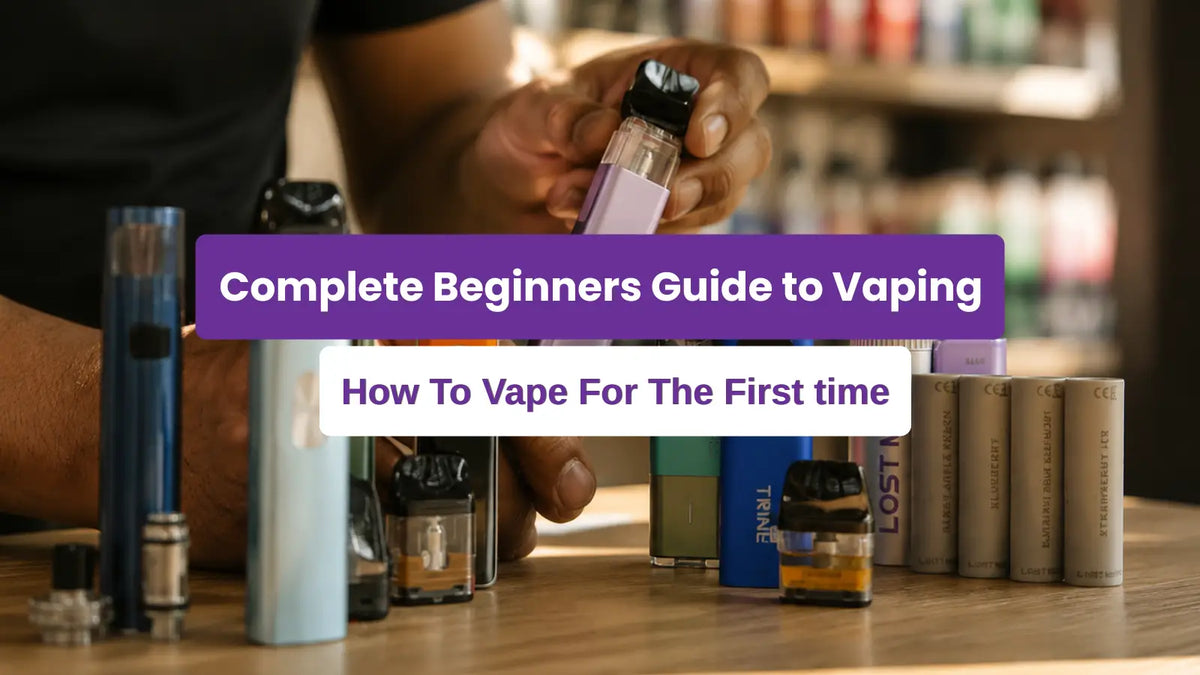
Complete Beginners' Guide to Vaping: How to Vape for the First Time
Vaping uses a battery powered device to heat e-liquid into an inhalable aerosol containing nicotine and flavourings, without combustion, tar, or tobacco smoke. This guide covers everything an adult smoker in the UK needs to know before picking up a vape for the first time, from device selection and e-liquid choices to UK legal limits, maintenance, and troubleshooting.
This page is written specifically for adult smokers considering aΒ switch from cigarettes to vaping. It reflects current UK regulations, public health guidance, and practical first-hand knowledge of how vaping devices work.
Important: Vaping is not risk-free. Under-18s and non-smokers should not vape. If you do not currently smoke, there is no reason to start vaping.
- Vaping products in the UK are regulated under the Tobacco and Related Products Regulations 2016 (TRPR)
- All nicotine-containingΒ e-liquidsΒ are limited to 20 mg/ml and sold in 10 ml bottles maximum
- The sale of vaping products to anyone under 18 is illegal
Reusable devices have replaced single-use disposables, which were banned from 1 June 2025.
Vaping Basics
Vaping delivers nicotine through heated aerosol rather than combustible tobacco smoke. A vaping device heats a liquid solution, known as e-liquid or vape juice, until it becomes a fine aerosol that the user inhales through a mouthpiece. The process involves no flame, no tobacco leaf, and no combustion byproducts such as tar or carbon monoxide.
The distinction between vaping and smoking is fundamental.Β Cigarettes burn tobacco at temperatures exceeding 800Β°C, producing over 7,000 chemicals, including at least 70 known carcinogens.
Vaping device heat e-liquid at significantly lower temperatures (typically 200 to 250Β°C), producing an aerosol that contains far fewer harmful constituents. The NHS states that vaping is substantially less harmful than smoking, but it is not harmless, and long-term effects continue to be studied.
Is Vaping Safer Than Smoking?
UK's Office for Health Improvement and Disparities (OHID), formerly Public Health England, has consistently concluded that vaping is at least 95% less harmful than smoking cigarettes. Cancer Research UK and the Royal College of Physicians support vaping as a reduced-harm alternative for adult smokers who cannot or choose not to quit nicotine entirely.
- The NHS endorses vaping as a tool to help smokers quit and includes it within local stop smoking service programmes
- Scientists estimate vaping carries approximately 0.5% of the cancer risk associated with cigarette smoking
-
Vaping is not risk-free, it still delivers nicotine, which is addictive, and aerosol exposure carries some residual risk
- Long-term population-level data is still being gathered, though existing longitudinal studies show health improvements in smokers who switch fully.
The key public health message is harm reduction, not zero risk. For a current smoker, switching fully to vaping represents a significant reduction in exposure to harmful chemicals. For a non-smoker, the calculus is entirely different, any exposure is unnecessary.
Who Should Not Vape
Vaping products exist to help adult smokers transition away from cigarettes. Several groups should not vape under any circumstances, and others should exercise caution.
- Under-18s: The sale of all vaping products to anyone under the age of 18 is illegal in the UK under TRPR. Retailers must operate age verification, most use the Challenge 25 scheme, requiring ID from anyone who appears under 25.
-
Non-smokers: If you do not currently smoke or use nicotine, do not start vaping. Nicotine is addictive, and introducing a dependency where none exists serves no health benefit.
-
Pregnant or breastfeeding individuals: Nicotine can affect foetal development. Pregnant smokers should speak to a GP or midwife about nicotine replacement options. The NHS stop smoking service can provide personalised guidance.
- Individuals with cardiovascular or respiratory conditions: Those with existing heart disease, severe asthma, or chronic obstructive pulmonary disease (COPD) should consult a clinician before using any nicotine product, including vapes.
If you currently smoke and fall into any of the caution categories above, contact your local NHS stop smoking service or GP for individual advice. These services increasingly incorporate vaping into their cessation programmes and can recommend the safest approach for your circumstances.
Important Facts About Vaping
-
Is it smoke? No. Vaping produces an aerosol (commonly called vapour) by heating liquid. There is no combustion, no smoke, and no ash.
-
Is nicotine the harmful part of smoking? No. Nicotine is addictive, but the primary harm from smoking comes from tar, carbon monoxide, and the thousands of chemicals produced by burning tobacco. Scientists describe nicotine's risk profile as broadly comparable to caffeine.
-
Can I vape indoors? No UK law banning vaping indoors, but individual premises set their own policies. Most offices, public transport, and enclosed public spaces prohibit vaping. Always check before vaping in any shared or commercial environment.
What Is Vaping?
Vaping is theΒ act of inhaling aerosol produced by an electronic device that heats a nicotine-containing liquid. The device is commonly called a vape,Β vape kit, or e-cigarette. The liquid it uses is called e-liquid or vape juice.
When shopping for vaping products in the UK, these terms appear repeatedly. Understanding each one prevents confusion at the point of purchase:
-
Vape / vape kit / vape device:Β The complete unit, battery, tank or pod, coil, and mouthpiece,Β used to produce and inhale aerosol
-
E-cigarette: An older term for the same device, still used in medical literature and regulation but largely replaced by "vape" in consumer contexts
-
Pod:Β A small, detachable cartridge that holds e-liquid and usually contains or connects to a coil. Pods are either prefilled (sealed with liquid inside) or refillable (empty, filled by the user)
-
Coil: The heating element inside the pod or tank. It consists of a metal wire or mesh wrapped around absorbent wicking material (usually organic cotton). The coil vaporises the e-liquid when heated
-
E-liquid / vape juice: The liquid solution heated by the coil. Contains propylene glycol (PG), vegetable glycerine (VG), flavourings, and usually nicotine
- Nicotine salt (nic salt): A form of nicotine processed with benzoic acid to deliver a smoother throat hit at higher strengths and faster bloodstream absorption. Distinct from freebase nicotine, which produces a sharper sensation
How Do Vapes Work?
EveryΒ vaping deviceΒ operates on the same basic principle, a battery supplies electrical power to a coil, the coil heats e-liquid absorbed into its wicking material, and the heated liquid becomes an aerosol that the user inhales through a mouthpiece. The process takes approximately one to two seconds from activation to inhalation.
The mechanical chain is straightforward, power, heat, vapour. Each stage involves a specific component, and understanding how they interact prevents common beginner errors such as burnt coils, weak draws, and flooded pods.
Power: Generated by the Battery/Mod
The battery is a lithium-ion cell that stores and delivers electrical energy to the coil. In most beginner devices, the battery is built into the device (internal battery) and recharged via a USB-C or micro-USB cable.Β Advanced devicesΒ (mods) may use removable external batteries, typically 18650 or 21700 cells.
Battery capacity is measured inΒ milliampere-hours (mAh). A higher mAh rating means the device can operate longer between charges. Most beginner kitsΒ range from 400 mAh to 1,500 mAh, providing roughly half a day to a full day of moderate use depending on vaping frequency and coil resistance.
- Use only the charging cable supplied with the device, or a certified USB cable rated for the device's input
- Do not leave devices charging unattended overnight or on flammable surfaces
- If using a mod with external batteries, always charge them in a dedicated external battery charger, never rely solely on USB pass through charging
- Inspect battery wraps (external cells only) for tears or damage before inserting, a damaged wrap can cause a short circuit.
Heat: Produced by the Coil
The coil converts electrical energy from the battery into heat. Inside every coil is a metal heating element, typically kanthal wire or mesh, wrapped around or adjacent to an absorbent wick, usually made from organic cotton. When the battery fires, the metal element heats rapidly, and the e-liquid saturating the wick evaporates into aerosol.
Coils have a limited lifespan. Depending on e-liquid type, power output, and usage frequency, aΒ coil typically lasts between one and three weeks. When the coil degrades, flavour diminishes, vapour production drops, and a burnt or muted taste develops. These are the primary indicators that the coil needs replacing.
- Every new coil must be primed before use, saturating the wick with e-liquid before firing prevents the dry cotton from burning (detailed priming instructions follow in the step-by-step section)
- Sweet or heavily sugared e-liquids caramelise on the coil faster, reducing lifespan significantly
- Running a coil above its recommended wattage range accelerates wear and produces a burnt taste
Vapour: Created from E-Liquid in the Tank/Pod
TheΒ tank or pod is the reservoir that holds e-liquid and houses the coil. As the coil heats the e-liquid, the resulting aerosol rises through the mouthpiece for inhalation. The density, temperature, and flavour of the aerosol depend on the e-liquid composition (PG/VG ratio), coil resistance, wattage, and airflow setting.
A small amount of condensation naturally collects inside the mouthpiece and airflow channel during use. This is not a leak, it is a normal byproduct of vapour cooling as it travels from the coil to the mouthpiece. Wiping the mouthpiece periodically with a dry cloth or cotton bud keeps it clear.
-
Pods and tanksΒ in the UK are limited to a 2 ml maximum e-liquid capacity under TRPR regulations
-
Overfilling beyond the maximum line causes flooding, gurgling, and e-liquid entering the mouthpiece
- Allowing the liquid level to drop below the coil's intake ports starves the wick and causes dry hits.
The Components of a Vaping Device
All vaping devices, regardless of shape or brand, share the same four core components: a battery or mod, a tank or pod (atomiser), a coil, and a mouthpiece. Understanding each part builds the confidence needed to make an informed purchase and handle basic maintenance.
Battery / Mod
The battery section powers the entire device. In beginner-friendlyΒ pod kits, the battery is sealed inside the device body with no user access, it charges via USB-C and operates with either a single fire button or automatic draw activation (no button at all, the device fires when the user inhales).
Advanced devices, referred to as mods, offer variable wattage, temperature control, and screen displays. Some mods use external removable batteries, which allow users to swap a depleted cell for a freshly charged one.
External batteries require a separate charger and safe storage, they must never be carried loose in a pocket alongside metal objects such as keys or coins, as this risks a short circuit.
-
Draw-activated devices fire automatically when the user takes a puff. No button press is needed. These are the simplest option for beginners.
-
Button-activated devices require the user to press and hold a fire button while inhaling. This offers more control over when the coil fires but adds a minor step.
Battery capacity (mAh) determines how many puffs the device delivers between charges. A 500 mAh pod kit typically lasts 300 to 400 puffs, a 1,500 mAh device may last a full day of regular use.
Tank / Pod / Atomiser
The atomiser is the component that holds e-liquid and contains the coil. The term covers two main designs: tanks and pods.
TanksΒ use a universal 510-threaded connection, meaning a tank from one manufacturer can fit on a battery/mod from another (provided both use 510 threading). Tanks are typically made from stainless steel and glass, are refillable, and allow coil replacement. They are more common on starter kits and mods.
PodsΒ use a proprietary connection specific to each device, a pod designed for one kit will not fit another. Pods are made from food-grade plastic and come in two forms:
-
Prefilled pods: Sealed with e-liquid already inside. When the liquid runs out or the coil degrades, the entire pod is discarded and replaced. No refilling, no coil changes. Simplest option.
Refillable pods: Empty pods filled by the user with their chosen e-liquid. -
Refillable pods: may have a built-in coil (the pod is replaced when the coil wears out) or a removable coil (only the coil is replaced, reducing waste and cost).
All tanks and pods sold in the UK are limited to 2 ml e-liquid capacity under TRPR.
Coil & Resistance (Ohms)
The coil is the consumable component that converts e-liquid into aerosol. Coils are rated by electrical resistance, measured in ohms (Ξ©). This rating determines how much power the coil requires, which directly affects the vaping experience.
What resistance means in practical terms:
-
Higher resistance (1.0 Ξ© and above): Requires less power. Produces a tighter draw, less vapour, and a warmer, more concentrated throat hit. Suited to MTL vaping and higher nicotine strengths (10 to 20 mg). Uses less e-liquid and less battery per puff.
- Lower resistance: Below 1.0 Ξ©, often called sub-ohm, requires more power. Produces an open, airy draw with large vapour clouds and intense flavour. Suited toΒ DTL vaping and lower nicotine strengths (0 to 6 mg). Consumes more e-liquid and drains the battery faster.
Every coil has a recommended wattage range printed on the coil body or packaging. Operating within this range ensures the coil heats correctly. Exceeding the upper limit burns the wick, dropping below the lower limit produces thin, unsatisfying vapour that may spit liquid.
For beginners, a coil between 0.8 Ξ© and 1.2 Ξ© paired with a device running at 10 to 15 watts provides a reliable MTL experience without requiring manual adjustment.
Airflow & Wattage (Beginner-Safe Overview)
Airflow and wattage are the two adjustable variables that shape the feel of each puff. Not all beginner devices offer adjustment, many pod kits have fixed airflow and fixed wattage, which simplifies the experience. Devices with adjustable settings give more control but require a basic understanding of how the two interact.
Airflow controls how much air mixes with the aerosol as the user draws. Tighter airflow restricts the air, producing a firmer draw similar to a cigarette (MTL). Open airflow allows more air in, producing a looser draw with cooler, denser vapour (DTL). Most adjustable devices use a sliding ring or dial on the pod or tank to control this.
Wattage controls how much power the battery sends to the coil, which determines how quickly and intensely the coil heats. Higher wattage produces warmer vapour and more cloud, lower wattage produces cooler, milder vapour.
- Start at the lowest recommended wattage for the installed coil and increase gradually
-
Match airflow to vaping style: tighter for MTL, more open for RDL or DTL
- If the device has no adjustable settings, the manufacturer has already optimised the airflow and wattage for the included coil, no adjustment is needed.
How to Vape for the First Time (Step-by-Step)
Most negative first experiences with vaping result from avoidable errors, an unprimed coil, the wrong nicotine strength, incorrect inhalation technique, or a device mismatch. Following a structured approach from device selection through to the first puff eliminates most of these issues.
Step 1: Choose the Right Beginner Device (MTL Recommended)
New vapers switching from cigarettes should start with a mouth-to-lung (MTL) device. MTL vaping replicates the draw resistance and inhalation style of a cigarette more closely than any other vaping style, making the transition feel natural rather than forced.
The most suitable beginner device types for MTL vaping are:
-
Refillable pod kits:Β The most versatile beginner option. The user chooses their own e-liquid, and only the coil (or pod with built-in coil) needs periodic replacement. Ongoing cost is lower than prefilled systems.
-
Prefilled pod kits:Β The simplest option. No filling, no coil changes. The user replaces the entire pod when it is empty. Less choice in flavours and typically higher cost per ml of liquid.
-
Starter kits (pen-style): Slightly larger than pod kits, with a tank and replaceable coils. Often offer adjustable airflow, allowing the user to experiment with RDL vaping later. Good value long-term.
When selecting a device, prioritise these features:
- Leak-resistant pod or tank design
- Easy coil or pod replacement (no tools required)
-
USB-C charging (faster and more widely available than micro-USB)
-
Clear e-liquid window or translucent pod so the liquid level is visible
-
Draw activation (no button) for the simplest experience, or single-button activation for slightly more control
- Local availability of replacement pods and coils, a device is only useful if consumables are easy to source
Note: Single-use disposable vapes were banned in the UK from 1 June 2025. All beginner devices must be reusable. Prefilled pod kits are the closest alternative to the disposable experience, offering the same simplicity with a rechargeable battery.
Step 2: Pick the Right Nicotine Strength
Selecting the correct nicotine strength is the single most important factor in a successful switch from smoking. Minimal nicotine leaves cravings unsatisfied, leading many new vapers to abandon the attempt and return to cigarettes. Excessive nicotine causes dizziness, nausea, or headaches.
The right strength depends on previous smoking volume and the type of e-liquid nicotine:
Nicotine salts deliver nicotine to the bloodstream faster than freebase nicotine, with a smoother throat hit at equivalent strengths.Β Heavy smokers seeking rapid craving satisfaction generally find nic salts more effective. Freebase nicotine provides a sharper throat sensation that some ex-smokers prefer because it feels closer to the harshness of cigarette smoke.
Signs your nicotine is too strong: dizziness, light-headedness, nausea, headache, or a harsh, peppery throat hit that makes you cough excessively.
Signs your nicotine is too weak: persistent cigarette cravings despite vaping regularly, constantly reaching for the device without feeling satisfied, or the urge to smoke returning within minutes of vaping.
The 20 mg/ml cap is the legal maximum for nicotine containing e-liquid sold in the UK under TRPR. No legitimate UK retailer sells e-liquid above this strength.
Step 3: Fill the Pod/Tank Correctly (Avoid Leaks)
Filling errors cause more beginner frustration than almost any other issue. Overfilling floods the coil and produces gurgling. Underfilling exposes the coil to air and causes dry hits. Filling into the wrong port, the central airflow chimney rather than the side fill port, floods the device immediately.
-
Remove the pod from the device (or detach the tank from the battery)
-
Locate the fill port, this is usually a silicone-sealed opening on the side or top of the pod. The central tube is the airflow chimney, not the fill port
-
Insert the e-liquid nozzle into the fill port and fill slowly. Stop at the maximum fill line. Do not overfill, leave a small air gap at the top
-
Close the fill port firmly to ensure the seal is complete
- Reattach the pod or tank to the device
If liquid enters the central airflow chimney, remove the pod, blow firmly through the mouthpiece onto a tissue to clear excess liquid, wipe the contacts dry, and reattach.
Step 4: Prime the Coil and Wait
Coil priming is the process of saturating the cotton wick with e-liquid before the coil is heated for the first time. Dry cotton burns instantly when electrical current passes through it, destroying the coil and producing an acrid, irreversible burnt taste. A burnt coil cannot be recovered, it must be replaced.
For pod kits with built-in coils:
-
Fill the pod with e-liquid as described above
-
Reattach the pod to the device
-
Allow the filled pod to stand for 5 to 10 minutes without vaping. This gives the cotton wick time to absorb e-liquid through the small intake ports
- After waiting, take 2 to 3 gentle puffs without activating the device (draw-activated users: cover the airflow sensor with a finger while drawing). This pulls liquid into the wick more thoroughly
For devices with removable coils:
-
Remove the new coil from its packaging
-
Locate the small cotton, exposed ports on the side of the coil and the open cotton at the top
-
Place 2 to 3 drops of e-liquid directly onto each exposed cotton port and onto the cotton visible at the top of the coil
- Install the coil into the tank or pod
-
Fill with e-liquid, reassemble, and wait 5 to 10 minutes before the first puff
Callout: Never skip priming. A burnt coil on first use is the most common reason beginners believe "vaping doesn't work." The 5 to 10 minute wait is not optional, it is the difference between a clean first puff and an immediate failure.
Step 5: Deciding Your Vaping Style
Vaping style describes the inhalation technique used to draw aerosol from the device. The style chosen affects which devices, coils, nicotine strengths, and e-liquids are suitable. Three styles exist, though only one is recommended for beginners.
Mouth-to-Lung (MTL)
MTL is the inhalation method that most closely replicates smoking. The user draws aerosol into the mouth first, holds it briefly, then inhales into the lungs, exactly as with a cigarette.
-
Paired with higher-resistance coils (0.8 Ξ© and above), higher nicotine strengths (10 to 20 mg nic salt or 6 to 18 mg freebase), and tighter airflow settings
- Produces a modest amount of visible vapour, a firm throat hit, and concentrated flavour
- The recommended starting point for all smokers switching to vaping
Do: Take slow, steady draws lasting 2 to 4 seconds. Seal your lips firmly around the mouthpiece. Allow a few seconds between puffs.
Don't: Draw hard or fast, this floods the coil. Don't leave the airflow wide open, which makes the draw too loose for MTL.
Direct-to-Lung (DTL)
DTL vaping bypasses the mouth-hold step. The user inhales aerosol directly into the lungs in one continuous breath, similar to taking a deep breath through a wide straw.
-
Paired with lower-resistance coils often 0.2 to 0.6 Ξ©, lower nicotine strengths (0 to 6 mg), and open airflow
- Produces large vapour clouds, intense flavour, and minimal throat hit
-
Not recommended for beginners, the open draw and low nicotine often fail to satisfy cigarette cravings
Restricted-Direct-Lung (RDL)
RDL is a hybrid style. The draw goes directly to the lungs (like DTL), but the airflow is partially restricted, producing a tighter pull than full DTL. It sits between MTL and DTL in terms of vapour production, throat hit, and nicotine delivery.
-
Paired with mid-range coils (0.4 to 0.8 Ξ©), moderate nicotine strengths (3 to 10 mg), and partially open airflow
- A natural progression for vapers who have been using MTL for several weeks and want more vapour without sacrificing throat hit entirely
- Many advanced pod systems support both MTL and RDL by swapping coils and adjusting airflow
The vaping style must match the device, coil, e-liquid, and nicotine strength. Using a high-nicotine nic salt in a DTL device produces an overwhelmingly harsh hit and potential nicotine sickness. Using low-nicotine freebase in an MTL pod produces weak, unsatisfying vapour. The pairings must align.
Step 6: First Puff Technique (Slow Draws, Pacing)
The first puff sets the tone for the entire vaping experience. Drawing too hard, too fast, or too frequently causes coughing, flooding, and an unpleasant throat sensation.
-
Ensure the device is charged, the coil is primed and saturated (5 to10 minutes minimum), and the pod or tank is filled
-
If the device has adjustable wattage, set it to the lowest recommended setting for the installed coil
-
If the device has adjustable airflow, close it down to the tightest or second-tightest setting for MTL
-
Seal your lips firmly around the mouthpiece, no air gaps
-
Draw slowly and steadily for 2 to 4 seconds, pulling vapour into your mouth
-
Remove the device from your mouth, then inhale the vapour into your lungs
- Exhale naturally
Pacing matters. Cigarettes enforce natural pacing, each one takes several minutes and is then discarded. A vape has no built-in stopping point. Chain vaping (continuous puffing without pause) floods the coil, reduces flavour, heats the device excessively, and, with higher nicotine, can cause dizziness or nausea.
-
Take 3 to 5 puffs, then put the device down for a few minutes
-
Drink water regularly, PG in e-liquid has a mild dehydrating effect, and dry mouth is common in the first few days of vaping
-
If your throat feels scratchy or dry, reduce the frequency of puffs and increase hydration
-
A slight cough on the first few puffs is normal and usually subsides within the first day or two as the throat adjusts
Choosing Your First Vape Kit as a Beginner
What Types of Vape Kits Are Available in the UK?
The UK market offers four main categories of reusable vape kit, each suited to different experience levels and preferences. Single, use disposable vapes are no longer legal for sale, the ban took effect on 1 June 2025 under provisions within the Tobacco and Vapes Bill.
Pod Vape Kits
Pod kitsΒ are the most popular category for beginners. They consist of two parts, a battery section and a detachable pod that holds the e-liquid and coil. Pods clip or slide into the battery unit and are replaced when the coil degrades or, in the case of prefilled pods, when the liquid runs out.
Prefilled Vape Pod Kits
Prefilled pod kitsΒ arrive with sealed pods containing e-liquid and a coil. The user charges the battery, inserts a pod, and vapes. When the pod is empty or the flavour deteriorates, the entire pod is discarded and a new one inserted.
-
Simplest possible vaping experience, no filling, no coil changes, no maintenance
-
Limited flavour and nicotine strength selection (restricted to the manufacturer's pod range)
-
Higher ongoing cost per ml of e-liquid compared to refillable systems
-
Best suited to vapers who prioritise convenience above all else, or those transitioning directly from the now, banned disposable format
Refillable Vape Pod Kits
Refillable pod kitsΒ ship with empty pods that the user fills with their chosen e-liquid. This opens up the full range of e-liquids available in the UK, hundreds of flavours across multiple nicotine types and strengths.
- Greater flavour and nicotine choice than any other beginner device
- Lower ongoing cost, e-liquid purchased separately is significantly cheaper per ml than prefilled pods
- Pods are available with built-in coils (replace the entire pod when the coil wears out) or removable coils (replace only the coil, reducing waste and cost further)
- Slightly more involvement than prefilled, filling and occasional coil changes are required
Refillable pod kits represent the best balance of simplicity, cost, and flexibility for most UK beginners. Royal Vapery UK stocks a range of refillable pod kits from established manufacturers, all TPD/TRPR compliant.
Vape Starter Kits
Starter kitsΒ are pen-style devices with a cylindrical battery and a small tank with a replaceable coil. They are slightly larger than pod kits and often include adjustable airflow, allowing the user to experiment with both MTL and RDL vaping.
-
Excellent long-term value, only the coil is a consumable, and coils are typically inexpensive
-
Adjustable airflow provides flexibility to progress from MTL to RDL without buying a new device
- Tanks use the widely compatible 510 connection, meaning the tank can be paired with a different battery/mod in the future
-
Slightly more maintenance than pod kits, periodic tank cleaning is recommended, especially when changing flavours
Vape Pens
Vape pensΒ share a similar form factor to starter kits but are often slimmer and lighter. Most feature a single button or draw activation, with limited or no adjustable settings. Some vape pens use pods rather than tanks.
-
Compact and pocket-friendly
-
Straightforward operation, few or no settings to configure
-
Lower battery capacity than starter kits or mods, requiring more frequent charging
-
Suitable for vapers who prioritise portability and simplicity
Advanced Vape Mods (Not Recommended for Beginners)
ModsΒ are larger, more powerful devices with variable wattage, temperature control, screen displays, and options for external batteries. They offer full customisation of the vaping experience, including precise wattage adjustment, coil compatibility across a wide resistance range, and compatibility with large-capacity tanks.
Mods are designed for experienced vapers who understand coil resistance, wattage interaction, battery safety, and airflow configuration. Using a mod without this knowledge risks burnt coils, dry hits, battery damage, or an unpleasant experience that discourages continued use.
- Not recommended for first-time vapers
- Best revisited after several months of successful vaping with a simpler device
- Require knowledge of Ohm's law basics, coil specifications, and battery safety practices
Disposable Vape Kits
Single use/disposable vapes are banned in the UK from 1 June 2025. The ban covers any vaping device designed to be discarded after the e-liquid is depleted or the battery dies. Devices marketed as "disposable" are no longer legal for retail sale.
The ban was introduced to address environmental waste (an estimated 5 million single-use vapes were discarded weekly in the UK), youth appeal, and non-compliance with product notification requirements.
What to use instead: Prefilled pod kits provide the closest experience to disposables, pre-loaded with e-liquid, rechargeable, and simple to use. Refillable pod kits offer greater flexibility and lower ongoing cost.
What to Look for in a Beginner Kit
The following criteria help identify a suitable first device. Apply these as a checklist when browsing online or in-store:
-
MTL draw capability, either fixed MTL airflow or an adjustable airflow ring that closes down to a tight draw
-
Leak-resistant design, top-fill pods with silicone-sealed fill ports, anti-leak coil seating
-
Simple coil/pod replacement, push-fit or press-fit, no threading, no tools
-
Clear liquid level indicator, translucent pod material or a visible window on the tank
-
USB-C charging port, faster charge times, universally available cables
-
Widely available replacement pods and coils, check that the device's consumables are stocked by multiple UK retailers (including Royal Vapery UK) before committing
-
Reasonable ongoing cost, compare the price of replacement coils or pods per unit, not just the device's upfront price
Starter Vape Kits We Recommend
Royal Vapery UK curates a selection of beginner-friendly vape kits tested for reliability, leak resistance, and ease of use. All kits stocked comply with UK TRPR regulations and include all components needed to start vaping, device, coil(s), USB-C cable, and user manual. Browse the full range in the starter kits category. Free UK delivery applies to orders over Β£49.99.
What Is E-Liquid?
E-liquid is the consumable solution that a vaping device heats to produce inhalable aerosol. Every time a user takes a puff, the coil vaporises a small amount of e-liquid from the wick, delivering nicotine and flavour in the resulting aerosol.Β
Choosing the correct e-liquidΒ is as important as choosing the correct device, the two must be compatible, or the experience fails.Β E-liquid interacts directly with the coil and wick. A liquid that is too thick for the coil's wicking ports causes dry hits because the cotton cannot absorb it fast enough.
A liquid that is too thin for a sub-ohm coil floods the chamber and leaks through the airflow. Understanding the four core ingredients, the main product formats, and the rules for matching liquid to device prevents these problems entirely.
What Are the Main Ingredients of E-Liquid?
All legitimate, TRPR-compliant e-liquids sold in the UK contain four core ingredients. Each serves a distinct function, and the ratio between them determines the character of the vaping experience.
Propylene Glycol (PG)
Propylene Glycol is a colourless, odourless liquid with a thin, water-like viscosity. PG acts as the primary carrier for flavour concentrates in e-liquid. Its low viscosity allows it to absorb quickly into the organic cotton wick inside a coil, making it well suited to small-port coils found in pod kits and starter devices.
PG produces the throat hit, the sharp, slightly peppery sensation at the back of the throat during inhalation. Smokers transitioning to vaping often seek this sensation because it replicates the harshness of cigarette smoke.
A higherΒ PG ratio (60% PG / 40% VG) delivers a more pronounced throat hit with less visible vapour.
- PG is widely used in food products, pharmaceuticals, and cosmetics, it is generally recognised as safe for ingestion, though inhaled exposure is a distinct context
- A small number of people experience sensitivity to PG, presenting as throat irritation, mild allergic reaction, or skin rash. Switching to a higher-VG e-liquid usually resolves this.
Vegetable Glycerine (VG)
Vegetable Glycerine is a thick, syrup-like liquid derived from plant oils (commonly soybean, palm, or coconut). VG is responsible for the visible vapour, the denser the cloud, the higher the VG content. VG also contributes a natural sweetness and produces a significantly smoother throat hit than PG.
BecauseΒ VG is viscous, it absorbs into coil wicking material more slowly than PG. High-VG e-liquids (70% VG or above) require coils with larger wicking ports to avoid dry hits, these coils are typically found in sub-ohm tanks and advanced devices, not in standard pod kits.
-
For pod kits and starter devices, a 50/50 VG/PG ratio is the safest default, it balances vapour production, throat hit, and wick absorption speed
- E-liquids labelled "high VG" (70/30 or 80/20) should only be used in devices explicitly designed for them, sub-ohm tanks with wide-port coils
Nicotine
Nicotine is the addictive compound that satisfies the cravings formerly met by cigarettes. In UK e-liquids, nicotine is available in two chemical forms, each with distinct delivery characteristics.
Freebase nicotine is the traditional form used in e-liquids since vaping began. It provides a sharp, noticeable throat hit that intensifies as the nicotine concentration increases. Above approximately 12 mg/ml, many users find freebase nicotine uncomfortably harsh. Freebase nicotine absorbs into the bloodstream more slowly than nicotine salt.
Nicotine salt is freebase nicotine combined with an organic acid (most commonly benzoic acid), which lowers the pH of the solution. This chemical modification achieves two effects, it smooths the throat hit dramatically (even at 20 mg/ml, the sensation remains mild), and it increases the speed of nicotine absorption into the bloodstream, delivering satisfaction faster.
This is why nic salts are the preferred format for heavy smokers transitioning to vaping, the rapid delivery more closely replicates the nicotine spike of a cigarette.
-
UK law caps nicotine strength at 20 mg/ml for all e-liquids sold in nicotine containing bottles (TRPR regulation)
-
Nicotine-free (0 mg) e-liquids exist for vapers who have tapered off nicotine entirely but still enjoy the hand-to-mouth habit and flavour
Flavourings
Flavourings are food grade concentrates that create the taste profile of an e-liquid. Under UK and EU regulations, all flavouring ingredients used in e-liquids must undergo emissions testing before the product can be legally sold. Ingredients known to be harmful when heated and inhaled, including diacetyl and acetyl propionyl, are excluded from compliant UK e-liquids.
The UK market offers an extensive range of flavour categories:
-
Tobacco: Replicates the taste of cigarette or pipe tobacco, a common starting point for transitioning smokers
-
Menthol: Cool, refreshing mint flavour, popular with former menthol cigarette smokers
-
Fruit: Covers a wide range, single fruits (strawberry, mango, blueberry) and fruit blends
-
Dessert / Bakery: Sweet profiles such as custard, vanilla, doughnut, biscuit
-
Beverage: Coffee, cola, lemonade, and similar drink-inspired blends
-
Candy / Ice: Sweet and cooling combinations, often the closest match to former disposable vape flavours
Research consistently shows that smokers who start vaping with a non-tobacco flavour are more likely to sustain the switch long-term. Experimenting across categories in the first few weeks helps identify a preferred profile.
What Are the Main Types of E-Liquids?
E-liquids are sold in several distinct formats, each governed by specific TRPR rules regarding bottle size and nicotine content. Understanding why these formats exist, not just what they contain, helps beginners make informed purchasing decisions.
Nicotine Salt E-Liquids
Nic salt e-liquidsΒ are the most popular format for new vapers using pod kits and starter devices. They are sold in 10 ml bottles (the maximum size permitted for nicotine-containing e-liquid under TRPR) and are available in strengths from 5 mg/ml to 20 mg/ml.
- Smooth throat hit even at high nicotine concentrations
- Fast nicotine absorption, cravings are satisfied quickly
- Typically blended at a 50/50 VG/PG ratio, making them compatible with virtually all pod kits and MTL coils
- Best suited to MTL and RDL vaping styles
Bar Salt E-Liquids
Bar saltsΒ are a subcategory of nicotine salt e-liquids with a higher concentration of flavour concentrate. They were developed specifically to replicate the intense, sweet flavour profiles associated with disposable vapes.Β
Vapers transitioning from the now-banned single-use devices to refillable pod kits often find bar salts the closest match to their previous experience.
-
Same 10 ml bottle size and 20 mg/ml maximum as standard nic salts
-
Stronger flavour intensity than regular nic salts
-
Higher sweetener content, this can reduce coil lifespan compared to standard nic salts, as caramelised sweetener builds up on the heating element faster
Freebase Nicotine E-Liquids
Freebase e-liquidsΒ are the original e-liquid format. They are sold in 10 ml bottles with nicotine strengths ranging from 0 mg/ml (nicotine-free) up to 18 mg/ml.The throat hit from freebase nicotine is sharper and more pronounced than nic salts at equivalent strengths.
-
Suited to vapers who prefer a stronger throat sensation
-
Available in 50/50 VG/PG and 60/40 VG/PG ratios
-
The wider strength range (including 0 mg) makes freebase the format of choice for vapers on a nicotine tapering programme
50/50 E-Liquids
The term '50/50' refers to the VG/PG ratio (50% vegetable glycerine, 50% propylene glycol) rather than a distinct product type. Both nic salt and freebase e-liquids are available in a 50/50 blend.Β
This ratio is the default recommendation for pod kits and MTL starter devices because it balances throat hit, flavour delivery, vapour production, and wick absorption at a level that suits small port coils.
-
Compatible with the widest range of beginner devices
-
Provides moderate throat hit and moderate vapour density
-
Absorbs efficiently into standard pod coils without flooding or dry hitting
Shortfill E-Liquids
Shortfill e-liquidsΒ are large format bottles (typically 50 ml or 100 ml) containingΒ nicotine-free e-liquid. The bottle is not filled to capacity, the remaining space allows the user to add one or more nicotine shots to achieve their desired strength.
The shortfill format exists because of TRPR, UK regulation prohibits selling nicotine containing e-liquid in bottles larger than 10 ml. Shortfills legally bypass this by selling the flavoured base without nicotine, while nicotine shots (sold separately in 10 ml bottles) are added by the consumer.
50 ml Shortfill E-Liquids
AΒ 50 ml shortfillΒ is packaged in a 60 ml bottle. Adding one 10 ml nicotine shot at 18 mg/ml produces 60 ml of e-liquid at approximately 3 mg/ml, suitable for DTL and RDL vaping.
100 ml Shortfill E-Liquids
A 100 ml shortfill is packaged in a 120 ml bottle. Adding two 10 ml nicotine shots at 18 mg/ml produces 120 ml at approximately 3 mg/ml. Adding a single shot produces 110 ml at approximately 1.6 mg/ml.
- Shortfills offer the lowest cost per ml of any e-liquid format
- Traditionally blended at high VG (70/30 or 80/20), making them suited to sub-ohm devices with large wicking ports
- However, 50/50 shortfills are now available, making the format accessible for pod kits and starter devices
- Shortfills require the user to mix, add the nic shot, close the bottle, and shake thoroughly for 30 to 60 seconds until fully blended
Nicotine Shots
Nicotine shotsΒ (nic shots) are small 10 ml bottles of concentrated nicotine liquid designed to be added to shortfill e-liquids. They are available in freebase and nicotine salt formulations, and in various strengths (most commonly 18 mg/ml or 20 mg/ml).
- Not intended for direct use in a device, the nicotine concentration is designed for dilution into a shortfill
- The type of nic shot (freebase vs salt) affects the throat hit and absorption profile of the final mixed liquid
- Always add the nic shot to the shortfill bottle, not the other way around, and shake thoroughly
Royal Vapery UK carries a full range of nic salt e-liquids, freebase e-liquids, bar salts, shortfills, and nicotine shots, all TRPR-compliant and available with free UK delivery on orders over Β£49.99.
How to Choose the Right E-Liquid (Device Match + Nicotine Match)
Mismatching e-liquid and device is the most common reason new vapers have a poor experience and abandon the switch. The wrong VG ratio in the wrong device causes mechanical failure (dry hits, leaking, flooding).Β The wrong nicotine strength causes physical discomfort (nausea, cravings, headaches). Both problems are entirely avoidable by following a simple set of rules.
-
Match VG/PG ratio to the device. Pod kits and MTL starter devices work best with 50/50 e-liquid. Sub-ohm and DTL devices handle 70/30 or higher VG. Do not put high-VG shortfill liquid into a small pod coil, the thick liquid will not wick fast enough and will produce dry hits.
-
Match nicotine strength to smoking habit:Β Use the table in Step 2 above. Start slightly higher than you think you need, it is easier to step down later than to fight cravings and relapse to cigarettes.
-
Choose nic salts for pod kits and MTL devices:Β use freebase for sharper throat hit or gradual tapering. Nic salts at 10 to 20 mg in a pod kit is the most effective combination for heavy smokers. Freebase at 6 to12 mg suits moderate smokers who want a more noticeable throat sensation.
-
Start with small bottles:Β Buy 10 ml bottles initially. Flavour preference is subjective, and a 100 ml shortfill in a flavour you dislike is expensive waste.
-
Start with simple, familiar flavour profiles:Β Tobacco or menthol flavours provide continuity for transitioning smokers. Fruit and dessert flavours can be explored once the device and nicotine level feel right.
-
Do not chain vape high-nicotine e-liquid:Β At 20 mg nic salt, every puff delivers a meaningful dose. Taking 15 to 20 rapid puffs in succession causes nicotine overconsumption, dizziness, nausea, and headache. Pace your vaping as you would pace cigarette breaks.
-
Check coil compatibility before buying:Β Some e-liquids are marketed for specific device types. If the label says "sub-ohm" or "high VG," it is not intended for a standard pod kit.
Beginner scenarios:
-
Light smoker (1 to 5 cigarettes/day): Refillable pod kit + 50/50 nic salt at 5 to10 mg/ml + tobacco or menthol flavour
-
Moderate smoker (10 to 20 cigarettes/day): Refillable pod kit + 50/50 nic salt at 10 to 5 mg/ml + flavour of choice
-
Heavy smoker (20+ cigarettes/day): Refillable pod kit + 50/50 nic salt at 18 to 20 mg/ml + tobacco, menthol, or strong fruit flavour for initial switc.
Common E-Liquid Mistakes to Avoid
-
High-VG E-Liquids (70/30 or above):Β the thick liquid cannot wick through narrow coil ports, causing dry hits and burnt cotton
-
Low Nicotine Strength:Β the most common reason new vapers return to cigarettes within the first week
-
Unprimed Coils: dry cotton burns on the first fire, destroying the coil and producing an acrid taste
-
Sweet E-Liquid Overuse: high-sweetener liquids (including most bar salts and dessert flavours) caramelise on the coil, reducing lifespan from weeks to days
-
Pod or Tank Overfilling:Β liquid floods through the coil into the airflow channel, causing gurgling, spitting, and leaking from the base of the device
-
Incorrect Filling: immediately floods the coil and pushes liquid into the mouthpiece
-
Wrong Nic Shot Mixes with shortfills:Β adding a salt nic shot to a high-VG shortfill designed for sub-ohm use changes the throat hit profile unpredictably
-
Poor E-Liquid Storage:Β nicotine degrades and flavour deteriorates. Store bottles upright, in a cool, dark place, with child-resistant caps securely fastened
-
Dry Pod Vaping: the exposed wick dries out and burns, even if liquid is added afterwards. Refill when the level drops to the lower quarter
-
Incorrect Wattage Use:Β exceeding the upper limit scorches the wick, running below the lower limit produces weak, spitty vapour
Vape Maintenance and Troubleshooting
A well maintained vaping device delivers consistent flavour, reliable vapour production, and longer component lifespan. Neglected devices develop problems, most of which are preventable with basic routine care.
Basic Maintenance (Cleaning, Storage, Battery Safety)
Cleaning cadence:
Routine cleaning prevents residue build-up, maintains connection integrity, and ensures the device performs consistently.
-
Mouthpiece: Wipe the inside of the mouthpiece with a dry cotton bud every 2 to 3 days. E liquid residue and condensation accumulate here, and pocket lint collects in the opening.
-
Pod/tank contacts: When removing a pod or tank for refilling, wipe the electrical contacts on both the pod and the battery section with a dry cloth. E-liquid residue on contacts weakens the electrical connection and can prevent the device from firing.
-
Tank cleaning (starter kits and pen-style devices): When changing coils or switching to a significantly different flavour, disassemble the tank, rinse all components (except the coil) under warm water, and allow them to air dry completely before reassembling. Residue from the previous e-liquid can taint the new flavour and clog the connections.
-
Battery/mod exterior: Wipe the exterior of the device with a dry or slightly damp cloth. Never submerge any part of the battery section in water or apply cleaning liquids to electronic components.
Storage:
-
Store the device upright when not in use, laying it on its side can cause slow leaking through the airflow
-
Keep the device away from extreme heat (above 35Β°C), direct sunlight, and freezing temperatures
-
Remove the pod or tank if storing the device for more than a few days to prevent long-term seal compression and slow-leak issues
- Store e-liquid bottles upright with caps tightly fastened, in a cool and dark location, out of reach of children and pets, nicotine is toxic if ingested
Battery safety:
-
Charge using the cable provided or a certified USB cable rated for the device
-
Do not charge on flammable surfaces (fabric, paper, bedding)
-
Disconnect the device once fully charged, most modern devices have overcharge protection, but prolonged trickle charging can degrade lithium-ion cells over time
-
If using a mod with external batteries, inspect battery wraps for tears before every use, store spare batteries in a protective case (never loose in a pocket or bag), and charge externally with a dedicated battery charger
-
Dispose of old batteries and devices at designated WEEE collection points. UK retailers selling vaping products are required to provide or direct you to battery recycling facilities
Changing Coils and How Long Coils Last
CoilsΒ are consumable components with a finite lifespan. The organic cotton wick degrades over time as it is repeatedly heated, and residue from e-liquid flavourings accumulates on the metal heating element. Eventually, the coil can no longer produce clean flavour or adequate vapour.
Average coil lifespan: 1 to 3 weeks, depending on three factors:
-
E-liquid type: Sweet, heavily flavoured liquids (especially dessert, candy, and bar salt profiles) contain more sucralose and sweetener, which caramelises on the coil and reduces lifespan. Tobacco, menthol, and simple fruit flavours are gentler on coils.
-
Vaping frequency: Heavy vapers (frequent, long sessions) wear coils faster than moderate or light users.
-
Wattage: Running a coil at the upper end of its recommended range accelerates wear. Running within the lower-to-mid range extends it.
Signs the coil needs replacing:
-
Flavour becomes muted, dull, or noticeably different from when the coil was new
-
Burnt or slightly charred taste, even with a full tank
-
Visible darkening of the e-liquid in the pod (the liquid turns darker as it circulates through a degraded coil)
-
Reduced vapour production despite a full battery and full tank
-
Gurgling or spitting that persists after checking fill level and seals
How to replace a coil:
-
Remove the pod or detach the tank from the battery
-
Discard any remaining e-liquid (or save it if it is still clean)
-
Remove the old coil, in pod systems, the coil usually pulls straight out, in tanks, it unscrews from the base
-
Insert the new coil, press-fit or screw into place until seated firmly
-
Prime the new coil (drops on exposed cotton + fill pod/tank + wait 5 to 10 minutes)
-
Refill with e-liquid, reassemble, and wait before vaping
Common Vape Problems
Most vaping issues have simple mechanical causes. The following troubleshooting matrix covers the problems beginners encounter most frequently.
Leaks
Leaking occurs when e-liquid escapes from the tank or pod through the airflow holes, seals, or mouthpiece.
Burnt Taste
A burnt taste indicates the wick is being heated without adequate e-liquid saturation.
Weak Flavour / No Vapour
Reduced flavour or vapour output without a burnt taste suggests a power delivery or saturation issue rather than a coil failure.
Gurgling / Spitback
Gurgling sounds and liquid spitting into the mouthpiece indicate excess e-liquid in the coil chamber or airflow channel.
Vaping Benefits vs Smoking (Practical, Measurable Comparisons)
This section addresses practical, measurable differences between smoking and vaping. It does not claim that vaping is safe, it compares the two on observable criteria relevant to daily life.
Smell, Staining, and Indoor Residue
Cigarette smoke leaves: persistent odour on clothing, hair, upholstery, and interior surfaces. The tar and particulate matter in tobacco smoke cause yellowing of walls, ceilings, teeth, and fingertips over time. These effects are cumulative and difficult to reverse.
Vaping aerosol: dissipates significantly faster than cigarette smoke and does not contain tar or particulate matter at comparable levels. Vapour may leave a faint, temporary scent (typically matching the e-liquid flavour) that dissipates within minutes. It does not cause yellowing, staining, or persistent odour on fabrics or surfaces.
- Teeth and finger staining associated with smoking cease and gradually reverse after switching to vaping
- The absence of carbon monoxide exposure means improved oxygen transport, many switchers report improved skin tone and reduced breathlessness within weeks
- Partners, children, and housemates are no longer exposed to secondhand tobacco smoke, studies have found no measurable passive health risk from secondhand vaping aerosol in domestic settings
Cost Considerations
Vaping is substantially cheaper than smoking on an ongoing basis, though the initial device purchase represents a small upfront cost that cigarettes do not require.
A pack-a-day smoker switching to a refillable pod kit can expect toΒ save approximately Β£3,000 to Β£4,500 per year. The device itself typically costs Β£15 to Β£35 and pays for itself within the first week of not buying cigarettes.
These estimates assume TRPR-compliant products purchased from legitimate UK retailers.Β
Royal Vapery UK's range of e-liquids and replacement coils is priced to reflect these cost brackets, with free delivery on orders over Β£49.99 reducing the total ongoing expense further.
Switching Journey: Cravings, Nicotine Tapering, Consistency
Switching from smoking to vaping is not instantaneous satisfaction for every person. The first few days involve adjustment, learning the draw technique, calibrating nicotine strength, and adapting to a different throat sensation. Most smokers who persist beyond the first week report significantly reduced cigarette cravings and improved confidence in maintaining the switch.
Key principles for a successful switch:
-
Switch fully rather than dual-using. Public health guidance encourages complete cessation of cigarettes, not supplementing smoking with vaping.Β Dual use (smoking and vaping simultaneously) reduces the health benefit and maintains cigarette dependency.
- Do not reduce nicotine strength prematurely. The priority in weeks 1 to 4 is eliminating cigarettes entirely. Nicotine reduction can begin once smoking has stopped completely and the vaping routine is stable, typically after 1to 3 months.
-
Taper nicotine gradually. Step down by one increment at a time (20 mg, 15 mg, 10 mg and 5 mg), spending at least 2 to 4 weeks at each level before reducing further. If cravings return at a lower strength, step back up temporarily.
-
Expect mild adjustment symptoms. Some transitioning smokers experience a slight cough, dry mouth, or throat irritation in the first few days. These typically resolve within a week as the body adjusts to inhaling aerosol rather than combustible smoke.
- Consistency matters. Keep the device charged, carry spare e-liquid, and have replacement coils on hand. Running out of supplies leads to cigarette relapse, preparation prevents it.
Vaping in the UK: Laws, Limits and Product Rules
The UK regulates vaping products under the Tobacco and Related Products Regulations 2016 (TRPR), which implements the relevant provisions of the EU Tobacco Products Directive (TPD) into domestic law. Understanding these rules protects consumers from non-compliant products and ensures every purchase meets minimum safety, quality, and labelling standards.
Legal Age and Where You Can Buy
The sale of all vaping products, devices, e-liquids, coils, pods, and accessories, to anyone under the age of 18 is illegal in the UK. This applies equally to online retailers and physical shops. Most UK retailers operate the Challenge 25 age verification scheme, requiring photographic ID from anyone who appears under 25 years of age.
Online retailers are required to implement age verification at the point of sale.
Royal Vapery UK verifies the age of all customers before dispatching orders, in compliance with UK law.
There is no UK-wide law prohibiting adults from vaping in public outdoor spaces. However, individual premises, employers, and transport operators set their own policies. Most enclosed public spaces, offices, public transport services, and hospitality venues prohibit vaping indoors. Always check the policy of the specific location.
TRPR Product Limits Beginners Should Know
TRPR sets specific product limits that directly affect what consumers can buy in the UK. These limits exist to standardise safety and restrict theΒ potential for nicotine overconsumption.
20 mg/ml Nicotine Capacity
The maximum nicotine strength permitted in any e-liquid sold in the UK is 20 mg/ml (equivalent to 2%). This applies to all nicotine-containing e-liquids regardless of format, nic salts, freebase, and nicotine shots.
Any e-liquid advertised at a strength above 20 mg/ml is either non-compliant (and therefore illegal to sell in the UK) or mislabelled.
2 ml Tank/Pod Cap for Refillables
All refillable tanks and pods sold in the UK must have a maximum e-liquid capacity of 2 ml. This applies to pods, tanks, and any other refillable atomiser component.
This limit is why UK vape pods are smaller than those sold in some other markets. It also means that heavy vapers may need to refill more frequently throughout the day.
10 ml Max Nicotine Refill Bottle
E-liquid containing nicotine cannot legally be sold in bottles larger than 10 ml in the UK. This is the regulation that created the shortfill market, manufacturers sell nicotine-free e-liquid in larger bottles (50 ml, 100 ml) and consumers add their own nicotine via separate 10 ml nic shots.
Single-Use Vapes Ban (What Changed and What to Use Instead)
Single-use (disposable) vaping devices were banned from sale in the UK on 1 June 2025. The ban covers any device designed to be used once and discarded, typically devices with a non-rechargeable battery, a sealed e-liquid reservoir, and no means of refilling or replacing the coil.
The ban was driven by environmental concerns (millions of non-recyclable devices entering landfill weekly), youth appeal (disposables were disproportionately popular among under-18s), and product compliance issues (many disposable brands failed to meet TRPR notification and testing requirements).
What to use instead:
-
Prefilled pod kits provide the closest experience to disposables, flavoured pods, rechargeable battery, no filling or coil changes
-
Refillable pod kits offer greater choice and lower cost per ml, with marginally more user involvement
Both formats are legal, TRPR-compliant, and available from UK retailers including Royal Vapery UK
MHRA Notification Basics (Why "UK Compliant" Matters)
Before any vaping product can be legally sold in the UK, the manufacturer must submit a product notification to the Medicines and Healthcare products Regulatory Agency (MHRA). This notification includes detailed information about ingredients, emissions, nicotine content, toxicological data, and manufacturing processes.
Products that carryΒ "TRPR compliant" or "MHRA notified" labelling have passed through this regulatory process. Non-notified products, often sold through unregulated online channels or non-specialist retailers, have not been tested, verified, or approved for sale in the UK.
As a consumer, buying from established UK vape retailers who stock only MHRA-notified products is the most effective way to ensure product safety and regulatory compliance.
History of Vaping
The concept of a smokeless nicotine delivery device predates the modern vape by several decades. The timeline below traces the key milestones.
Quick Timeline (1963 to 2003 and Today)
-
1963: Herbert A. Gilbert filed the first patent for a battery, powered device that heated flavoured liquid to produce a smokeless aerosol. The device contained no nicotine, and the patent expired before reaching commercial production.
-
1979: Dr Norman Jacobson coined the term "vaping" when describing a non-combustion nicotine delivery concept. Despite the name, his device did not produce visible vapour.
-
2000s: Tobacco companies developed and marketed nicotine replacement therapies (NRTs) including gums, patches, and lozenges, deliberately avoiding cigarette-like form factors.
-
2003: Hon Lik, a Chinese pharmacist, invented the first commercially viable e-cigarette, the "cig-a-like." Motivated by his father's smoking-related illness, Lik designed a device that combined nicotine delivery with the hand-to-mouth action smokers rely on.
- Present: The UK market offers hundreds of device types across pods, pens, starter kits, and mods, supported by thousands of e-liquid options. UK public health policy formally endorses vaping as a cessation tool, and regulation under TRPR ensures product safety standards.
Beginner Vaping FAQs
How Do You Vape for the First Time as a Beginner?
Charge the device fully. Insert and fill the pod (if refillable) or attach a prefilled pod. Prime the coil by waiting 5 to 10 minutes after filling. Set the device to the lowest power setting if adjustable. Take a slow, steady MTL draw lasting 2 to 4 seconds, into the mouth first, then into the lungs. Exhale naturally. Pause between puffs. Stay hydrated.
What Vape Should a Beginner Start With?
Most beginners do best with a reusable pod kit designed for MTL vaping. Pod kits are simple, compact, low maintenance, and replicate the draw resistance of a cigarette. Prioritise leak-resistant pods, easy coil or pod replacement, affordable consumables, and USB-C charging. Avoid advanced mods until several months of successful vaping experience.
How Do I Use a Vape for the First Time (Step-by-Step)?
-
Charge the device fully using the supplied USB-C cable
-
Fit the pod or tank and fill with e-liquid (do not overfill past the maximum line)
-
If the coil is new, prime it, wait 5 to 10 minutes for the wick to saturate
-
Set the device to the lowest power setting if adjustable
-
Seal your lips around the mouthpiece and use MTL inhale: draw into mouth first, then inhale to lungs
-
Exhale gently and pause before the next puff
What Should Beginners Know Before Trying Their First Vape?
Most poor first experiences stem from rushing: unprimed coils, hard draws, and incorrect nicotine strength. Choose a simple MTL device, match the e-liquid to the device (50/50 VG/PG is standard for pods), and select a nicotine strength based on previous smoking volume. Stay hydrated, PG has a mild drying effect. Pace puffs with breaks.
Do You Inhale with Your Mouth or Nose When Vaping?
Inhale through the mouth. Most users exhale through the mouth as well. Exhaling through the nose can enhance flavour perception (retronasal taste), but higher nicotine or strong menthol flavours may sting nasal passages. Do not inhale directly through the nose,Β draw through the mouth using slow, steady puffs.
Why Do I Struggle to Inhale a Vape?
Common causes include drawing too hard and fast (pull slower, 2 to 4 seconds), nicotine strength too high (reduce by one increment), airflow set too tight (open slightly if adjustable), wattage too high (reduce to the coil's lower range), or a device style mismatch (a DTL kit when MTL is needed). Adjust one variable at a time.
What Is the Best Beginner's Vaping System?
A reusable pod system is the most beginner-friendly category. Pod kits are compact, consistent, and designed to run on 50/50 e-liquid or prefilled pods. They require minimal maintenance and produce a satisfying MTL draw. Avoid advanced mods initially, the complexity of wattage, coil matching, and build decks causes dry hits and frustration for inexperienced users.
What Features Should Beginners Look For in Their First Vape?
Key features for a beginner-friendly device,Β MTL draw or adjustable airflow that closes to a tight setting, leak-resistant pod design, simple coil or pod replacement without tools, clear liquid window to monitor level, USB-C charging, and good UK availability of replacement pods and coils from multiple retailers.
How Do I Use a Vape Pen with No Button?
A buttonless vape pen is draw-activated, the device fires automatically when the user inhales through the mouthpiece. Insert the pod, confirm it contains e-liquid, and take a slow, steady draw. If the draw feels weak, check the battery charge level and ensure the airflow holes are not blocked. If it tastes burnt, the coil or pod is dry and needs replacing.
How Do I Avoid Dry Hits When Vaping?
Dry hits occur when the coil heats faster than the wick can absorb liquid. Prevention, always prime new coils and wait 5 to 10 minutes after filling before vaping. Keep the liquid level above the minimum line. Take gentler puffs with pauses between draws. Use the correct VG/PG ratio for the device, pods prefer 50/50. Avoid chain vaping at high wattage.
What Are Common Vaping Mistakes (and What Not to Do)?
The most frequent beginner errors, skipping coil priming (causes immediate burnt taste), chain vaping high-nicotine e-liquid (causes dizziness and nausea), overfilling pods (causes leaking and gurgling), using e-liquid that is too thick for the device (causes dry hits), running the pod nearly empty (damages the wick), and setting power too high for the installed coil.
First Time Vaping as a Non-Smoker Should You Do It?
If you do not currently smoke, do not start vaping. Vaping products are designed as a harm reduction tool for adult smokers switching from cigarettes. Nicotine is addictive, and introducing a dependency where none exists provides no benefit. Curiosity alone does not justify the risk of developing a nicotine habit.
What Is the "Vape Trick" for Beginners?
Most beginners asking about a "vape trick" benefit from mastering the slow-sip technique, long, gentle draws lasting 2 to 4 seconds, MTL inhale, then a relaxed exhale. This technique minimises coughing, prevents coil flooding, and produces the most consistent flavour. Cloud tricks and vapour manipulation are advanced skills, focus on smooth, satisfying draws first.
What Is the "Nose Trick" for Vaping?
The nose trick refers to exhaling gently through the nose after an MTL mouth draw, which engages retronasal olfaction and intensifies flavour perception. Keep the exhale gentle, high-nicotine or strong menthol liquids can irritate nasal passages. This is a flavour-enhancement technique, not an inhalation method. Always inhale through the mouth.
Is Vaping Legal in the UK?
Vaping is legal for adults aged 18 and over in the UK. All vaping products must comply with the Tobacco and Related Products Regulations 2016 (TRPR), which governs nicotine limits, tank capacity, bottle sizes, labelling, and product notification via the MHRA. There is no national law banning vaping in public outdoor spaces, but individual premises set their own policies.
What Are the UK Limits (Nic/Tank/Bottle)?
UK law limits nicotine strength to 20 mg/ml maximum, tank and pod capacity to 2 ml maximum, and nicotine-containing e-liquid bottles to 10 ml maximum. These limits are set by TRPR and apply to all products sold in the UK. Shortfill e-liquids (nicotine-free) are exempt from the bottle size restriction and sold in 50 ml or 100 ml formats.
Are Disposable Vapes Legal in the UK?
Single-use disposable vapes were banned from sale in the UK on 1 June 2025. The ban covers non-rechargeable, non-refillable devices designed for one-time use. Reusable alternatives include prefilled pod kits (closest experience to disposables) and refillable pod kits (greater choice, lower ongoing cost). All legal alternatives are rechargeable and TRPR-compliant.