


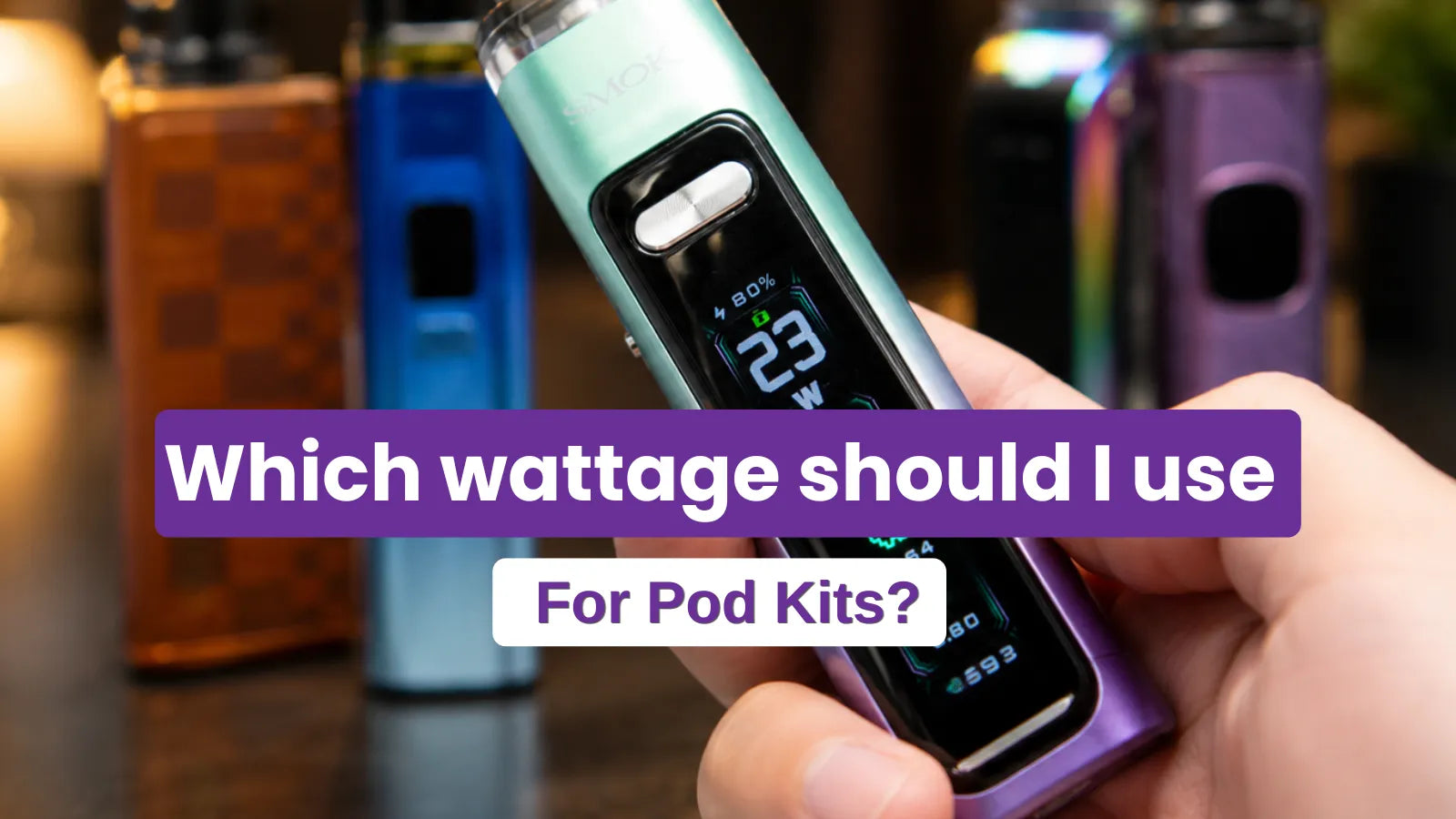
Pod kit wattage is the electrical power, measured in watts (W), that the battery sends to the coil to turn e-liquid into vapour. Pod kits run lower than sub-ohm devices, between 8W and 25W, because they pair higher-resistance coils with thinner 50/50 e-liquids.
The correct setting rests on three factors: coil resistance, e-liquid type, and your own taste. This guide sets out the wattage ranges for common pod coils, explains why nic salts need less power, shows what fails at each extreme, and walks you through finding your ideal number in minutes.
What Is Wattage in a Pod Kit?
Wattage in a pod kit is the power the battery delivers to the coil, controlling how hot it runs. Higher wattage heats the coil faster, producing warmer vapour, denser clouds, and stronger flavour. Lower wattage cools the draw, lightens the vapour, and stretches battery life across the day. Most pod kits ship pre-tuned to a sensible figure, so adjustment matters far more on variable models than on simple closed devices.
What Wattage Should I Use for Pod Kits?
Pod kits work best between 8W and 25W. Most pod kits paired with nic salt e-liquid sit at 12W to 18W, while 50/50 freebase suits 14W to 22W. Start at the low end of your coil's printed range and climb in small steps until the warmth and flavour feel right.
Coil resistance sets the window, so the table below maps each common pod coil to its working range, draw style, and best-matched e-liquid.
| Coil Resistance | Wattage Range | Draw Style | Best E-Liquid |
|---|---|---|---|
| 1.2Ω | 8W to 14W | Tight MTL | Nic salts 10mg to 20mg |
| 1.0Ω | 10W to 16W | MTL | Nic salts or 50/50 |
| 0.8Ω | 12W to 20W | MTL / loose MTL | Nic salts or 50/50 |
| 0.6Ω | 15W to 25W | RDL | 50/50 or 60/40 |
Resistances below 0.6Ω cross into sub-ohm territory, where power climbs past 30W and pod kits give way to dedicated cloud devices. The ranges above cover the coils you find inside everyday refillable and prefilled pods.
How Does Coil Resistance Set Your Pod Kit Wattage?
Coil resistance, measured in ohms (Ω), decides how much power the coil needs to heat correctly. Lower-resistance coils let more current through, so they demand higher wattage; higher-resistance coils need less.
Common pod coils, including 0.6Ω, 0.8Ω, and 1.2Ω versions, each carry their own printed range on the side or the packaging. Read that figure first if you want to learn what coil resistance means for your specific device. The printed number stays the most reliable starting point, with the chart above as a backup when the box is long gone.
How Does Your E-Liquid Change the Right Wattage?
E-liquid thickness changes how fast liquid reaches the coil, which shifts the wattage you need. Thinner 50/50 blends wick quickly and run well at lower power, so 50/50 e-liquids suit the 12W to 20W band on a pod coil.
High-VG shortfills sit thicker on the wick and need far more heat, which is why they belong in sub-ohm kits rather than pods. Nicotine salt formulas behave like 50/50 here, staying smooth at low wattage. Match the liquid to the coil, not the other way round, and most flooding and burning problems disappear.
What Wattage Should I Use for Nic Salts in a Pod Kit?
Nic salt e-liquid in a pod kit runs best below 20W, usually 10W to 18W on a 0.8Ω to 1.2Ω MTL coil. Nicotine salts deliver a smooth draw at low power, which is the reason pod kits and nic salt e-liquids pair so naturally. Push a 20mg salt to 30W or higher and the inhale turns sharp and uncomfortable.
UK nic salts cap at 20mg/ml under TRPR rules, sold in 2ml pods and 10ml bottles, so the low-wattage match keeps that strength pleasant rather than harsh. Choosing the best coil for nic salts gives you the right resistance before you touch the wattage dial at all.
Does Your Pod Kit Have Adjustable Wattage?
Pod kits fall into two groups: fixed or auto-wattage devices that set themselves, and variable-wattage devices you control. Auto-wattage pods detect the coil and choose a safe figure, which is common on beginner-friendly prefilled pod kits and many closed systems.
Variable-wattage models, often found among refillable pod kits, let you raise or lower power in small steps to fine-tune the draw. Check your screen or button layout to confirm which type you own before you try to adjust anything.
What Happens If You Use the Wrong Wattage?
The wrong wattage damages flavour, components, and battery life in opposite ways at each extreme.
Wattage Set Too High
Excess power dries the cotton faster than liquid can soak in, which produces burnt, harsh hits that linger after the pod is changed. Coils wear out sooner at high wattage, sending you back to replacement pods more often than necessary. Battery charge drains quicker too, shortening the time between charges.
Wattage Set Too Low
Too little power leaves e-liquid only half-vaporised, so it pools and floods the coil. Flooded coils gurgle, spit, and leak through the airflow. Flavour turns flat and the vapour thins out, because the coil never reaches its working temperature.
How Do You Find the Best Wattage for Your Pod Kit?
To find the best wattage for your pod kit, follow these five steps:
- Check the wattage range printed on the coil or pod packaging.
- Prime the coil by filling the pod and resting it for 5 to 10 minutes.
- Start at the lowest watt in the printed range.
- Increase the power in 1 to 2W steps across the next 15 draws.
- Stop once the flavour and warmth sit where you want them.
Priming matters most on a fresh coil, so learn how to prime a coil before that first low-wattage puff. This slow climb protects the cotton and lands you on a setting that suits your liquid and your draw.
Common Pod Kit Wattage Mistakes
New pod kit users repeat the same five errors when dialling in power:
- Firing a fresh coil hot: burns the dry cotton within minutes, before the liquid has soaked in.
- Running nic salts at high power: turns a 20mg salt sharp and uncomfortable on the throat.
- Forgetting to adjust between liquids: leaves a thin fruit salt and a thick dessert blend on the same wrong setting.
- Ignoring the printed range: shortens coil life above it and mutes flavour below it.
- Loading high-VG shortfill into a pod coil: chokes the wick, which belongs in sub-ohm kits instead.
FAQs About Pod Kit Wattage
Most pod kits default to 10W to 18W out of the box, matched to the nic salt e-liquid they are designed for. Auto-wattage models read the coil and pick a figure inside its safe range. Fixed-power closed pods hold a single setting around the lower end, which keeps the draw smooth for new vapers.
No, you cannot change the wattage on every pod kit. Closed and auto-wattage pods lock their power to a preset figure with no dial or buttons. Variable-wattage pod kits, common among refillable open systems, give you a screen and controls to raise or lower the setting in small increments.
A 0.8 ohm pod coil works best at 12W to 20W, with most vapers settling around 14W to 16W. Start at 12W with nic salt or 50/50 e-liquid, take a few gentle draws, then climb in 2W steps. Stop the moment the warmth and flavour feel balanced for your draw.
No, a higher wattage is not better for pod kits. Pod coils carry high resistance and small wicks, which handle only modest power before the cotton scorches. Higher wattage suits sub-ohm cloud devices, not MTL pods. Staying inside the coil's printed range protects flavour, coil life, and a comfortable draw.
Disposable vapes ran at roughly 7W to 12W on a 1.0Ω to 1.4Ω coil, with no adjustment, which is part of why they felt so consistent. Single-use disposables are banned across the UK from 1 June 2025. To match that feel, set a refillable pod kit to a 1.0Ω or 0.8Ω coil at 10W to 16W with 10mg or 20mg nic salt.
A new pod kit tastes burnt when the coil fires before the cotton has soaked, or when the wattage sits above the coil's range. Rest a freshly filled pod for 5 to 10 minutes, start at the lowest watt, and build up slowly. Burnt flavour that survives a fresh pod points to a setting still too high for the coil.


