


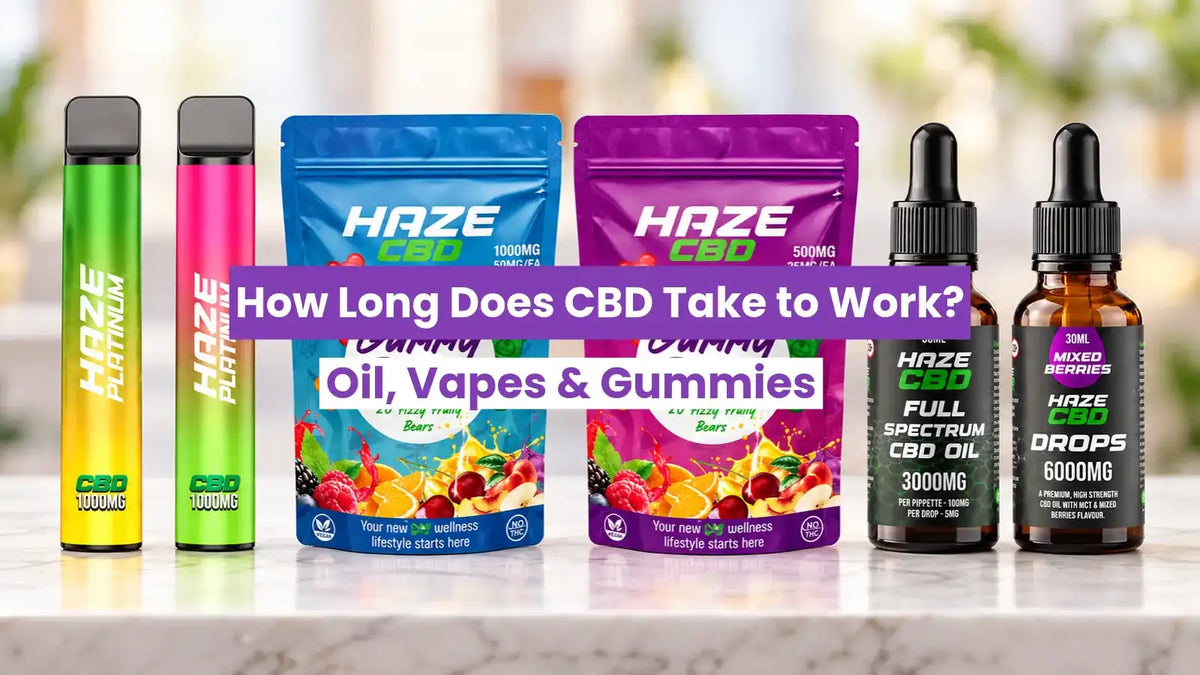
CBD can enter the bloodstream within minutes when inhaled, while CBD oil and gummies generally take longer to absorb. Inhaled CBD has the fastest absorption, sublingual CBD oil may begin absorbing within minutes, and swallowed CBD products often take 30 minutes to 2 hours or longer before any noticeable effects.
Cannabidiol (CBD) is a naturally occurring compound found in cannabis plants. Unlike THC, CBD does not typically cause intoxication. However, CBD absorption does not guarantee that a person feels relaxed, sleepy or experiences relief from a medical symptom.
The time CBD takes to work depends on its delivery method, formulation, food intake and individual metabolism. CBD concentration, peak blood levels and the duration of noticeable effects are separate measurements.
Royal Vapery offers CBD oils, gummies and e-liquids through its Haze CBD collection. Understanding how each format behaves helps adults compare products without confusing faster absorption with stronger or medically proven effects.
How Long Does CBD Take to Work by Product Type?
CBD absorption is generally fastest through inhalation, followed by products used under the tongue and products swallowed for digestion. The timing of noticeable effects is less predictable because research frequently measures CBD concentration in blood rather than when someone begins feeling an effect.
The following table compares common onset estimates, absorption routes and typical timing differences.
| CBD Product Type | Approximate Onset of Noticeable Effects | Absorption Method |
|---|---|---|
| CBD Vape | Within minutes, if noticeable | Lungs |
| CBD Oil Under the Tongue | Around 15 to 45 minutes, sometimes longer | Oral membranes and digestive system |
| Swallowed CBD Oil | Around 30 minutes 2 hours or longer | Digestive system |
| CBD Gummies | Around 30 minutes 2 hours or longer | Digestive system |
| CBD Drinks | Around 30 minutes 2 hours or longer | Digestive system; formulation-dependent |
How Long Does CBD Oil Take to Work?
CBD oil held under the tongue may produce noticeable effects within approximately 15 to 45 minutes, although absorption and individual responses vary considerably. Swallowed CBD oil generally takes longer because it passes through the digestive system.
Sublingual administration means placing CBD oil beneath the tongue. Some CBD enters through the oral mucosa, while the remaining oil is swallowed and processed through digestion.
Royal Vapery stocks the Full Spectrum CBD Oil 3000mg and Haze CBD Oil 6000mg Drops. Both are oil-based products, but their total CBD concentrations differ.
A higher concentration does not automatically produce faster absorption. Consumers should check the CBD content per drop or millilitre before deciding whether a product is appropriate.
How Long Does CBD Vape Take to Work?
Inhaled CBD reaches the bloodstream rapidly, often within minutes, because absorption occurs through the lungs. Noticeable effects, when present, may begin sooner than with swallowed CBD products.
CBD vape e-liquid is heated into an aerosol that enters the respiratory system during inhalation. CBD can pass from the lungs into the bloodstream without first travelling through the digestive tract.
A 2024 systematic review in Cannabis and Cannabinoid Research reported rapid peak blood concentrations after inhaled CBD administration. However, the study did not establish a universal time at which users experience a particular benefit.
Royal Vapery's CBD vape liquid range includes CBD Diamond 15000mg E-Liquid 100ml and CBD Strains 60ml E-Liquid.
CBD vaping is not risk-free. Inhaling an aerosol exposes the lungs to substances and potential risks that do not arise from swallowing CBD. Non-smokers and non-vapers should not start vaping solely to obtain faster CBD absorption.
How Long Do CBD Gummies Take to Work?
CBD gummies may take approximately 30 minutes to 2 hours or longer before noticeable effects occur. Digestion, food intake and product formulation influence how quickly CBD enters the bloodstream.
CBD gummies differ from sublingual oils because consumers chew and swallow them. CBD then travels through the stomach and intestines before entering circulation, with some undergoing first-pass metabolism in the liver.
Royal Vapery stocks CBD Gummy Bears 500mg and 1000mg and CBD Sleep Gummies 3000mg.
The Haze Sleep Gummies contain 150mg CBD per gummy, according to the product listing. That amount substantially exceeds the UK Food Standards Agency's provisional daily CBD intake advice of 10mg for a healthy adult.
Consumers should not treat the product's suggested serving as evidence that 150mg is a safe daily intake. Medical advice and current UK safety guidance take priority over marketing instructions.
Important: CBD gummies can have delayed absorption and later peak blood concentrations. Do not take more simply because no effect is noticeable after 30 minutes. Allow for the delayed onset and follow professional safety advice rather than repeatedly increasing the dose.
How Long Do CBD Effects Last?
The duration of noticeable CBD effects varies by formulation, dose and individual response. Effects sometimes described by users as lasting several hours cannot be assigned a reliable universal duration.
CBD blood concentrations and subjective effects follow different timelines. A measurable quantity of CBD may remain in the body after any noticeable sensation has disappeared.
Three measurements help distinguish these timelines:
-
Onset time: When an effect first becomes noticeable.
-
Peak concentration: When CBD reaches its highest measured concentration in blood.
- Duration: How long a particular effect continues, if an effect occurs.
The time CBD remains detectable in the bloodstream is not the same as the time someone experiences a benefit.
When Do CBD Effects Reach Their Peak?
CBD blood concentrations commonly peak later than the initial absorption period, particularly after oral consumption. A 2024 pharmacokinetic systematic review examined 39 studies and reported substantial differences in time to maximum concentration.
| Administration Route | Reported Mean Tmax Range Across Study Arms |
|---|---|
| Inhaled CBD | 0 to 0.6 hours |
| Oromucosal CBD | 1.0 to 5.01 hours |
| Oral CBD | 0.59 to 10.45 hours |
The wide oral range reflects differences between doses, formulations and study conditions. Oral CBD can peak several hours after ingestion, but a fixed 3 to 5-hour peak is not reliable for every product.
Researchers measure Tmax using blood samples. Tmax does not establish when a person feels maximum relaxation or symptom relief.
Source: Moazen-Zadeh et al., Cannabis and Cannabinoid Research, 2024.
Why Does the Duration of CBD Effects Vary?
CBD duration varies because absorption, distribution, metabolism and elimination differ between individuals and formulations.
Several characteristics influence CBD exposure:
-
Administration route: Inhaling CBD and swallowing CBD produce different concentration-time profiles.
-
CBD formulation: Oils, emulsions and other preparations absorb differently.
-
Food intake: Meals can substantially change oral CBD exposure.
-
Metabolism: Liver enzymes influence CBD processing and elimination.
- Dose: Higher doses can increase CBD exposure without guaranteeing stronger or longer benefits.
The duration of measurable CBD exposure is not proof that CBD continues producing a therapeutic effect throughout that period.
What Factors Affect How Quickly CBD Works?
The main factors affecting CBD absorption are administration route, formulation, food intake, dose and individual physiology. Each factor changes the movement of cannabidiol through the body.
These differences explain why two people using similar CBD products may report different experiences.
Does Taking CBD Oil Under the Tongue Affect Onset Time?
Holding CBD oil under the tongue provides an opportunity for absorption through oral membranes, potentially reducing reliance on digestion.
Sublingual CBD oil contacts the tissue beneath the tongue before the remaining oil is swallowed. Consumers should follow the manufacturer's administration instructions rather than assuming that holding oil under the tongue for a specific number of seconds guarantees faster effects.
Research examining oromucosal CBD shows considerable variability. Oral sprays and sublingual oils cannot automatically be treated as identical formulations.
Does Food Affect CBD Absorption?
Food can significantly increase the amount of orally administered CBD absorbed into the bloodstream. A meal, particularly one containing fat, may change CBD exposure and the time required to reach peak concentration.
CBD is fat-soluble. Its absorption can therefore differ between fasting and fed conditions. The 2024 pharmacokinetic review found that taking CBD with food was associated with higher maximum blood concentrations and greater overall exposure than taking CBD while fasting.
However, increased absorption does not necessarily mean faster onset or improved medical outcomes. Consumers should avoid interpreting food-related changes in CBD exposure as a reason to exceed recommended intake limits.
Does CBD Strength Affect How Quickly It Works?
CBD strength affects the amount of cannabidiol in a product, not necessarily the speed of absorption. CBD strength is usually displayed in milligrams (mg), either as total package content or per serving.
For example:
| CBD Oil | Total CBD | Bottle Volume | Calculated Concentration |
|---|---|---|---|
| Haze CBD Oil 3000mg | 3000mg | 30ml | 100mg/ml |
| Haze CBD Oil 6000mg | 6000mg | 30ml | 200mg/ml |
The 6000mg CBD oil contains twice the CBD concentration of the 3000mg version, assuming the labelled contents are accurate.
Neither concentration establishes how rapidly CBD enters the bloodstream. The formulation, method of administration and individual response remain important.
A 6000mg bottle does not represent a 6000mg recommended serving. Measure CBD intake using the amount in each drop or millilitre, not the amount printed on the front of the bottle.
How Do Metabolism and Individual Differences Affect CBD?
Individual differences affect CBD absorption and elimination through variations in physiology, liver enzyme activity, food intake and medication use.
Body weight, metabolic characteristics and the frequency of CBD exposure may influence measured concentrations. However, body weight alone cannot reliably predict the right CBD dose or onset time.
Liver enzymes, including CYP450 enzymes, participate in CBD metabolism. Certain medicines use overlapping metabolic pathways, creating potential interactions.
Repeated exposure may change how much CBD is present in the body, but consumers should not assume that tolerance or accumulation automatically improves results.
How Does CBD Absorption Differ Between Oil, Vapes and Gummies?
The main difference between CBD oil, vape products and gummies is the route through which cannabidiol enters circulation. This route influences absorption rate, peak concentration and exposure.
Oil used under the tongue contacts oral membranes. Vaped CBD enters through the lungs. Gummies and swallowed oil undergo gastrointestinal absorption and first-pass metabolism.
How Is CBD Absorbed Under the Tongue?
Sublingual CBD can pass through the oral mucosa, although some of the administered oil is swallowed.
The tissue beneath the tongue contains blood vessels that allow certain substances to enter circulation without first passing through the entire digestive system. Actual absorption depends on the CBD formulation and its contact with the oral membranes.
Sublingual administration is not equivalent to injecting CBD directly into the bloodstream. Blood concentration studies show that peak absorption may still take hours.
What Happens When You Swallow CBD Oil or Gummies?
Swallowed CBD passes through the digestive tract and undergoes metabolism before reaching systemic circulation.
The digestive process includes three principal stages:
-
CBD enters the stomach and moves into the small intestine.
-
CBD is absorbed from the digestive tract.
- A proportion undergoes first-pass metabolism in the liver before reaching systemic circulation.
Oral CBD has variable bioavailability, and meals can increase total exposure.
CBD gummies and swallowed CBD oil share this general digestive pathway, although their formulations may produce different absorption profiles.
How Does Inhaled CBD Differ From Oral CBD?
Inhaled CBD enters circulation through the lungs, while oral CBD reaches circulation after gastrointestinal absorption and liver metabolism.
Pulmonary absorption generally produces an earlier rise in CBD concentration. Oral administration usually produces a slower and more variable concentration-time profile.
The faster bloodstream entry associated with inhalation does not establish that CBD vaping is safer, more effective or appropriate for treating medical conditions.
People comparing CBD formats should consider both absorption characteristics and the separate risks associated with each delivery method.
How Long Does CBD Take to Work for Anxiety, Sleep and Pain?
There is no clinically established onset time at which over-the-counter CBD reliably treats anxiety, insomnia or pain. Studies of CBD frequently investigate particular doses, medical populations and controlled formulations that differ from retail products.
Absorption time indicates when CBD enters the body. Therapeutic efficacy requires separate evidence showing that a product meaningfully improves a defined health outcome.
What Does Research Say About CBD and Anxiety?
Research suggests CBD may influence anxiety-related responses in some circumstances, but clinical findings remain inconsistent.
A 2024 systematic review of 11 randomised controlled trials found potentially beneficial results in certain anxiety settings alongside contradictory findings across studies.
CBD has been investigated for possible interactions with serotonin signalling, including the 5-HT1A receptor. However, a proposed receptor mechanism does not prove that retail CBD oil treats anxiety.
Clinical research often uses CBD doses substantially higher than the FSA's provisional daily intake advice for food products. Results from those clinical studies cannot be transferred directly to Haze CBD oils, gummies or e-liquids.
People experiencing persistent anxiety should seek assessment from a qualified healthcare professional rather than replacing established treatments with CBD.
What Does Research Say About CBD and Sleep?
Current clinical evidence does not establish CBD as a reliable treatment for insomnia or other sleep disorders.
A 2024 randomised pilot trial in the Journal of Clinical Sleep Medicine compared 150mg CBD with placebo in 30 adults experiencing insomnia.
The study found no significant differences between groups for several sleep outcomes, including insomnia severity and self-reported sleep-onset latency. Some secondary measures improved, but most sleep outcomes were similar to placebo.
The trial's 150mg dose was administered under research conditions. It should not be interpreted as a recommended dose for consumers.
For readers comparing CBD gummies, the important distinction is that delayed digestive absorption does not establish a predictable time to fall asleep.
What Does Research Say About CBD and Pain?
Clinical research has not established a reliable pain-relief onset time for CBD alone.
A 2025 systematic review of cannabis-based treatments for chronic pain found that purified oral CBD alone was not associated with meaningful improvements in pain severity or physical function compared with placebo.
Some clinical findings involving THC-containing cannabis medicines differ from findings involving CBD alone. These treatments should not be treated as interchangeable.
The evidence does not support claiming that CBD oil relieves pain within 30 minutes or that CBD vaping reliably produces immediate pain relief.
People experiencing persistent pain, joint discomfort or muscle inflammation should seek medical advice to identify the underlying cause and appropriate treatment.
Why Might You Not Notice Any Effects From CBD?
CBD may produce no noticeable effects because its absorption does not guarantee a subjective or therapeutic response.
The absence of an obvious sensation does not necessarily mean a product contains no CBD.
A person may absorb CBD without feeling relaxed, drowsy or otherwise different. Expectations, formulation and individual physiology contribute to reported experiences.
Can Expectations Influence the Effects You Notice?
Expectations can influence perceived CBD effects through placebo-related responses.
A placebo response occurs when a person's expectations or the treatment context influence reported symptoms or experiences independently of the active substance.
Placebo-controlled trials help researchers separate CBD-specific effects from changes associated with expectation, natural symptom variation and study participation.
A perceived improvement does not, by itself, establish that CBD caused the change.
Does Taking More CBD Make It Work Faster?
Taking a higher CBD dose does not reliably accelerate absorption or produce better results. Larger doses can increase CBD exposure and the risk of adverse effects, including drowsiness, diarrhoea and potential medicine interactions.
CBD quantity and absorption rate are different characteristics. The UK FSA's provisional advice of 10mg daily for healthy adults is particularly relevant when consumers compare concentrated CBD oils with high-strength gummies.
Do not increase CBD intake because an earlier serving has not produced noticeable effects.
Does Repeated CBD Use Guarantee Better Results?
Repeated CBD use does not guarantee improved anxiety, sleep, pain or general wellbeing outcomes. Research into daily CBD exposure examines different doses, treatment periods and clinical populations.
Some trials assess results over days or weeks rather than immediately after administration. However, longer observation periods do not prove that commercial CBD supplements require several weeks to become effective.
Routine use can increase exposure and introduces additional considerations concerning medicine interactions, liver health and cumulative intake. Consumers should not assume that daily CBD use is automatically necessary, effective or risk-free.
What Are the Safety Considerations When Using CBD in the UK?
UK CBD safety guidance distinguishes food supplements from authorised medicines and places important restrictions on consumer intake and health claims.
CBD products sold as food supplements must not be promoted as treatments for diagnosed medical conditions without the appropriate medicinal authorisation.
The Food Standards Agency (FSA) provides consumer safety advice for CBD-containing foods, while the Medicines and Healthcare products Regulatory Agency (MHRA) regulates products marketed for medicinal purposes.
What Is the FSA's Recommended Daily CBD Limit?
The UK FSA advises healthy adults to limit CBD from food to 10mg per day. The FSA's provisional acceptable daily intake is based on a healthy 70kg adult and reflects uncertainties in long-term safety evidence.
The guidance applies to CBD consumed through foods and food supplements. It is not a clinical treatment dose or a recommended amount for vaping.
The difference between total package strength and daily CBD intake is especially important for high-concentration products.
For example, a gummy containing 150mg CBD contains 15 times the FSA's 10mg provisional daily limit in a single piece. The fact that a product is available for purchase does not establish that its advertised serving complies with the FSA's daily intake advice.
Can CBD Cause Side Effects or Interact With Medicines?
CBD can cause adverse effects and can interact with prescription medicines.
Reported side effects include:
-
Drowsiness and fatigue
-
Diarrhoea and digestive discomfort
-
Changes in appetite
-
Dizziness
- Liver-related effects, particularly at higher medicinal doses
CBD can affect the metabolism of other medicines. Potentially important interactions include medicines such as anticoagulants, certain anticonvulsants and drugs that cause sedation.
A doctor or pharmacist should assess compatibility before CBD is combined with prescription medicines, including antidepressants or other treatments.
CBD should not be combined with medicines or alcohol on the assumption that natural products are automatically safe. Avoid driving or operating machinery if dizziness or drowsiness occurs.
Who Should Avoid CBD or Seek Medical Advice?
Certain groups should avoid CBD food products because of safety concerns or insufficient evidence.
UK safety guidance identifies particular groups requiring additional caution:
-
Children and people under 18
-
Pregnant or breastfeeding people
-
People trying to conceive
-
People taking prescription medicines
-
People with existing health conditions
- Immunosuppressed individuals
People with liver disease, blood pressure concerns or complex medication schedules should obtain individual medical advice.
The NHS advises that CBD can affect liver function and alter how other medicines work. Products marketed as medical treatments are subject to different authorisation requirements from ordinary CBD foods.
Before choosing a CBD product, check the label, cannabinoid content, batch information and applicable UK safety guidance.
What Should You Remember About CBD Onset Times?
CBD onset depends primarily on delivery method, formulation and individual absorption rather than the total milligrams printed on a product.
Inhalation generally produces the fastest increase in blood CBD concentration. Sublingual oils offer a different absorption pathway, while swallowed CBD oils, gummies and drinks undergo digestion.
CBD may reach peak concentrations hours after administration, particularly when swallowed. The time CBD enters the bloodstream does not reliably establish when a medical benefit begins.
For adults comparing different formats, Royal Vapery's CBD oils and CBD vape liquids provide examples of products with different administration routes.
Product choice should prioritise accurate CBD content, appropriate safety information and professional medical advice where needed, not promises of immediate pain, anxiety or sleep relief.
Frequently Asked Questions
How Long Does It Take for CBD to Relax You?
CBD has no reliable, clinically established time to produce relaxation. Some people report subjective effects, while others notice none. The delivery method affects CBD absorption, but faster absorption does not guarantee relaxation or anxiety relief.
How Do You Know When CBD Kicks In?
There is no universal sensation indicating that CBD has started working. Some people report drowsiness or other subtle changes, while many experience no noticeable effects. CBD can enter the bloodstream without creating a distinct feeling.
What Does 10mg of CBD Feel Like?
A 10mg CBD serving may produce no noticeable sensation. Individual responses vary, and a subjective feeling cannot reliably indicate the amount absorbed. Ten milligrams is the FSA's provisional daily intake advice for healthy adults consuming CBD through foods, not a guaranteed effective dose.
How Long Does CBD Take to Work for Anxiety?
There is no established onset time for CBD to treat anxiety. Clinical trials have produced mixed findings and used varying formulations and doses. CBD should not replace prescribed anxiety treatments or professional mental healthcare.
How Long Does CBD Oil Take to Work for Pain Relief?
CBD oil has no clinically established onset time for reliable pain relief. Research has not demonstrated consistent pain benefits from CBD alone. Persistent or worsening pain requires appropriate medical assessment.
How Long Does CBD Take to Wear Off?
CBD's noticeable effects, when present, may fade before the substance has been eliminated from the body. Duration depends on dose, administration route and metabolism. There is no dependable universal time at which CBD completely wears off.
How Long Does CBD Oil Stay in Your Body?
CBD elimination can take substantially longer than the period of noticeable effects. Its elimination half-life varies across studies and dosing conditions. Repeated use may affect how long CBD remains detectable, but no single duration applies to everyone.
How Long Does CBD Drink Take to Work?
Swallowed CBD drinks may take around 30 minutes to 2 hours or longer before noticeable effects occur. Water-soluble and other specialised formulations may behave differently. Product formulation and food intake influence absorption.
Is One Drop of CBD Oil Enough?
One drop cannot be assessed without knowing the product's CBD concentration and drop volume. Different oils contain different amounts of CBD per millilitre, so one drop of a concentrated oil may contain more CBD than a drop of a weaker product.
Do CBD Gummies Take Longer to Work Than CBD Oil?
CBD gummies generally absorb more slowly than CBD oil used under the tongue because gummies are swallowed and digested. Swallowed CBD oil follows a similar gastrointestinal pathway, so the difference depends on how the oil is administered.
Can You Take CBD Every Day?
Daily CBD use is not automatically safe or necessary. The FSA advises healthy adults to limit CBD from food to 10mg daily. Medication use, existing health conditions and long-term exposure require additional consideration.


