


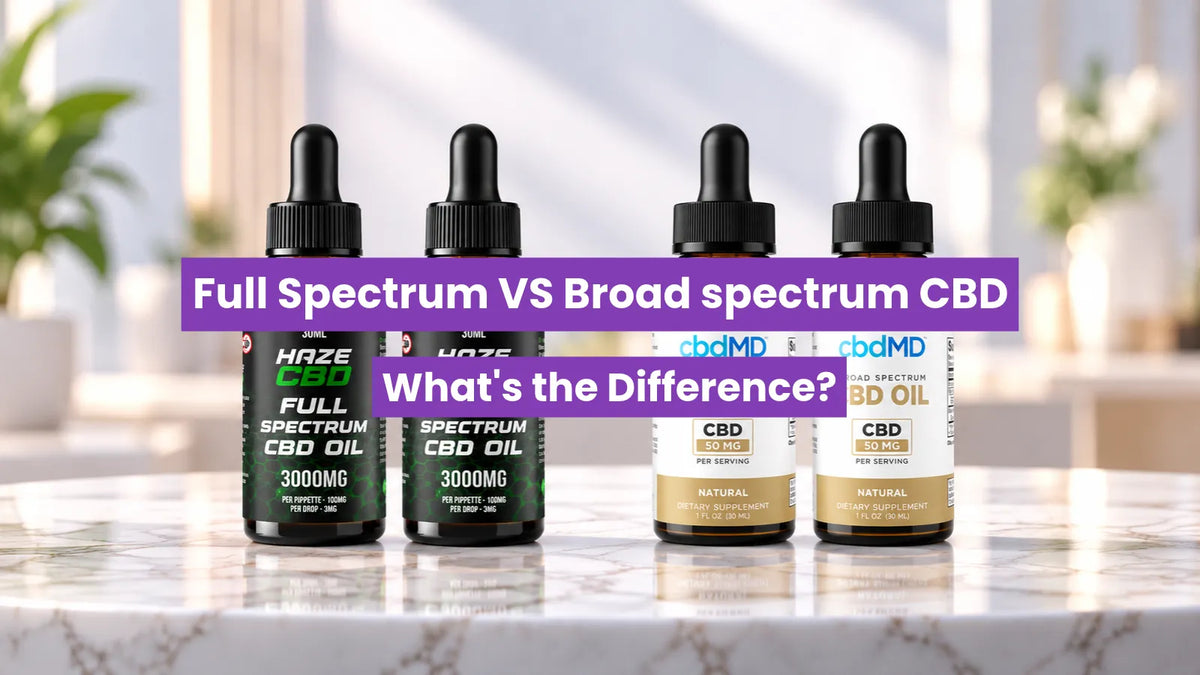
The main difference between full spectrum and broad spectrum CBD is the presence of THC (tetrahydrocannabinol). Full-spectrum CBD contains CBD, other naturally occurring hemp compounds and potentially small amounts of THC. Broad-spectrum CBD contains CBD and other selected plant compounds, but manufacturers remove THC to a specified testing level.
Both types appear in CBD oils, gummies and other hemp-derived products. The right choice depends on their cannabinoid profile, laboratory testing, CBD strength and whether avoiding THC matters to you.
Royal Vapery stocks several Haze CBD products, including full-spectrum oil. Understanding these differences makes it easier to compare CBD products without relying on unsupported health claims.
What Is the Difference Between Full and Broad Spectrum CBD?
Full-spectrum CBD retains a wider range of hemp compounds, including potentially detectable THC. Broad-spectrum CBD retains multiple hemp compounds while removing THC to a specified detection limit.
The following table compares their composition, processing, testing considerations and typical product characteristics.
| Feature | Full-Spectrum CBD | Broad-Spectrum CBD |
|---|---|---|
| CBD content | Contains cannabidiol | Contains cannabidiol |
| THC content | May contain trace THC | THC removed to a specified detection limit |
| Other cannabinoids | May contain CBG, CBC and others | May retain CBG, CBC and others |
| Terpenes | Often present | May be retained or reintroduced |
| Flavonoids | May be present | May be present |
| Entourage effect | Proposed interaction between plant compounds | Proposed interaction without intentionally retained THC |
| Drug testing | Potential THC-positive result | Lower potential exposure, but not zero risk |
| CBD strength | Depends on labelled milligrams | Depends on labelled milligrams |
| Typical preference | Wider hemp compound profile | Avoiding detectable THC |
| UK legality | Depends on product compliance | Depends on product compliance |
The most important buying distinction is THC exposure, not guaranteed effectiveness. Neither classification automatically establishes product purity, safety or suitability.
What Is Full-Spectrum CBD?
Full-spectrum CBD is a hemp extract containing cannabidiol alongside a range of naturally occurring cannabinoids and other plant compounds. Depending on the extraction process, the finished product may retain small quantities of THC.
Which Cannabinoids Are Found in Full-Spectrum CBD?
Full-spectrum CBD products can contain several cannabinoids and plant constituents:
-
CBD (cannabidiol): A non-intoxicating cannabinoid and the main ingredient in CBD oils.
-
THC (tetrahydrocannabinol): The principal intoxicating cannabinoid associated with cannabis.
-
CBG (cannabigerol): A minor cannabinoid found in some hemp extracts.
-
CBC (cannabichromene): Another naturally occurring cannabinoid.
-
Terpenes: Aromatic compounds that contribute to the plant's scent and flavour.
- Flavonoids: Plant compounds that contribute to the chemical profile of hemp.
The amount of each compound varies between manufacturers and batches. Full-spectrum labelling does not prove that every listed cannabinoid is present in a meaningful quantity.
How Does Full-Spectrum CBD Work?
Full-spectrum CBD introduces several hemp-derived compounds into the body rather than cannabidiol alone. Researchers study how these compounds interact with biological pathways, including the endocannabinoid system.
The endocannabinoid system includes cannabinoid receptors, naturally occurring signalling molecules and enzymes involved in several physiological processes.
CBD differs from THC in how it interacts with cannabinoid receptors. THC has stronger direct activity at CB1 receptors, which contributes to its intoxicating effects.
Combining CBD with other plant compounds is associated with the proposed entourage effect, although research has not established that full-spectrum consumer CBD products consistently outperform broad-spectrum products.
What Are the Advantages and Limitations of Full-Spectrum CBD?
Full-spectrum CBD retains a comparatively wide hemp compound profile. Its suitability depends on individual preferences, THC content and documented product quality.
Potential advantages:
-
Contains multiple naturally occurring hemp constituents.
-
Retains some of the original plant's chemical diversity.
- Offers a less refined hemp extract option.
Limitations:
-
May contain detectable THC.
-
May create workplace drug-testing concerns.
-
Varies in cannabinoid composition between batches.
- Has no proven health advantage over broad-spectrum CBD
A clearly labelled full-spectrum CBD oil is most useful when its batch-specific laboratory report identifies the cannabinoid quantities.
What Is Broad-Spectrum CBD?
Broad-spectrum CBD is a hemp extract containing cannabidiol and selected additional plant compounds, with THC removed during processing to a defined testing threshold.
The exact cannabinoid profile depends on the manufacturer. Some broad-spectrum products retain several minor cannabinoids and terpenes, while others contain a more limited mixture.
How Is Broad-Spectrum CBD Made?
Broad-spectrum CBD generally undergoes additional refinement to reduce THC content.
Manufacturers commonly follow these stages:
-
Extract cannabinoids and other compounds from hemp.
-
Refine the initial extract to remove unwanted plant material.
-
Separate THC through specialised purification processes.
-
Retain or reintroduce selected cannabinoids and terpenes.
- Test the finished product for CBD concentration, THC and contaminants.
The finished extract may be labelled THC-free or THC non-detectable. However, a non-detectable result means the measured THC level falls below the laboratory's stated detection threshold. It does not prove absolute chemical absence.
What Is Broad-Spectrum CBD Used For?
Broad-spectrum CBD is commonly chosen by consumers who want a multi-cannabinoid hemp product while seeking to minimise THC exposure.
Common reasons for choosing broad-spectrum CBD include personal preference, sensitivity concerns and workplace drug-testing requirements.
Broad-spectrum CBD is not an established treatment for anxiety, pain, insomnia or other medical conditions. Anyone seeking treatment for a health condition should consult an appropriate healthcare professional.
Full Spectrum vs Broad Spectrum vs CBD Isolate.
CBD isolate contains cannabidiol with most other hemp compounds removed. Full-spectrum and broad-spectrum extracts retain a wider mixture of compounds.
| Characteristic | Full Spectrum | Broad Spectrum | CBD Isolate |
|---|---|---|---|
| Main compound | CBD | CBD | CBD |
| Minor cannabinoids | Often present | Often present | Generally absent |
| THC | May be present | Targeted for removal | Targeted for removal |
| Terpenes | May be retained | May be retained | Generally removed |
| Processing | Extraction and refinement | Extraction and additional THC removal | Extensive purification |
| Drug-test concerns | Higher potential THC exposure | Residual contamination remains possible | Residual contamination remains possible |
| Main distinction | Wider plant profile | Multiple compounds, reduced THC | Primarily purified CBD |
CBD isolate is the most chemically selective of the three categories. However, independent batch testing remains necessary when accurate THC identification is important.
Which Is Stronger: Full-Spectrum or Broad-Spectrum CBD?
Neither full-spectrum nor broad-spectrum CBD is automatically stronger. Product strength depends on CBD concentration, serving size and the actual cannabinoid composition.
For example, a 30ml bottle containing 3000mg CBD has a labelled concentration of 100mg/ml. A second 30ml bottle containing 6000mg CBD has a labelled concentration of 200mg/ml.
The second bottle contains twice the CBD concentration, regardless of whether the extract is full-spectrum or broad-spectrum.
A higher CBD concentration does not establish greater therapeutic effectiveness. The UK Food Standards Agency advises healthy adults to limit CBD intake from food products to 10mg per day as a precaution. according to its FSA's recommended daily CBD intake guidance
Full Spectrum vs Broad Spectrum CBD for Anxiety: Which Is Better?
Neither full-spectrum nor broad-spectrum CBD has been established as the better treatment for anxiety.
Researchers have investigated cannabidiol for anxiety-related symptoms, but findings from specific clinical preparations cannot be applied automatically to retail CBD oils.
Evidence is insufficient to recommend one consumer CBD spectrum over another for anxiety treatment.
THC exposure is an additional consideration because THC can affect mood, perception and anxiety in some individuals.
People experiencing persistent anxiety should seek medical advice rather than replacing established treatments with CBD supplements.
Full Spectrum vs Broad Spectrum CBD for Sleep: Which Is Better?
Neither spectrum has convincing evidence of superior sleep benefits in ordinary consumer CBD products.
CBD research involving sleep outcomes varies considerably in study design, dose, formulation and participant characteristics.
Full-spectrum CBD may contain THC, while broad-spectrum products aim to remove it. That difference does not prove either product improves sleep quality, sleep duration or insomnia.
For readers comparing product formats, Royal Vapery stocks Haze CBD Sleep Gummies 3000mg. The product name does not establish a clinically proven sleep benefit, and its exact cannabinoid profile should be checked before use.
Persistent insomnia or disturbed sleep warrants professional assessment.
Full Spectrum vs Broad Spectrum CBD for Pain: What Does the Evidence Show?
Current evidence does not establish that full-spectrum CBD is better than broad-spectrum CBD for treating pain.
Some research studies investigate cannabinoids in medical settings, but results involving prescribed cannabis medicines, THC-containing treatments or specialised preparations cannot establish benefits for over-the-counter CBD supplements.
The presence of additional cannabinoids does not automatically make a consumer CBD oil an effective pain treatment.
People managing chronic pain should discuss suitable treatments with a healthcare professional rather than relying on unverified CBD product claims.
What Is the Entourage Effect in CBD?
The entourage effect is the hypothesis that cannabinoids, terpenes and other cannabis-derived compounds may interact to produce different biological effects when combined.
Full-spectrum extracts contain a broader mixture of plant compounds, including potentially THC. Broad-spectrum extracts contain selected accompanying compounds without intentionally retained THC.
Researchers continue to investigate these interactions. However, the entourage effect is not proof that full-spectrum CBD provides greater health benefits than broad-spectrum CBD.
The concentration and identity of individual compounds matter more than the spectrum label alone.
Is Full-Spectrum CBD Legal in the UK?
Full-spectrum CBD is not automatically legal in the UK simply because it contains a low percentage of THC.
UK rules consider controlled cannabinoids, the finished product, applicable exemptions and food law requirements.
The commonly quoted 0.2% THC figure relates to specific industrial hemp cultivation rules. It is not a general legal allowance for THC in finished consumer CBD oil.
The Home Office explains that CBD products containing controlled cannabinoids must meet relevant legal requirements, including the exempt-product criteria where applicable.
CBD food products are subject to UK CBD novel food guidance. In England and Wales, the Food Standards Agency maintains a public list of products linked to relevant novel food applications. Inclusion on that list is not equivalent to full product authorisation.
Before purchasing CBD, consumers should check the manufacturer's documentation and whether the specific product meets applicable UK requirements.
Can Full-Spectrum or Broad-Spectrum CBD Cause a Positive Drug Test?
Full-spectrum CBD can contribute to a positive THC drug test because it may contain residual THC.
Broad-spectrum CBD generally aims to reduce THC exposure. However, trace contamination, inaccurate labelling and differences in laboratory detection limits mean drug-test risk cannot be ruled out.
Most conventional cannabis drug tests focus on THC or its metabolites rather than CBD itself.
People subject to workplace, professional or sporting drug tests should not assume that a broad-spectrum or isolate label guarantees a negative result.
How Do You Read a CBD Certificate of Analysis?
A Certificate of Analysis (COA) is a laboratory report showing the measured composition of a product sample.
A useful CBD laboratory report identifies the product or batch and provides measurable results rather than relying on general claims such as “premium” or “THC-free”.
Check the following details:
-
Batch number: Match the report to the purchased product.
-
CBD concentration: Compare reported milligrams with the label.
-
THC results: Check delta-9-THC and other relevant controlled cannabinoids.
-
Detection limits: Review the laboratory's limit of detection and limit of quantification.
-
Other cannabinoids: Identify whether CBG, CBC and other compounds are actually measurable.
-
Contaminant testing: Look for relevant tests covering pesticides, heavy metals and residual solvents.
- Laboratory details: Check the testing date and laboratory accreditation or testing credentials.
An older report from a different batch does not confirm the composition of the bottle being sold.
Which CBD Oils and Products Can You Compare at Royal Vapery?
Royal Vapery's CBD range includes oils, gummies and CBD e-liquids. These formats differ in concentration, ingredients and intended method of use.
| Product | Listed strength | Format |
|---|---|---|
| Haze Full Spectrum CBD Oil | 3000mg / 30ml | Oral oil |
| Haze CBD Drops Oil | 6000mg / 30ml | Oral oil |
| Haze CBD Gummy Bears | 500mg or 1000mg | Gummies |
| Haze CBD Diamond | 15000mg / 100ml | CBD e-liquid |
The CBD Full Spectrum CBD Oil 3000mg is explicitly labelled full-spectrum, with a nominal CBD concentration of 100mg/ml.
Royal Vapery lists a separate CBD 6000mg Drops Oil, but its spectrum classification requires confirmation from its product documentation.
Consumers comparing other formats can examine CBD Gummy Bears. Gummies provide individually portioned pieces, although the amount of CBD per piece must be checked on the label.
CBD e-liquids are a separate product category. Oral CBD oil must not be placed in a vaping device unless the manufacturer expressly identifies the formulation as suitable for inhalation.
How Do You Choose Between Full-Spectrum and Broad-Spectrum CBD?
Choose CBD according to verified composition, THC requirements, concentration and product quality.
A practical comparison involves five checks:
-
Identify your THC requirements. Avoid assuming that any consumer CBD product guarantees a negative drug test.
-
Compare cannabinoid profiles. Check the laboratory report instead of relying only on the spectrum label.
-
Calculate the CBD content. Compare total milligrams, bottle volume and milligrams per serving.
-
Review the ingredients. Check carrier oils, flavourings, allergens and product directions.
- Check UK safety guidance. Review current FSA recommendations and consult a healthcare professional where appropriate.
The spectrum label describes the type of extract. The laboratory report provides stronger evidence of what the finished product contains.
What Should You Not Mix CBD With?
CBD can interact with medicines because it affects enzymes involved in drug metabolism.
Potential interactions are relevant to medicines such as anticoagulants, anti-seizure medicines and some sedatives. The precise risk depends on the medicine and individual circumstances.
The Food Standards Agency advises people taking medication to avoid consuming CBD unless under medical direction.
Pregnant or breastfeeding people, those trying to conceive and people with relevant underlying health conditions should follow current FSA precautions. CBD supplements are not substitutes for prescribed medicines.
Frequently Asked Questions About Full and Broad-Spectrum CBD
Which is better, broad-spectrum or full-spectrum CBD?
Neither type is universally better. Full-spectrum CBD retains a wider range of hemp compounds and may contain THC. Broad-spectrum CBD reduces THC to a specified detection threshold while retaining selected accompanying compounds.
Which form of CBD is most effective?
No consumer CBD format or spectrum is established as the most effective for general health conditions. Effectiveness depends on the specific clinical application, formulation and supporting evidence.
How does full-spectrum CBD make you feel?
There is no single predictable response to full-spectrum CBD. Effects depend on the product, cannabinoid content and individual factors. Possible adverse effects include tiredness, dizziness and digestive discomfort.
Is full-spectrum CBD better than regular CBD?
“Regular CBD” is not a standard cannabinoid classification. Product comparisons should identify whether the extract is full-spectrum, broad-spectrum or isolate, then check its actual CBD and THC content.
Does broad-spectrum CBD contain THC?
Broad-spectrum CBD is manufactured to remove THC. However, “non-detectable THC” refers to a particular laboratory detection limit and does not guarantee absolute absence.
Can you get high from full-spectrum CBD?
CBD itself does not produce the typical intoxicating high associated with THC. Full-spectrum products can contain THC, so effects depend on actual cannabinoid content and amount consumed.
What level of CBD is best for anxiety?
There is no established over-the-counter CBD dose for treating anxiety. The FSA's 10mg daily precautionary recommendation for healthy adults is a food-safety guideline, not an effective anxiety-treatment dose.
Can you take full-spectrum CBD every day?
Regular CBD consumption requires attention to the FSA's daily-intake advice, product concentration and potential interactions. The FSA advises healthy adults not to exceed 10mg CBD per day from food products as a precaution.
What is full-spectrum CBD vs broad-spectrum CBD by Haze CBD?
A Haze full-spectrum product is labelled to retain multiple hemp constituents, potentially including trace THC. A Haze product should only be described as broad-spectrum when its manufacturer confirms that classification and the appropriate batch laboratory results.
Editorial information: Royal Vapery's guides are written by Naeem Mansoor and reviewed by Nadeem Mansoor. The team has 19 years of combined UK vaping-industry experience. This comparison provides consumer information and does not constitute medical advice.


