


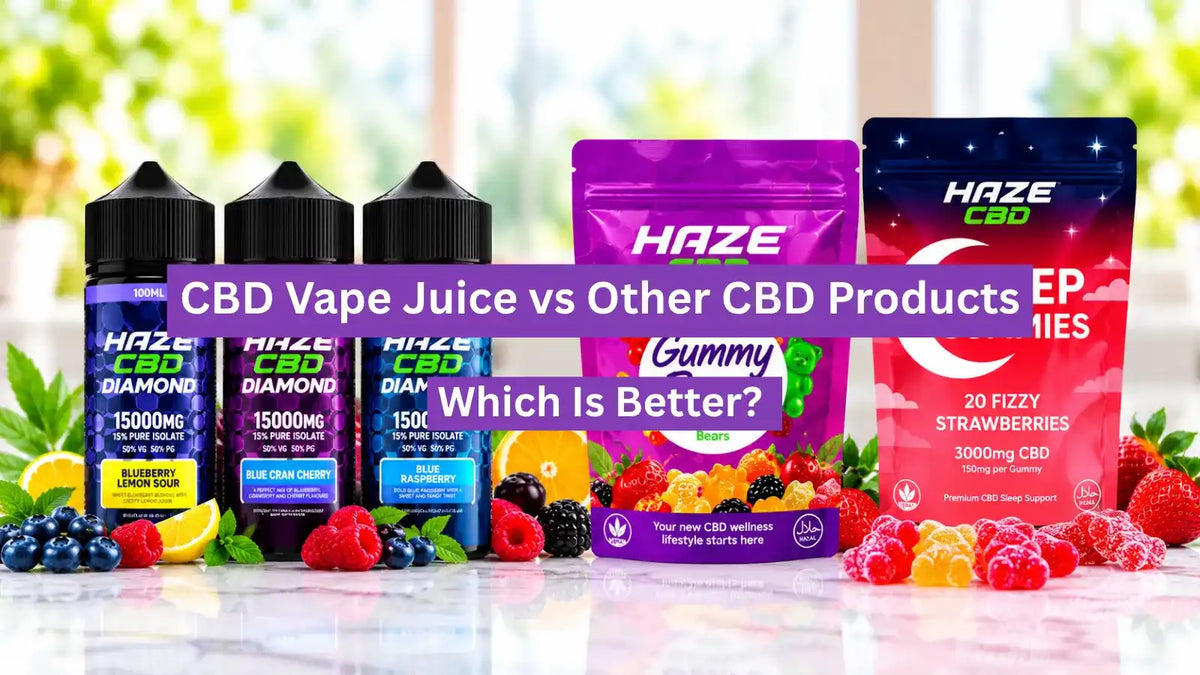
The main difference between CBD vape juice and other CBD products is how cannabidiol enters your body. CBD vape juice delivers cannabidiol through inhalation, CBD oil is taken orally or under the tongue, and CBD gummies pass through the digestive system.
CBD vape juice generally reaches the bloodstream faster than swallowed CBD, but inhalation introduces respiratory risks and makes measuring the delivered amount difficult. CBD oils and gummies avoid inhalation, while offering more straightforward serving measurements when their labels are accurate.
Whether you're comparing CBD vape liquids, oils or gummies, the right choice depends on formulation, administration method, product quality and your personal health circumstances. This guide compares five common CBD formats, explains their differences, and covers the UK regulations that affect them.
What Are the Differences Between CBD Vape Juice and Other CBD Products?
CBD vape juice differs from CBD oil, gummies and topical products in its method of administration, formulation, dosing accuracy and potential risks. Each format delivers or applies cannabidiol differently, making some options simpler to use or measure than others.
The comparison below covers the five main types of CBD products available to UK consumers.
html
| Feature | CBD Vape Juice | CBD Oil / Drops | CBD Gummies |
|---|---|---|---|
| Usage | Inhaled as an aerosol | Placed under the tongue or swallowed | Chewed and swallowed |
| Formulation | CBD with vape-compatible ingredients | CBD mixed with a carrier oil | CBD in an edible gummy |
| Absorption | Through the lungs | Through tissues under the tongue and/or the digestive system | Through the digestive system |
| Onset | Generally faster | Varies by route and formulation | Generally slower |
| Duration | Variable; evidence for direct comparisons is limited | Variable | Variable |
The main takeaway: Vaping offers a faster route of administration, CBD oil provides flexible measured servings, and gummies provide fixed labelled portions. Topical products are different because they are applied to the skin rather than inhaled or swallowed.
What Is CBD Vape Juice and How Does It Work?
CBD vape juice is an e-liquid containing cannabidiol (CBD), a cannabinoid found in cannabis plants. CBD is not the same as tetrahydrocannabinol (THC), the compound primarily associated with cannabis intoxication.
CBD vape juice is formulated for compatible vaporising devices and commonly contains CBD extract, propylene glycol (PG), vegetable glycerine (VG) and, depending on the product, flavouring ingredients.
When a compatible device heats the liquid, it produces an aerosol that the user inhales. CBD can then enter the bloodstream through the respiratory system.
The speed and amount absorbed depend on the formulation, device, aerosol characteristics and inhalation behaviour.
CBD e-liquids come in different concentrations. For example, the Haze CBD Diamond 15000mg E-Liquid is listed with 15,000 mg of CBD across a 100 ml bottle. The stated concentration is therefore 150 mg/ml, assuming the labelled total CBD content is accurate.
A bottle's total CBD content does not represent the amount absorbed during one vaping session. CBD delivered per puff depends on liquid consumption and device operation, while the amount entering the bloodstream requires further assessment.
What Are the Main Advantages and Limitations of CBD Vape Juice?
CBD vape juice offers distinct practical characteristics compared with oral and topical CBD products.
Practical advantages:
-
CBD enters the bloodstream relatively quickly through inhalation.
-
Refillable devices can use different compatible CBD e-liquid formulations.
-
CBD concentration is available on properly labelled products.
- Vape-specific liquids do not require chewing or swallowing.
Important limitations:
-
CBD delivery per puff is difficult to measure accurately.
-
Vaping requires suitable equipment and maintenance.
-
Inhaling aerosol introduces respiratory exposure.
-
Long-term safety evidence for inhaled CBD formulations remains limited.
- Product quality and ingredient suitability vary between manufacturers.
Vaping is not a risk-free way to consume CBD. People who do not already vape should not assume that inhalation is preferable to a non-inhaled format.
CBD Vape Juice vs CBD Oil: What Is the Main Difference?
The main difference between CBD vape juice and CBD oil is inhalation versus oral administration. CBD vape juice is heated in a compatible device and inhaled, whereas CBD oil is formulated for oral use, commonly using a carrier oil such as MCT oil.
CBD oil and CBD vape juice are not interchangeable, even when their packaging shows similar cannabidiol concentrations.
How Does CBD Oil Compare With CBD Vape Juice?
CBD oil provides a non-inhaled method of consuming CBD. Users measure a serving through a calibrated dropper or another manufacturer-provided measuring method and administer the product according to its label.
Some CBD oils are held beneath the tongue before swallowing. Others are intended to be swallowed directly. Absorption depends on the preparation, administration technique, food intake and individual physiology.
CBD vape juice generally results in faster peak blood concentrations in studies of inhaled cannabinoids. However, the available research does not establish a universal onset time or duration for every commercial CBD vape juice.
For consumers comparing concentrations, Royal Vapery lists both CBD 6000mg CBD Drops Oil and CBD Full Spectrum Oil 3000mg.
A 6000 mg bottle containing 30 ml has a nominal concentration of 200 mg/ml. A 3000 mg bottle containing 30 ml has a nominal concentration of 100 mg/ml.
These figures describe concentration, not a recommended serving size or evidence of superior results.
Can You Put CBD Oil in a Vape?
No. Oral CBD oil should never be placed in a vape device. CBD oils commonly contain fatty carrier oils that are not formulated for inhalation.
A liquid labelled as CBD oil may refer to either oral CBD drops or CBD e-liquid, depending on the retailer. Always check the manufacturer's stated intended use.
Only liquids specifically formulated for vaping should be considered for a compatible vaping device. Oral tinctures, cooking oils and skincare products are not suitable substitutes.
CBD Vape Juice vs CBD Gummies: Which Is More Convenient?
The main difference between CBD vape juice and CBD gummies is how they are used and how precisely the serving amount can be identified.
CBD gummies contain cannabidiol within an edible sweet. Each gummy should have a declared CBD content, allowing consumers to identify how much CBD they ingest without using a vape device.
CBD vape juice requires a refillable device or another compatible vaporising system. Its measured bottle concentration does not provide a reliable CBD-per-puff value.
How Do CBD Gummies Work Compared With Vape Juice?
CBD gummies pass through the digestive system before CBD is absorbed. Food intake, metabolism and formulation affect the timing and extent of absorption.
Inhaled CBD can enter the bloodstream more quickly, but faster absorption does not necessarily mean better health outcomes. For example, Royal Vapery lists CBD Gummy Bears 500mg &1000mg, alongside CBD Sleep Gummies 3000mg.
The strength stated in each product title should be checked against the number of gummies and the CBD content per individual piece.
A 3000 mg pack does not necessarily contain 3000 mg in each gummy. The total CBD content needs to be divided by the number of servings only when the label confirms that the stated strength refers to the full pack.
CBD gummies eliminate the need for vaping equipment, but their fixed portion sizes may make it difficult to follow lower-intake advice when an individual gummy contains a relatively high amount of CBD.
Products marketed as sleep gummies should not be assumed to treat insomnia or improve sleep. Their names are not clinical evidence of effectiveness.
Does CBD Vape Juice Work Faster Than CBD Oil or Gummies?
Inhaled CBD generally reaches peak blood concentrations faster than swallowed CBD, although the speed varies according to formulation, dose and individual factors.
Frontiers in Pharmacology: published a 2018 systematic review examining 24 studies involving CBD pharmacokinetics. Researchers found that the route of administration influenced the time taken to reach peak CBD concentration in the bloodstream.
The review identified substantial gaps in evidence, particularly in comparisons between different methods of administration.
A subsequent systematic review and meta-regression published in 2023 reinforced the importance of dose, formulation, food intake and administration route.
The results do not support assigning a single reliable onset or duration to every commercial CBD vape juice, oil or gummy.
For example, a statement that CBD vape juice always works within five minutes and lasts exactly two hours would be too precise without evidence specific to the product and outcome being measured.
Absorption is not the same as effectiveness. Faster appearance of CBD in the bloodstream does not establish that vaping treats anxiety, reduces pain, improves concentration or provides superior therapeutic outcomes.
Which CBD Product Is Easier to Measure Accurately?
CBD gummies generally provide the clearest labelled amount per unit, while CBD oil allows measurements using a suitable dropper. CBD vape juice is harder to quantify per puff.
CBD concentration can be expressed in milligrams per millilitre (mg/ml), milligrams per gummy, or milligrams per complete package.
For example:
-
A 3000 mg CBD oil: containing 30 ml has a nominal concentration of 100 mg/ml.
-
A 6000 mg CBD oil: containing 30 ml has a nominal concentration of 200 mg/ml.
-
A 15000 mg CBD e-liquid: containing 100 ml has a nominal concentration of 150 mg/ml.
- A pack containing 500 mg: across 50 gummies would contain 10 mg per gummy, assuming uniform distribution.
The gummy calculation is an illustrative example, not a verified specification for any listed Royal Vapery product.
A higher milligram figure does not mean a product has greater medical effectiveness. The relevant information includes the quantity per serving, route of administration, measured cannabinoid content and supporting quality documentation.
Are CBD Vape Juice and Other CBD Products Safe?
No, CBD format is completely risk-free. Safety depends on the product's composition, route of administration, dose, contaminants, medications and individual health circumstances.
CBD consumed as food may interact with medicines and can be associated with adverse effects. The UK Food Standards Agency identifies concerns about long-term exposure, including possible effects on the liver and thyroid.
CBD vape juice raises additional questions because it is inhaled. The safety of swallowing an ingredient does not demonstrate that heating and inhaling the same ingredient is safe.
CBD vaping formulations require particular attention to solvent composition, thermal decomposition products, impurities and device operation.
The Food Standards Agency advises vulnerable groups, including children, pregnant or breastfeeding people, those trying to conceive and people taking medication, to avoid CBD unless under medical direction.
Consumers with respiratory conditions should seek professional advice rather than assuming CBD vaping is suitable.
Independent laboratory results can help establish cannabinoid content and identify selected contaminants. However, a laboratory certificate does not prove that vaping a product has no long-term health risks.
Is CBD Vape Juice Legal in the UK?
CBD vape juice is not automatically illegal in the UK, but its legality depends on product composition, controlled cannabinoid content, marketing claims and the regulations applicable to its intended use.
CBD itself is not generally treated as a controlled drug. However, CBD products may contain THC or other controlled cannabinoids, and their presence can create legal compliance issues.
What UK Rules Apply to CBD Oil and Gummies?
CBD oil, gummy bear and sleep gummies marketed as foods are subject to UK food regulation, including the novel foods framework.
In Great Britain: CBD extracts and isolates used in food require novel food authorisation. The Food Standards Agency maintains a public list of CBD food products linked to eligible applications.
A product appearing on the public list is not equivalent to receiving full novel food authorisation.
Northern Ireland: has a different regulatory framework linked to EU novel food requirements, so consumers and businesses should not assume that the same rules apply throughout every part of the UK.
Does the FSA's 10mg Daily CBD Guidance Apply to Vaping?
No, established CBD vaping limit is created by the FSA's 10 mg daily recommendation. The recommendation concerns consumption of CBD in food products by healthy adults.
The FSA's June 2026 guidance advises healthy adults to limit CBD consumed in food to 10 mg daily. The agency highlights risks from long-term exposure and advises certain vulnerable groups to avoid CBD unless medically directed.
The 10 mg recommendation should not be presented as an approved daily CBD vaping dose. Equally, the absence of an established vaping limit does not establish that higher inhaled amounts are safe.
Can CBD Products Make Medical Claims?
CBD products marketed to diagnose, treat or prevent medical conditions may be classified as medicines under UK law.
MHRA guidance on CBD products marketed for medical purposes explains that products containing CBD and marketed for medical purposes may fall within medicines regulation.
Ordinary retail CBD vape juices, oils and gummies should not be described as proven treatments for anxiety, depression, insomnia, arthritis or chronic pain. The same distinction applies to marketing language that implies an unapproved therapeutic benefit.
What Should You Check Before Choosing a CBD Product?
A CBD product comparison should consider formulation, strength, intended use, independent testing and applicable UK compliance requirements.
Check the following product information before making a decision:
-
CBD concentration: Confirm the total milligrams and the amount per millilitre or serving.
-
Intended administration: Distinguish oral drops, vape liquids, edible products and topical formulations.
-
Ingredient list: Review carrier oils, PG/VG, flavourings, sweeteners and other additives.
-
Laboratory testing: Look for recent, batch-relevant cannabinoid analysis and contaminant testing.
-
THC information: Check the cannabinoid profile and evidence supporting controlled-substance compliance.
-
Product traceability: Identify the manufacturer, batch number and contact information.
-
Regulatory status: Check the FSA public list for CBD food products where applicable.
-
Health claims: Be cautious of products promising treatment, cure or guaranteed symptom relief.
CBD quality cannot be determined from price, flavour or milligram strength alone. A clearly labelled and independently tested product provides more useful information than one supported only by promotional claims.
Which CBD Products Can You Compare at Royal Vapery?
Royal Vapery lists CBD products in vape liquid, oral oil and gummy formats. These products have different intended uses, and their concentrations should not be treated as interchangeable doses.
Haze CBD Diamond 15000mg CBD E-Liquid 100ml
The Haze CBD Diamond e-liquid listing states 15,000 mg CBD in 100 ml of vape liquid, equivalent to a nominal 150 mg/ml. The product belongs to the inhaled CBD category and requires attention to compatible equipment, labelling and formulation.
Haze CBD Strains 60ml 3000mg CBD E-Liquid
The CBD Strains 60ml 3000mg E-Liquid provides another concentration comparison. Its stated 3000 mg across 60 ml corresponds to 50 mg/ml.
CBD Oils and Gummies
Royal Vapery's oral CBD formats can be explored through its CBD oils and CBD gummies categories. CBD oils use an oral carrier formulation, while gummies contain measured portions within an edible product. Before selecting either format, check CBD per serving, the manufacturer's directions and its applicable FSA listing status.
Product note: The strengths above are calculated from the listed total CBD and container volumes. They do not verify actual laboratory concentrations, batch compliance, medical suitability or a safe intake.
Which CBD Product Is Better for You?
The best CBD format cannot be determined by absorption speed alone. The more useful comparison is which administration method, formulation and level of exposure are appropriate for your circumstances.
CBD oil: provides a non-inhaled liquid format with measurable servings. Gummies and capsules use fixed portions, reducing the need for manual measurement. Topical CBD products are intended for the skin rather than oral or inhaled administration.
CBD vape juice: offers an inhaled administration method, but it introduces respiratory risks and uncertainty in per-puff delivery.
Consumers who do not already vape have no established health-based reason to begin inhaling CBD instead of considering non-inhaled options.
People taking prescription medication or managing a medical condition should discuss CBD with an appropriate healthcare professional before use.
Questions About CBD Vape Juice vs Other CBD Products
Which is better for CBD, a vape or CBD oil?
CBD oil avoids inhalation and allows measured oral servings, while CBD vape juice generally produces faster bloodstream absorption. Neither has been established as universally more effective or safer for every consumer.
Does CBD vape juice actually work?
CBD can enter the bloodstream when inhaled, but absorption does not prove that commercial CBD vape juice treats medical conditions. Clinical effectiveness depends on the outcome studied and supporting evidence.
Which form of CBD is most effective?
No single CBD format is proven to be the most effective for all purposes. Administration route, formulation, dose and the specific clinical outcome influence research findings. Over-the-counter products should not be equated with authorised CBD medicines.
Is it safe to vape CBD daily?
The long-term safety of daily CBD vaping is not established. Regular inhalation introduces respiratory exposure, while CBD itself can cause adverse effects and interact with medications. Avoid assuming that nicotine-free CBD vaping is harmless.
What is the difference between CBD oil and CBD vape juice?
CBD oil is formulated for oral administration and commonly contains a fatty carrier oil. CBD vape juice is formulated for inhalation in a compatible vaporising device. Oral CBD oil must not be vaped.
Can you put CBD vape juice in a normal vape?
Some refillable vaping devices can be used with compatible CBD e-liquids, but suitability depends on the manufacturer's instructions, coil, operating power and liquid formulation. Closed prefilled-pod devices should not be refilled unless designed for that purpose.
Can you mix CBD vape juice with nicotine?
Physical mixing does not establish chemical stability, device compatibility or inhalation safety. Consumers should not assume CBD and nicotine e-liquids are suitable for mixing without formulation-specific evidence and manufacturer guidance.
What wattage should you use for CBD vape juice?
There is no universal safe wattage for CBD vape juice. Operating power depends on the liquid formulation and device specification. Using excessive power can alter aerosol composition, and an incompatible setup should not be used.
Is full-spectrum CBD vape juice better than CBD isolate?
Full-spectrum CBD products may contain additional cannabinoids and plant compounds, while CBD isolate formulations primarily contain purified cannabidiol. Neither type is universally proven to provide better health outcomes. Full-spectrum products require careful checks for THC and other controlled cannabinoids.
Can CBD vape juice help with anxiety or sleep?
There is insufficient evidence to recommend ordinary retail CBD vape juice as a treatment for anxiety or sleep disorders. CBD products marketed with medicinal claims may require authorisation under UK medicines law.
Are expensive or premium CBD vapes worth buying?
A higher price does not demonstrate better safety, absorption or clinical effectiveness. Evaluate ingredient transparency, batch testing, device compatibility and manufacturer traceability before comparing prices.
Can you find CBD vape juice without PG and VG?
Some products are marketed with alternative solvent formulations. However, the absence of PG or VG does not establish inhalation safety. Check the complete ingredient list and obtain reliable formulation-specific safety information.
Medical and regulatory notice: This article provides general consumer information, not personalised medical advice. Retail CBD products are not substitutes for prescribed medicines. Product legality and the applicability of UK regulations depend on formulation, intended use, claims and jurisdiction.


