


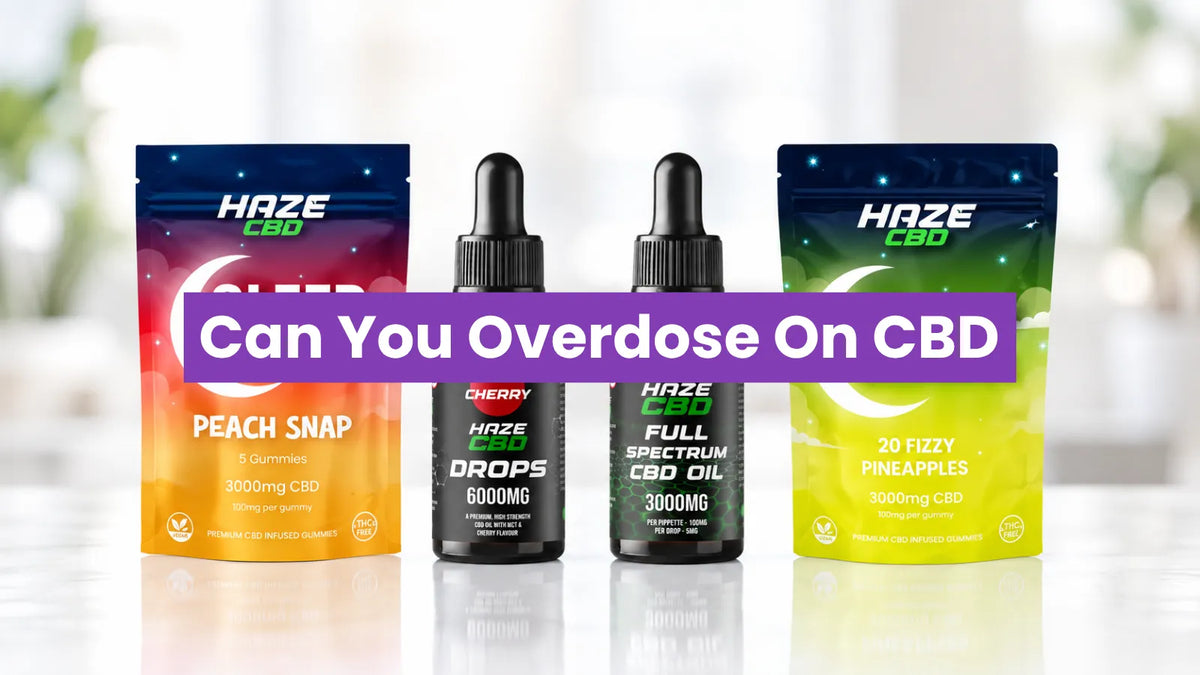
Yes, you can take too much CBD. Taking high amounts can cause drowsiness, nausea, diarrhoea and dizziness. Regularly taking large doses may also affect liver function and interact with prescription medicines.
The UK Food Standards Agency (FSA) recommends that healthy adults consume no more than 10mg of CBD daily from food products. Taking more does not automatically mean an overdose, but it may increase health risks.
Royal Vapery's Haze CBD collection includes products with different strengths. A label showing 3000mg, 500mg or 6000mg refers to the total CBD content, not necessarily the amount in one serving. This guide explains overdose symptoms, safe intake, possible side effects and what to do if you take too much CBD.
Can You Actually Overdose on CBD?
CBD can cause adverse effects when consumed in excessive amounts, but a clearly established fatal dose of CBD in humans does not exist. Taking too much CBD is not the same as experiencing a life-threatening poisoning emergency.
Cannabidiol is a naturally occurring compound found in the cannabis plant. CBD is different from tetrahydrocannabinol (THC), the compound primarily responsible for the intoxicating effects of cannabis.
Pure CBD does not produce the typical THC-related high. However, non-intoxicating does not mean harmless.
The risk of excessive CBD consumption depends on the amount taken, how frequently it is used, individual health conditions and other substances or medicines taken alongside it.
What's the Difference Between CBD Overconsumption and CBD Toxicity?
CBD overconsumption occurs when someone takes more CBD than intended or more than their body tolerates comfortably. CBD toxicity refers to harmful biological effects associated with CBD exposure.
|
Factor |
CBD overconsumption |
CBD toxicity |
|---|---|---|
|
Meaning |
Taking more CBD than intended or tolerated |
Harmful effects associated with CBD exposure |
|
Possible effects |
Tiredness, nausea, diarrhoea |
Liver enzyme changes and other adverse effects |
|
Risk factors |
Large servings, repeated intake, multiple products |
Higher exposure, repeated dosing, medicine interactions |
|
Recommended response |
Stop taking CBD and assess symptoms |
Seek medical assessment when adverse effects are significant or suspected |
The distinction matters because temporary symptoms and clinically significant harm are not identical. A person may feel unwell after CBD without developing organ damage, while some liver enzyme changes may occur without noticeable symptoms.
What Are the Symptoms of Taking Too Much CBD?
Commonly reported CBD side effects include sleepiness, diarrhoea, reduced appetite, nausea and fatigue. The severity varies with dose, formulation and individual sensitivity.
Possible symptoms include:
-
Drowsiness: Excessive tiredness or difficulty concentrating.
-
Nausea: Feeling sick or experiencing stomach discomfort.
-
Diarrhoea: Loose stools after consuming CBD.
-
Dizziness: Light-headedness or reduced balance.
-
Dry mouth: Reduced saliva or an uncomfortable dry sensation.
- Reduced appetite: Less interest in eating than usual.
These symptoms are not exclusive to CBD. THC exposure, another ingredient, alcohol or a medicine interaction may contribute to a reaction.
Can CBD Make You Sick?
Yes, CBD can cause nausea, diarrhoea and digestive discomfort, particularly at higher doses. Some oral CBD products contain carrier oils, sweeteners and additional ingredients that may contribute to stomach upset.
Persistent vomiting, severe weakness or worsening symptoms require medical assessment rather than assuming CBD is the only cause.
Can Too Much CBD Cause Death?
A fatal human dose attributable to CBD alone has not been established. However, CBD products cannot be considered incapable of causing serious harm.
Severe reactions, medicine interactions, contamination and the presence of THC or other substances can create additional risks. A person who becomes unconscious, has difficulty breathing or cannot be awakened needs emergency medical assistance.
How Much CBD Is Too Much in the UK?
The Food Standards Agency recommends a maximum of 10mg of CBD per day for healthy adults consuming CBD food products.
The FSA introduced the updated precautionary recommendation in October 2023, replacing its previous advice of 70mg daily.
The recommendation concerns long-term exposure and potential adverse effects involving the liver, thyroid and other areas where safety evidence remains incomplete.
According to the FSA's CBD consumer guidance, adults should calculate their daily intake using the CBD content of each serving, not the amount advertised on the entire bottle.
Is Taking More Than 10mg of CBD an Overdose?
No, Consuming more than 10mg does not automatically mean a medical overdose has occurred. The 10mg figure is a precautionary daily intake recommendation, not a threshold at which poisoning begins.
A single accidental exposure and repeated consumption over weeks or months represent different risk situations. The FSA does not recommend routinely exceeding 10mg of oral CBD per day without medical direction.
Who Should Avoid CBD?
The FSA advises the following groups to avoid consumer CBD products unless under medical direction:
- Under 18: People under 18.
- Pregnancy: Pregnant or breastfeeding people.
- Trying to Conceive: People planning a pregnancy.
- Medication: People taking medication.
- Health Conditions: People with existing health conditions.
CBD food products should not replace prescribed medicines or be used to treat a medical condition without professional advice.
Can You Overdose on CBD Oil or CBD Drops?
CBD oil and CBD drops can cause side effects when taken in excessive amounts. Their concentration determines how much CBD is delivered in each millilitre or measured serving.
CBD oil strength is usually expressed as total milligrams of cannabidiol per bottle, percentage concentration or milligrams per millilitre.
For example, Royal Vapery lists Haze CBD 6000mg Drops Oil in a 30ml bottle. The calculated concentration is:
6000mg ÷ 30ml = 200mg CBD per ml
At this concentration, a precisely measured 0.05ml portion contains 10mg of CBD.
However, a drop is not a standardised measurement. Drop size varies according to the dropper, formulation and dispensing technique. Customers should use the manufacturer's verified serving information rather than estimate CBD content from an assumed number of drops.
Can You Overdose on Full Spectrum CBD Oil?
Yes, excessive consumption of full-spectrum CBD oil can cause adverse effects. Full-spectrum extracts may contain additional cannabinoids, including trace quantities of THC.
The Full Spectrum CBD Oil 3000mg contains a labelled total of 3000mg in a 30ml bottle. Its nominal CBD concentration is:
3000mg ÷ 30ml = 100mg CBD per ml
A measured 0.1ml portion therefore contains approximately 10mg of CBD based on the labelled concentration. Full-spectrum products require particular attention to verified cannabinoid testing because CBD concentration alone does not establish their total cannabinoid exposure or safety.
Can You Overdose on CBD Gummies or Gummy Bears?
Yes, eating too many CBD gummies can cause adverse effects. Gummies may be easy to consume repeatedly because they resemble ordinary sweets.
Unlike CBD oil, gummies commonly contain a fixed amount of CBD per piece. The important measurement is milligrams per gummy, not the total CBD printed on the package.
Royal Vapery lists CBD Gummy Bears 500mg and 1000mg. These values describe product strengths, but the amount in each gummy depends on the confirmed number of pieces and formulation.
For example, a hypothetical pack containing 500mg of CBD across 50 gummies contains 10mg per gummy. A 500mg pack containing 25 gummies contains 20mg per gummy.
Neither calculation should be applied to a specific product until its actual gummy count and CBD content have been verified.
Can You Overdose on CBD Sleep Gummies?
CBD sleep gummies can cause excessive drowsiness and other adverse effects when consumed in large quantities.
Royal Vapery lists CBD Sleep Gummies 3000mg. The 3000mg label does not establish the dose in an individual gummy.
Consumers should check the CBD content per gummy and review any additional ingredients, including melatonin or herbal extracts where present.
CBD food products are not authorised treatments for insomnia, and evidence does not establish that taking larger doses improves sleep.
Can You Take CBD Sleep Gummies Every Night?
Daily CBD use increases cumulative exposure over time. The UK FSA's 10mg recommendation considers potential risks associated with regular consumption.
People taking medicines, experiencing daytime drowsiness or living with an underlying health condition should seek professional advice rather than continue nightly CBD use without assessment.
Can CBD Sleep Gummies Cause Sleeplessness?
Some people report changes in their sleep patterns after using CBD products, but there is insufficient evidence to predict that CBD gummies will improve sleep or cause insomnia in any individual.
Sleep disruption can have several causes, including other ingredients, caffeine, medications and existing sleep conditions.
Can You Overdose on CBD Vape Juice?
Excessive CBD vape use can produce unwanted effects, but the UK's 10mg daily recommendation for CBD foods should not be presented as a validated inhalation safety limit.
Inhaled CBD and swallowed CBD follow different absorption pathways. Inhalation introduces additional concerns involving the vape formulation, heating process, device and respiratory exposure.
Royal Vapery lists two CBD e-liquid formulations:
These calculations describe liquid concentration only. They do not establish how much CBD enters the bloodstream from each puff.
The CBD inhaled per puff depends on several factors, including device output, aerosol generation, puff duration and formulation.
The long-term safety of inhaling CBD e-liquids is not well established. Consumers should not convert the 10mg oral-food recommendation into a suggested number of CBD vape puffs.
For more detail on concentration and device-related factors, read Royal Vapery's guide to choosing CBD vape strength.
Can Taking Too Much CBD Damage Your Liver?
Yes, High doses of CBD can increase liver enzyme levels, which may indicate liver stress or possible liver injury. Some changes occur without noticeable symptoms, making repeated excessive consumption a concern.
A randomised clinical trial published in JAMA Internal Medicine in 2025 examined the effects of oral CBD on 201 healthy adults.
Participants received either a placebo or CBD at 5mg per kilogram of body weight daily, equivalent to approximately 250 to 550mg of CBD per day.
What Should You Not Mix CBD With?
CBD can interact with certain medicines, including anticoagulants, anti-epileptic medicines and sedating medications. These interactions can alter drug concentrations or increase adverse effects.
Cannabidiol affects enzymes involved in drug metabolism. Some clinically important interactions have been documented with prescription CBD formulations.
Examples include:
- Medicine or substance
- Potential concern
- Clobazam
- Increased sedation and exposure to an active metabolite
- Valproate
- Increased risk of liver enzyme elevations
- Warfarin
- Potential changes in anticoagulant exposure
- Certain antidepressants
- Potential metabolic interactions, depending on the medicine
- Alcohol and sedatives
Increased drowsiness or impaired alertness
Interaction evidence varies by medicine, CBD dose and formulation. Not every combination produces the same effect.
People taking medicines should consult their GP or pharmacist before using consumer CBD products. They should never stop prescribed treatment to accommodate CBD consumption.
The NHS medical cannabis safety guidance explains the potential for cannabis-based medicines to affect other treatments and liver function.
What Should You Do If You Have Taken Too Much CBD?
Stop taking additional CBD, assess the quantity consumed and seek medical guidance if symptoms develop or poisoning is suspected. Severe symptoms require emergency assistance.
Follow these steps after suspected excessive CBD consumption:
-
Stop further CBD consumption. Avoid additional oil, gummies, drops or CBD e-liquid.
-
Check the product label. Identify the total CBD strength, amount consumed and time of exposure.
-
Avoid driving. Drowsiness, dizziness or impaired concentration can affect safety.
-
Check for other substances. Identify any alcohol, medicines, THC or additional ingredients consumed.
-
Contact NHS 111. Seek advice if the amount is uncertain, symptoms are concerning or possible poisoning cannot be ruled out.
- Call 999 for an emergency. Difficulty breathing, seizures, loss of consciousness or inability to wake someone requires urgent assistance.
Do not induce vomiting after suspected poisoning. Follow medical advice before giving someone food, drinks or home remedies.
What If a Child Accidentally Eats CBD Gummies?
A child who has swallowed CBD gummies needs prompt medical assessment. CBD products are not recommended for children, and gummies can be mistaken for ordinary sweets.
Call NHS 111 for immediate advice if exposure is suspected and the child appears well. Call 999 if the child develops severe symptoms or poisoning is suspected to be serious.
Keep the product packaging available for healthcare professionals. The same precaution applies to CBD products containing additional cannabinoids or ingredients that have not been independently verified.
How Can You Avoid Taking Too Much CBD?
CBD dosage safety depends on knowing the amount in each serving, following official guidance and recognising potential medicine interactions.
Consumers can assess CBD exposure by following these 4 practical precautions.
1. How Do You Check CBD Strength Before Buying?
Check the total CBD content, bottle volume and serving concentration.
A label showing 3000mg describes the total CBD content of the product unless the manufacturer specifies otherwise. Use the following formula:
For CBD oil:
CBD per ml = Total CBD in bottle (mg) ÷ Bottle volume (ml)
For Gummies:
CBD per gummy = Total CBD in pack (mg) ÷ Number of gummies
For a more detailed explanation of drop calculations, read Royal Vapery's CBD oil Drops Guide. The FSA's 10mg daily advice remains the relevant precautionary reference for healthy adults consuming CBD foods.
2. Why Should You Avoid Increasing Your CBD Intake?
Increasing CBD consumption raises exposure and may increase the likelihood of unwanted effects.
A higher quantity does not necessarily produce a greater benefit. Consumer CBD foods have no authorised UK health claims for treating anxiety, insomnia or other medical conditions. Do not increase intake because the effects are not immediately noticeable.
3. Should You Combine CBD Oil and Gummies?
Combining oral CBD products increases total daily CBD intake. The CBD content from every swallowed product contributes to the total exposure.
For example, a person who consumes 6mg from CBD oil and 8mg from gummies has consumed 14mg of oral CBD that day.
The combined amount exceeds the FSA's precautionary 10mg daily recommendation. Inhaled CBD should be evaluated separately because vaping does not have an equivalent established daily safe-intake threshold.
4. How Can You Reduce the Risk of CBD Side Effects?
Review product composition, cannabinoid testing and medicine interactions before use.
Check that the product provides clear information about CBD concentration, serving size, ingredients and batch testing where available.
Keep CBD gummies, oils and other products out of the reach of children and pets. Product testing improves confidence in label accuracy, but a laboratory certificate does not establish that a particular dose is safe for every individual.
How Do Different CBD Strengths Compare?
CBD product labels describe concentration or total CBD quantity, not necessarily the amount consumed in one serving. The table compares the labelled strengths of 6 Haze CBD products listed by Royal Vapery.
|
Haze CBD product |
Labelled total CBD |
Calculated concentration or dose information |
|---|---|---|
|
CBD Drops Oil, 30ml |
6000mg |
200mg/ml |
|
Full Spectrum CBD Oil, 30ml |
3000mg |
100mg/ml |
|
Sleep Gummies |
3000mg |
Per-gummy content requires verification |
|
Gummy Bears |
500mg or 1000mg |
Per-gummy content requires verification |
|
CBD Diamond E-Liquid, 100ml |
15000mg |
150mg/ml of liquid |
|
CBD Strains E-Liquid, 60ml |
3000mg |
50mg/ml of liquid |
The calculations use the product strengths and volumes listed in the Royal Vapery catalogue. Actual intake depends on the measured amount consumed, and inhaled delivery cannot be established from liquid concentration alone.
Readers comparing the two e-liquid strengths can explore the CBD Strains vs CBD Diamond guide.
What Is the Final Verdict on CBD Overdose?
CBD can cause harm when consumed in excessive amounts, even though a fatal dose from CBD alone has not been established in humans.
The principal safety concerns include drowsiness, digestive problems, medicine interactions and liver enzyme elevations associated with high-dose exposure.
For UK consumers, the Food Standards Agency recommends limiting CBD from food products to 10mg daily for healthy adults.
CBD oil, drops and gummies require careful measurement because total package strength differs from individual serving size. CBD vape liquids introduce separate inhalation risks that are not covered by the oral-food intake recommendation.
Consumers should prioritise accurate product labels, verified cannabinoid content and professional medical advice when appropriate.
FAQs About CBD Overdose
Is 3000mg of CBD too much?
3000mg taken as a single oral dose is far above the FSA's recommended daily intake for healthy adults. However, a bottle or packet labelled 3000mg usually describes total product content, not a single serving.
Is 200mg of CBD a lot?
Yes, An oral dose of 200mg is 20 times the FSA's precautionary daily recommendation of 10mg. Higher oral doses have been studied in clinical research, but medical research doses are not general consumer dosage recommendations.
Is a 100mg CBD Gummy a lot?
Yes, A gummy containing 100mg of CBD provides 10 times the FSA's recommended daily amount for healthy adults. A pack labelled 100mg in total is different from a single gummy containing 100mg.
Is 5000mg of CBD strong?
A product containing 5000mg of CBD has a high total labelled CBD quantity, but its concentration depends on the product volume and serving size. The total label strength cannot determine whether an individual serving is excessive without further information.
How strong is 3000mg of CBD?
A 3000mg CBD oil in a 30ml bottle contains a nominal concentration of 100mg/ml. A 3000mg gummy pack requires a confirmed number of gummies to calculate the CBD content per piece.
How strong is 1200mg of CBD?
CBD strength depends on the container volume. A 1200mg bottle containing 30ml has a nominal concentration of 40mg/ml, while a 10ml bottle containing 1200mg has a concentration of 120mg/ml.
What does 100mg of CBD feel like?
A 100mg oral CBD dose may cause drowsiness, fatigue, nausea or no obvious immediate sensation. Responses vary by person, formulation and other medicines. The amount substantially exceeds the FSA's precautionary recommendation for consumer CBD foods.
What will 50mg of CBD feel like?
A 50mg CBD dose may produce tiredness, dizziness or digestive side effects in some people. Others may notice little immediate effect. A lack of noticeable effects does not demonstrate that the dose is safe.
Can CBD make you feel buzzed?
Pure CBD does not typically produce the intoxicating high associated with THC. Feeling intoxicated after using a CBD product may indicate the presence of THC, another ingredient or an unexpected reaction.
What level of CBD is best for anxiety?
A standard consumer CBD dose is not established as an authorised treatment for anxiety in the UK. CBD food products cannot legally be marketed as treatments for anxiety without appropriate medicinal authorisation.
Anyone experiencing anxiety should seek guidance from a qualified healthcare professional rather than increase CBD consumption to manage symptoms.
What is the correct CBD amount for a first-time user?
The FSA recommends that healthy adults consume no more than 10mg of CBD daily from food products. The recommendation is not a prescribed starting dose or a guarantee of safety. Individuals taking medicines or belonging to vulnerable groups should avoid CBD unless under medical direction.
Can you overdose on CBD diamond oil or gummies?
CBD Diamond is a product or formulation name, not a separate substance with an established overdose threshold. Excessive CBD exposure can cause adverse effects regardless of branding. Check whether the item is an oil, edible or inhaled product and calculate its actual CBD content.
When is the best time to take CBD?
There is no universally established best time for taking consumer CBD. Timing does not eliminate the risk of side effects, medicine interactions or excessive daily intake.


